
11th India-Russia Working Group Session Bolsters Industrial and Technological Ties

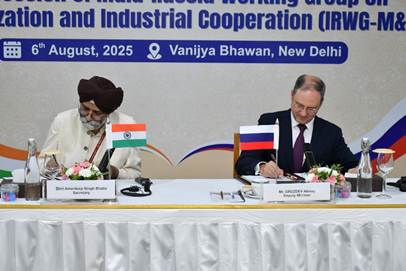
11th Session of the India-Russia Working Group on Modernization and Industrial Cooperation convened at Vanijya Bhawan, New Delhi, under the framework of the India-Russia Intergovernmental Commission on Trade, Economic, Scientific, Technological, and Cultural Cooperation. Co-chaired by Shri Amardeep Singh Bhatia, Secretary of the Department for Promotion of Industry and Internal Trade (DPIIT), Ministry of Commerce and Industry, India, and H.E. Mr. Alexey Gruzdev, Deputy Minister of Industry and Trade, Russian Federation, the session marked a significant milestone in deepening bilateral ties. The meeting culminated in the signing of a Protocol, reaffirming the strategic partnership and outlining new avenues for collaboration in key sectors like aluminium, fertilizers, railways, and mining technology. This article explores the outcomes, focus areas, and implications of the session for India-Russia industrial cooperation.
Overview of the 11th Session
The session brought together approximately 80 delegates, including senior government officials, domain experts, and industry representatives from both nations. It served as a platform to review progress since the 10th session and to advance cooperation in critical industrial and technological domains. The discussions were structured around updates from sub-groups focused on modernization, mining, fertilizers, and railway transport, while also exploring emerging areas of collaboration aligned with both countries’ economic priorities.
The session underscored the strategic importance of the India-Russia partnership, which has been bolstered by high-level engagements, including Prime Minister Narendra Modi’s visits to Russia in July and September 2024 for the 22nd India-Russia Summit and the BRICS Summit, respectively. The Working Group’s efforts align with the goal of increasing bilateral trade to $100 billion by 2030, as set during these summits.
Key Focus Areas of Cooperation
The 11th session identified several priority sectors for collaboration, reflecting the complementary strengths of India and Russia in industrial and technological innovation. The key areas discussed include:
-
Aerospace Science and Technology:
-
Modernized Wind Tunnel Facility: Both sides explored the establishment of advanced wind tunnel facilities to support aerospace research and development, critical for testing aircraft and missile designs.
-
Small Aircraft Piston Engines: Discussions focused on joint production of piston engines for small aircraft, leveraging Russia’s expertise in aerospace engineering and India’s growing aviation market.
-
Carbon Fibre Technology and Additive Manufacturing: The session emphasized joint development in carbon fibre production and additive manufacturing (3D printing), which are vital for lightweight, high-strength materials used in aerospace, automotive, and defense industries.
-
-
Critical Minerals and Mining:
-
Rare Earth and Critical Minerals Extraction: India and Russia agreed to collaborate on the exploration and extraction of rare earth elements (REEs) and critical minerals like lithium, cobalt, and nickel, essential for energy transition technologies such as electric vehicles (EVs) and renewable energy systems.
-
Underground Coal Gasification: The session explored technologies to convert coal into gas underground, offering a cleaner alternative to traditional coal mining and supporting India’s energy diversification goals.
-
Mining Sector Equipment: Cooperation in capacity building and technology transfer for advanced mining equipment was prioritized to enhance efficiency and sustainability in India’s mining sector.
-
-
Aluminium Industry:
-
The two sides welcomed enhanced engagement in aluminium production, building on Russia’s position as one of the world’s largest aluminium producers and India’s growing demand for lightweight metals in automotive, aerospace, and construction sectors. Potential areas include joint ventures for smelting, refining, and value-added aluminium products.
-
-
Fertilizers:
-
Collaboration in fertilizer production was a key focus, driven by India’s need to secure a stable supply of agricultural inputs amid global supply chain disruptions. Russia, a major fertilizer exporter, offers expertise in potash, phosphate, and nitrogen-based fertilizers, which could support India’s agricultural productivity.
-
-
Railway Transport:
-
The session explored joint initiatives to modernize railway infrastructure, including high-speed rail systems, advanced signaling technologies, and rolling stock manufacturing. This aligns with India’s ambitious railway modernization plans, such as the Vande Bharat trains and dedicated freight corridors.
-
-
Industrial and Waste Management:
-
Both nations discussed creating modern industrial infrastructure and addressing industrial and domestic waste management. This includes adopting advanced technologies for recycling, waste-to-energy conversion, and sustainable industrial practices.
-
Outcomes and Protocol Signing
The meeting concluded with the signing of the Protocol of the 11th Session by Shri Amardeep Singh Bhatia and H.E. Mr. Alexey Gruzdev, formalizing the commitment to deepen industrial and economic cooperation. The Protocol outlines actionable steps for the identified focus areas, emphasizing:
-
Establishment of joint working groups to implement specific projects, such as wind tunnel facilities and carbon fibre production.
-
Enhanced industry participation to foster public-private partnerships and attract investment in critical sectors.
-
Regular monitoring of progress through sub-groups to ensure timely execution of agreed initiatives.
The Protocol reaffirms the strategic partnership, building on the momentum from the 22nd India-Russia Summit, where both nations committed to strengthening economic ties and addressing global challenges collaboratively.
Strategic Context and Economic Significance
The 11th session occurs at a time of heightened global economic and geopolitical uncertainties, including supply chain disruptions and rising demand for critical minerals. India’s push to reduce import dependence, particularly for REEs and critical minerals dominated by China, aligns with Russia’s expertise in mining and advanced technologies. The collaboration supports India’s National Mineral Policy 2023 and its goal of achieving self-reliance in critical minerals by 2030, crucial for the energy transition and high-tech industries.
Bilateral trade between India and Russia reached $65.7 billion in FY 2024-25, with India’s exports to Russia growing 34% to $5.67 billion from April to November 2024. Key Indian exports include pharmaceuticals, engineering goods, and agricultural products, while Russia supplies petroleum, fertilizers, and minerals. The Working Group’s focus on aluminium, fertilizers, and mining technology aims to diversify this trade basket, reducing India’s trade deficit and fostering mutual economic growth.
The session also builds on recent developments, such as the Hindustan Copper Limited (HCL) and GAIL (India) Limited MoU signed on August 6, 2025, for critical minerals exploration, highlighting India’s broader strategy to secure mineral resources. Russia’s expertise in REEs and mining technology complements these efforts, offering opportunities for technology transfer and joint ventures.
Challenges and Considerations
While the session marks a positive step, several challenges must be addressed to realize the full potential of the collaboration:
-
Regulatory Alignment: Harmonizing India’s and Russia’s regulatory frameworks for mining, aerospace, and industrial projects is essential to facilitate seamless cooperation.
-
Geopolitical Risks: Ongoing global tensions, including sanctions on Russia due to the Ukraine conflict, could impact joint ventures, particularly in international markets. India must navigate these complexities to maintain its neutral stance while deepening ties with Russia.
-
Investment Requirements: Projects like wind tunnel facilities and carbon fibre production require significant capital expenditure. Attracting private investment and ensuring cost-effectiveness will be critical.
-
Environmental Sustainability: Mining and industrial activities must adhere to sustainable practices to align with India’s net-zero emissions goal by 2070 and Russia’s environmental commitments.
Industry and Market Response
The India-Russia Working Group’s outcomes have been well-received by industry stakeholders. Indian companies like Hindustan Aeronautics Limited (HAL) and Bharat Dynamics Limited (BDL) are poised to benefit from aerospace cooperation, while firms in the mining sector, such as HCL, could leverage Russian technology for critical minerals. The fertilizer industry, facing global supply constraints, sees Russia as a reliable partner to ensure stable supplies. The railway sector, with projects like the Mumbai-Ahmedabad High-Speed Rail, could gain from Russian expertise in advanced rail technologies.
Market analysts anticipate that the collaboration will boost investor confidence, particularly in India’s mining and industrial sectors. HCL’s stock, for instance, surged 4.05% to ₹261.70 on June 24, 2025, following its earlier partnerships, and similar positive sentiment is expected as India-Russia cooperation deepens.
The 11th Session of the India-Russia Working Group on Modernization and Industrial Cooperation, held on August 6, 2025, in New Delhi, marks a pivotal moment in strengthening the strategic partnership between the two nations. By focusing on aerospace, critical minerals, aluminium, fertilizers, railways, and waste management, the session lays the groundwork for transformative industrial collaboration. The signing of the Protocol by Shri Amardeep Singh Bhatia and H.E. Mr. Alexey Gruzdev reaffirms their commitment to achieving $100 billion in bilateral trade by 2030. While challenges like regulatory alignment and geopolitical risks remain, the partnership leverages India’s growing market and Russia’s technological expertise to drive economic growth and global competitiveness. As both nations deepen their cooperation, they are poised to address shared challenges and unlock new opportunities in the global industrial landscape.