
Primary vs Secondary Gold Deposits: Understanding the Two Main Types of Gold Sources

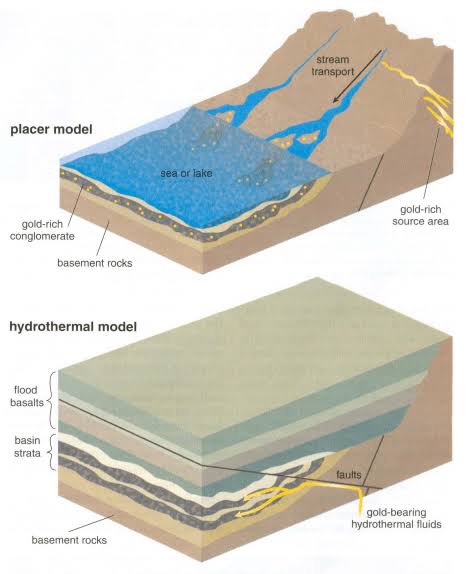
Understanding the Difference Between Primary and Secondary Gold Deposits
Gold has been one of the most sought-after minerals throughout human history, not just for its monetary value, but also for its industrial and cultural significance. However, not all gold is found in the same way or place. Geologists categorize gold deposits into two main types — primary (lode) deposits and secondary (placer) deposits — each with distinct geological processes and mining techniques.
Primary Gold Deposits (Lode or Hard Rock Deposits)
Primary gold deposits are where gold is found in its original geological setting, still locked within the rock where it was formed. These are often called lode deposits or hard rock deposits.
Key Characteristics:
Original Source: Gold occurs in veins or disseminated throughout host rocks, commonly associated with quartz or sulfide minerals such as pyrite.
Formation Process: These deposits are created through hydrothermal activity deep underground, where hot, mineral-rich fluids penetrate cracks in the Earth’s crust and precipitate gold over time.
Mining Method: Extracting gold from primary deposits typically requires crushing and milling the host rock to free the gold particles. This process is capital-intensive and often involves underground or open-pit mining.
Examples: Many major gold mines, such as those in South Africa, Canada, and Australia, are based on primary gold deposits.
Secondary Gold Deposits (Placer Deposits)
Secondary or placer gold deposits form when gold from primary deposits is eroded, transported, and then re-deposited by natural forces such as water, gravity, or wind.
Key Characteristics:
Transported Gold: Over time, weathering and erosion break down primary rocks, freeing the gold, which is then carried by rivers or streams.
Heavy & Durable: Because gold is dense and resistant to corrosion, it tends to settle in low-energy environments like riverbeds, floodplains, or coastal beaches, where it accumulates as nuggets or flakes.
Mining Method: Secondary gold is commonly mined through panning, sluicing, dredging, or hydraulic mining — methods that take advantage of gold’s high density.
Examples: Historic gold rushes in California, the Yukon, and India’s riverbeds are examples of placer gold exploitation.
Comparison Table
Feature Primary Gold Deposits Secondary Gold Deposits
Also Known As Lode or Hard Rock Deposits Placer Deposits
Location In veins or rocks deep underground In riverbeds, alluvial plains, or beaches
Formation Process Hydrothermal activity Erosion and sedimentation
Mining Techniques Crushing, milling, underground/open-pit Panning, sluicing, dredging
Associated Minerals Quartz, sulfides (e.g., pyrite) Gravel, sand, clay
Gold Form Embedded in rock Free particles, nuggets, flakes.
Why Understanding the Difference Matters
Knowing the difference between primary and secondary gold deposits is crucial for:
Exploration: Prospectors use this knowledge to decide where to look — in mountains for lode gold, or riverbeds for placer gold.
Mining Economics: Hard rock mining is more expensive but can yield larger deposits, while placer mining is more accessible for small-scale operations.
Environmental Impact: Secondary deposits often have lower environmental impact, but their limited size may require extensive land use. Primary deposits involve larger industrial operations with greater regulatory scrutiny.
Conclusion
Both primary and secondary gold deposits play vital roles in global gold supply. While primary deposits offer long-term, high-volume yields, secondary deposits provide quicker, more accessible opportunities — especially for artisanal miners or during gold rushes. Understanding their differences not only helps in mining and exploration but also reveals the geological history of how gold is formed, moved, and concentrated over millions of years.