
Petroleum Traps: The Hidden Structures That Store the World’s Oil and Gas

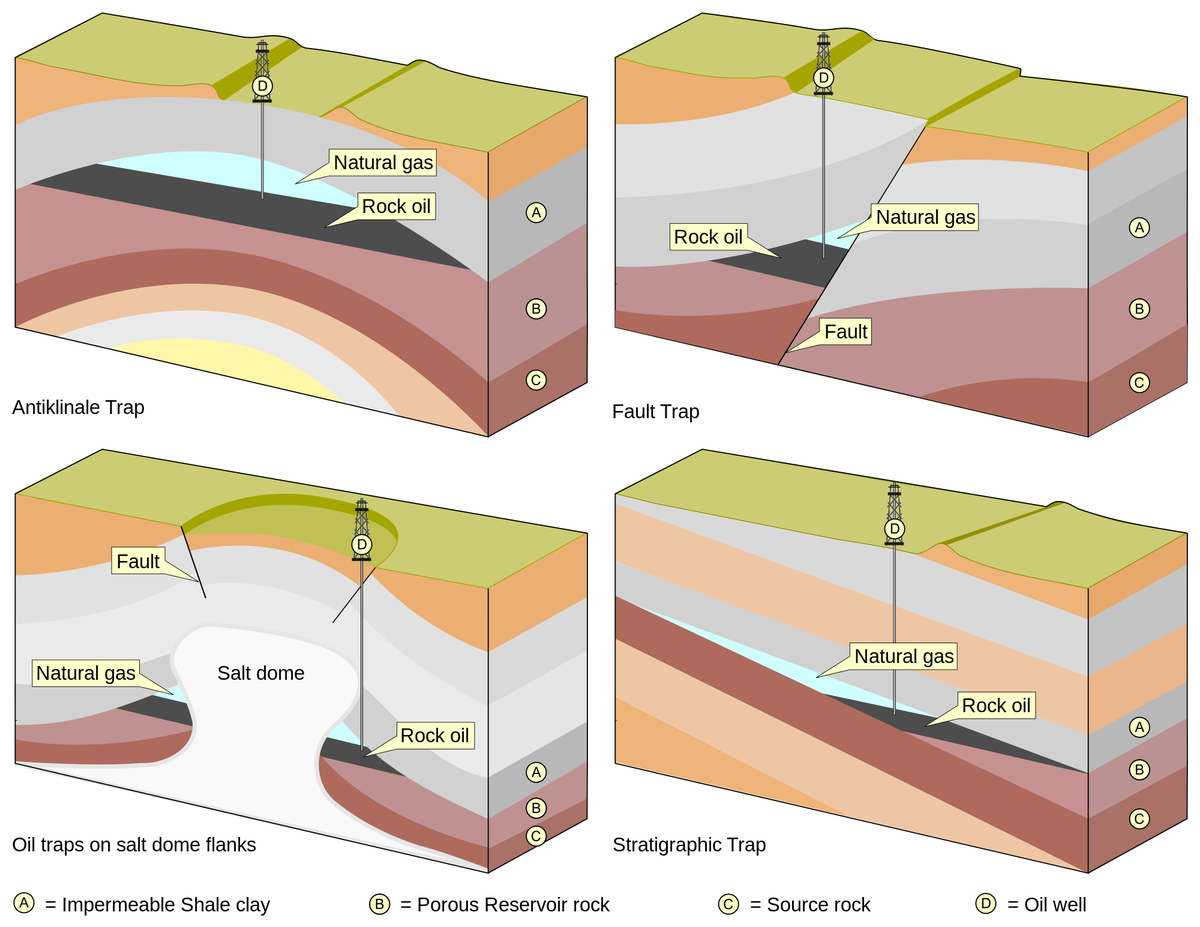
Petroleum Traps: Nature’s Subsurface Reservoirs
Did you know that oil and gas do not accumulate randomly underground? Instead, they are stored in specific geological formations that act as natural reservoirs, holding hydrocarbons in place for thousands to millions of years. These structures, known as petroleum traps, are essential for the formation of commercially recoverable oil and gas deposits. Without them, much of the world’s energy resources would have simply escaped to the surface and dispersed.
How Petroleum Traps Work
Petroleum originates in source rocks deep beneath the Earth’s surface, where heat and pressure convert organic matter into hydrocarbons over geological time. Once formed, these hydrocarbons begin to migrate upward through permeable rock layers. Along the way, they may accumulate in porous reservoir rocks, which act like underground sponges.
However, unless these reservoir rocks are sealed by an impermeable cap rock, the oil and gas would continue migrating until they seep out at the surface. Petroleum traps provide the necessary containment, preventing such loss and allowing hydrocarbons to accumulate in recoverable volumes.
Types of Petroleum Traps
There are several categories of petroleum traps, each with distinct geological characteristics:
-
Structural Traps
These are formed by the deformation of rock layers through tectonic forces. The most common structural traps include:-
Anticlines: Upward-arching folds in rock layers.
-
Fault traps: Created when rock strata are displaced by faults.
-
Salt domes: Formed when buoyant salt layers pierce through overlying rocks, distorting nearby sedimentary layers into dome-like structures.
-
-
Stratigraphic Traps
Unlike structural traps, these arise from changes in rock properties such as porosity and permeability. They occur due to variations in sediment deposition, erosion, or other non-tectonic processes that create barriers to hydrocarbon migration. -
Combination Traps
These traps feature both structural and stratigraphic elements. They are often the most complex and challenging to identify but can yield some of the largest and most lucrative discoveries.
Why Petroleum Traps Matter
Petroleum traps are not just geological curiosities; they are a critical focus in oil and gas exploration. Discovering and correctly interpreting these subsurface features is essential for determining whether a basin contains commercially viable reserves. Even with advanced seismic imaging and modeling, locating an effective trap remains a significant technical challenge—and a major opportunity.
Without these natural containment systems, giant oil fields like those in the Middle East, Gulf of Mexico, and North Sea would not exist. In essence, petroleum traps are Earth’s subsurface guardians, preserving vital energy resources through geological time.