

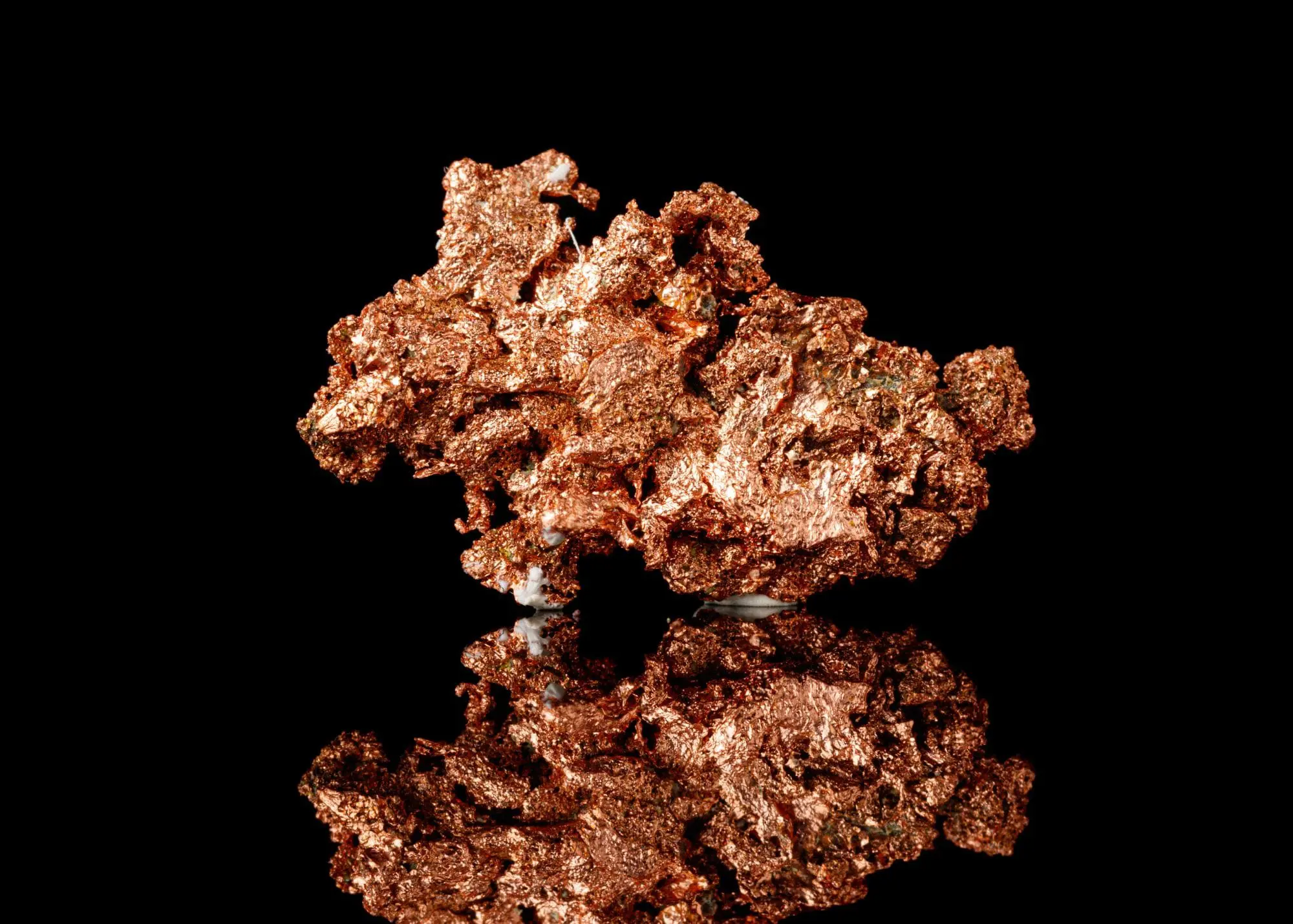
Copper, a naturally occurring metallic element found in the Earth’s crust, has been a cornerstone of human civilization for thousands of years. Valued for its high electrical and thermal conductivity, ductility, and corrosion resistance, copper is one of the few metals that occur in nature in a directly usable metallic form, known as native copper. From ancient tools to modern electronics, copper’s versatility makes it indispensable in industries ranging from construction to renewable energy. This article explores the properties of copper, its major ore minerals, their geological significance, and their role in meeting global demand for this critical metal.
The Unique Properties of Copper
Copper (Cu, atomic number 29) is a reddish-orange metal known for its exceptional physical and chemical properties. Its high electrical conductivity—second only to silver—makes it the material of choice for electrical wiring, power grids, and electronic components. Copper’s thermal conductivity is equally impressive, enabling its use in heat exchangers and cooling systems. Its ductility allows it to be drawn into thin wires, while its corrosion resistance ensures durability in harsh environments, such as marine applications. These properties, combined with its recyclability, position copper as a vital resource in the global push for sustainable technologies, including electric vehicles (EVs), wind turbines, and solar panels.
Copper occurs naturally in two forms: as native copper, which is nearly pure (99.9% copper), and as ore minerals, where it is chemically bonded with other elements. Native copper, found in volcanic regions and sedimentary deposits, was used by ancient civilizations for tools and ornaments. However, most copper today is extracted from ore minerals through mining and processing, with global production reaching 22 million tonnes in 2024, according to the International Copper Study Group.
Major Copper Ore Minerals
Copper is extracted from a variety of ore minerals, each with distinct chemical compositions, copper content, and geological occurrences. Below is a detailed look at the primary copper-bearing minerals, their properties, and their significance in the mining industry.
1. Native Copper – 99.9% Copper
Native copper is pure metallic copper found in nature, typically in basaltic lava flows, volcanic rocks, or oxidized zones of copper deposits. Its high purity makes it directly usable without extensive processing, though its occurrence is rare compared to copper ores. Major deposits are found in the Keweenaw Peninsula, Michigan, USA, and parts of Chile. Native copper’s scarcity limits its commercial significance, but it remains a geological marvel and a collector’s item.
2. Cuprite (Cu₂O) – 88.8% Copper
Cuprite, a red oxide mineral, is a rich source of copper, often found in the oxidized zones of copper deposits alongside native copper and malachite. Its high copper content makes it a valuable ore, though its brittle nature requires careful handling during mining. Cuprite is mined in regions like the Democratic Republic of Congo (DRC) and Australia, contributing to high-grade copper concentrates.
3. Chalcocite (Cu₂S) – 79.8% Copper
Chalcocite, a dark gray to black copper sulfide mineral, is one of the most valuable copper ores due to its high copper content. Found in supergene enrichment zones where copper is redeposited by weathering, chalcocite is mined in major copper-producing countries like Chile, Peru, and Zambia. Its high grade makes it a preferred ore for smelting, accounting for a significant portion of global copper production.
4. Covellite (CuS) – 66.5% Copper
Covellite, a striking blue copper sulfide mineral, is less common but still economically significant. It forms in secondary enrichment zones and is often associated with chalcocite. Covellite’s vibrant color makes it a favorite among mineral collectors, but its copper content supports its use in commercial mining, particularly in deposits in Montana, USA, and Chile.
5. Malachite (Cu₂CO₃(OH)₂) – 57.3% Copper
Malachite, a green carbonate mineral, is often found with azurite in oxidized copper deposits. Its vibrant color and banded patterns make it a popular ornamental stone, but it is also a significant copper ore. Malachite is mined in the DRC, Australia, and Russia, where it contributes to both copper production and the gemstone market. Its relatively high copper content supports its use in small-scale mining operations.
6. Azurite (Cu₃(CO₃)₂(OH)₂) – 55% Copper
Azurite, a deep blue carbonate mineral, is closely related to malachite and often occurs in the same deposits. Its lower copper content compared to chalcocite or cuprite makes it less economically significant, but it is still mined in regions like Arizona, USA, and Namibia. Azurite’s vivid color has historically made it a pigment for art, but today it is primarily valued for its copper content and aesthetic appeal.
7. Chrysocolla (Cu₂H₂Si₂O₅(OH)₄·nH₂O) – 37.9% Copper
Chrysocolla, a hydrated copper silicate mineral, is typically blue to green and found in oxidized copper deposits. Its lower copper content and complex structure make it less viable for large-scale mining, but it is extracted in regions like Peru and the DRC. Chrysocolla’s vibrant colors also make it a sought-after material for jewelry and decorative items.
8. Chalcopyrite (CuFeS₂) – 34.5% Copper
Chalcopyrite, a brassy yellow copper-iron sulfide, is the most abundant and commercially important copper ore mineral, accounting for approximately 70% of global copper production. Found in porphyry copper deposits, chalcopyrite is mined in major copper belts like the Andes (Chile and Peru), the Central African Copperbelt (Zambia and DRC), and Australia. Its lower copper content requires extensive processing, including crushing, grinding, flotation, and smelting, but its widespread availability makes it the backbone of the copper industry.
Global Copper Production and Mining Processes
Global copper production is concentrated in a few countries, with Chile (5.5 million tonnes), Peru (2.4 million tonnes), and the DRC (2.2 million tonnes) leading in 2024. Copper mining involves open-pit or underground methods, depending on the deposit’s depth and geology. Ore is processed through flotation to produce copper concentrates (25–35% copper), which are then smelted and refined to achieve 99.99% purity for industrial use.
The extraction process is energy-intensive and environmentally challenging, with concerns about water usage, tailings management, and carbon emissions. Sustainable mining practices, such as water recycling and renewable energy adoption, are gaining traction to address these issues. Copper’s 100% recyclability also reduces environmental impact, with recycled copper accounting for 35% of global supply.
Economic and Strategic Significance
Copper’s role in the global energy transition cannot be overstated. It is a critical component in:
-
Renewable Energy: Solar panels and wind turbines use 4–6 times more copper than fossil fuel-based systems.
-
Electric Vehicles: EVs require 60–80 kg of copper per vehicle, compared to 20 kg for internal combustion engine vehicles.
-
Electronics: Copper is essential for wiring, circuit boards, and semiconductor interconnects.
-
Infrastructure: Power grids and smart cities rely on copper for efficient electricity transmission.
The global copper market, valued at $350 billion in 2024, is projected to reach $450 billion by 2030, driven by a 4% annual demand growth. Supply constraints, due to declining ore grades and limited new discoveries, have pushed prices to $9,500 per tonne in mid-2025, up 10% from 2024. Geopolitical tensions and supply chain disruptions, such as those seen during the COVID-19 pandemic, underscore the need for diversified copper sources.
Challenges in the Copper Industry
The copper industry faces several challenges:
-
Declining Ore Grades: Major deposits like chalcopyrite are seeing lower copper content, increasing extraction costs.
-
Environmental Impact: Mining and smelting generate significant carbon emissions and waste, requiring investment in green technologies.
-
Supply Chain Risks: Concentration of production in a few countries exposes the market to geopolitical and natural risks.
-
Investment Needs: Developing new mines requires $10–20 billion per project, with long lead times of 5–10 years.
Opportunities for Growth
Despite these challenges, opportunities abound:
-
Technological Advancements: Innovations in hydrometallurgy and bioleaching can improve extraction efficiency and reduce environmental impact.
-
Recycling: Expanding copper recycling, which requires 85% less energy than primary production, can meet 40–50% of global demand by 2030.
-
Exploration: New deposits in regions like Africa and South America could bolster supply.
-
Energy Transition Demand: Rising needs for EVs, renewables, and smart grids ensure long-term market growth.
Looking Ahead
Copper’s enduring importance lies in its unique properties and critical role in modern technology. As the world transitions to a low-carbon economy, demand for copper from minerals like chalcopyrite, chalcocite, and cuprite will continue to surge. Sustainable mining practices, increased recycling, and technological innovations will be key to meeting this demand while addressing environmental concerns. From ancient civilizations to the renewable energy revolution, copper remains a vital resource, shaping the future of industries and economies worldwide.