

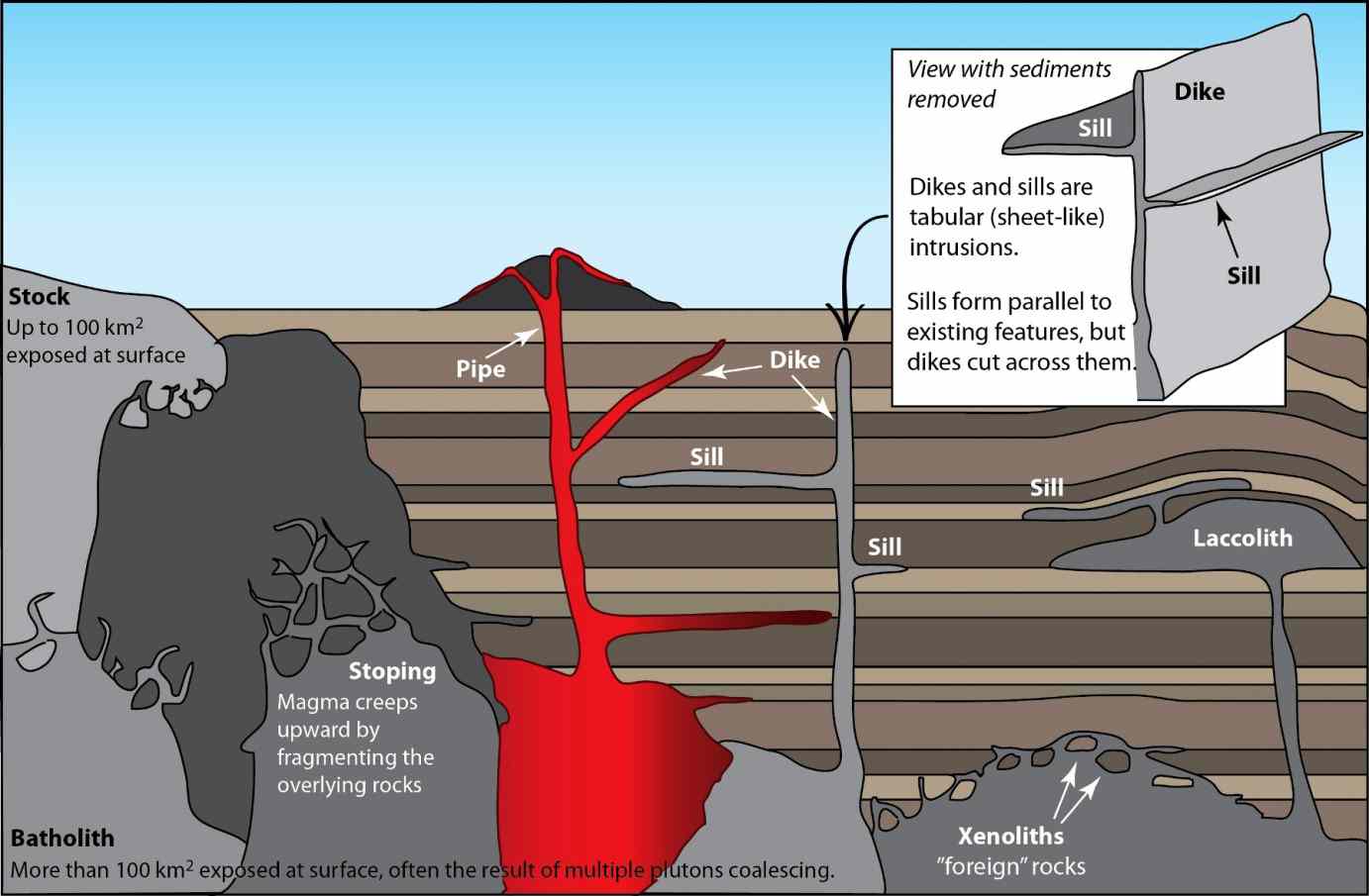
Plutons are large, intrusive igneous rock bodies that form when magma cools and solidifies slowly beneath the Earth’s surface. These massive intrusions crystallize deep within the crust and, over millions of years, are revealed through uplift and erosion. When several plutons merge together, they create expansive geological structures known as batholiths.
Formation Process
-
Intrusion of Magma (Time 1 & 2):
Magma originating from deep chambers rises into the Earth’s crust, forming geological structures such as dikes, sills, and laccoliths. In some cases, magma escapes to the surface, erupting as lava flows or volcanic material. -
Development of Plutons (Time 2):
Large volumes of magma remain trapped underground, cooling slowly to form plutons. With repeated intrusions over geologic time, multiple plutons can accumulate, eventually forming batholiths. -
Exposure at the Surface (Time 3):
Through tectonic uplift and long-term erosion, the overlying rock layers are stripped away. This gradual process exposes plutons and batholiths at the Earth’s surface, often creating striking landscapes.
Features of Plutons and Batholiths
-
Contact Zones: Boundaries where intrusive rocks meet surrounding wall rock. These zones often show a “baked” effect due to intense heat.
-
Granite Plutons: Granite is one of the most common plutonic rocks, with famous examples found in the Mojave Desert (USA) and Torres del Paine (Chile).
-
Batholiths: Enormous composite intrusions that cover vast regions, such as the Sierra Nevada Batholith in California, which spans hundreds of kilometers.
-
Exposed Intrusions: Today, plutons and batholiths are visible in geological regions like the Coast Ranges, Idaho Batholith, and Peninsular Batholith of North America.
Geological Importance
-
Insights into Magmatic Processes: Plutons and batholiths are natural records of how magma behaves and crystallizes deep underground.
-
Spectacular Landscapes: Landmarks like Yosemite National Park (part of the Sierra Nevada Batholith) and Torres del Paine in Chile owe their dramatic scenery to exposed plutonic rocks.
-
Tectonic and Crustal Evolution: Studying these formations helps geologists reconstruct the history of continental growth and mountain-building events.
-
Mineral Resources: Plutons are often associated with valuable mineral deposits, making them economically important.
Plutons and batholiths are not just hidden giants of Earth’s crust—they are time capsules of geological history. Their exposure at the surface allows scientists to trace magmatic activity, understand tectonic forces, and appreciate the spectacular landscapes carved from these once-hidden features. From the Sierra Nevada to the Patagonian Andes, these formations continue to inspire awe while deepening our knowledge of Earth’s dynamic processes.