
China Eases Rare-Earth Export Curbs: Boost for India’s Electronics and Manufacturing Sectors

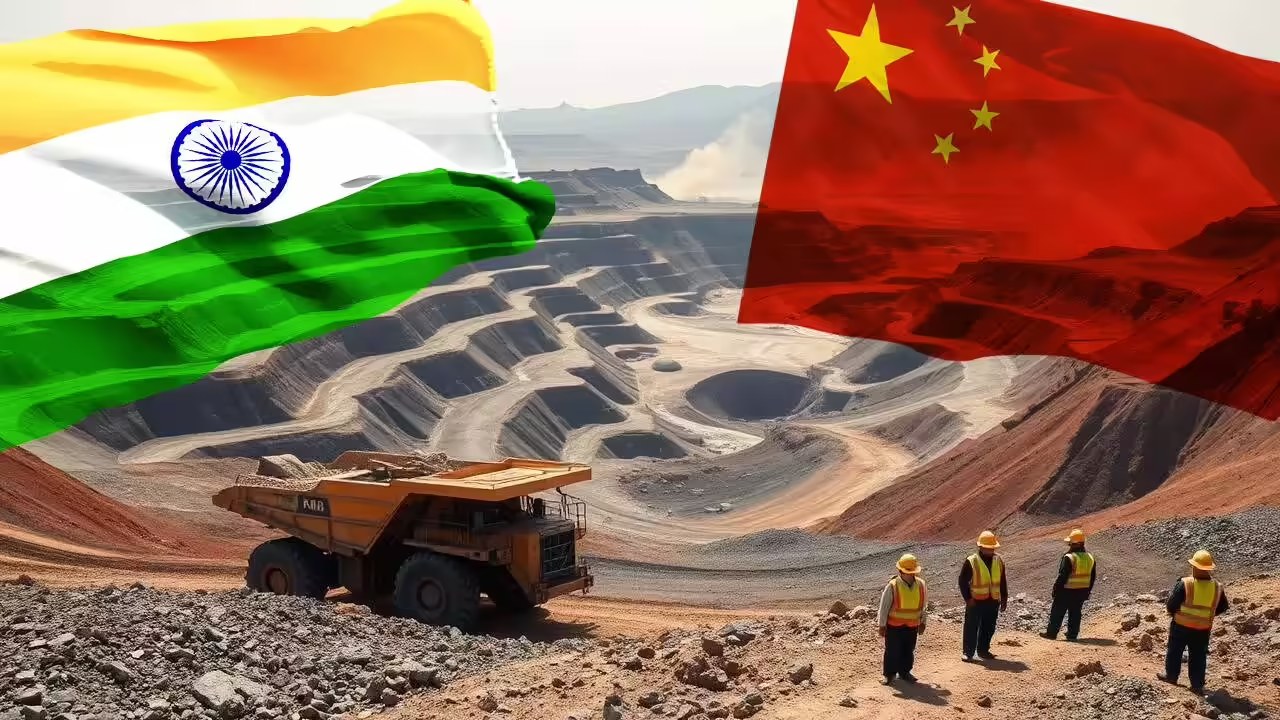
In a move with far-reaching global implications, China has relaxed its export restrictions on rare-earth metals, providing potential relief for nations dependent on these critical materials, including India, according to The Times of India. The development is expected to ease supply constraints that have long affected India’s electronics, electric vehicle (EV), renewable energy, and advanced manufacturing industries.
A Global Shift in Rare-Earth Trade Dynamics
China, the world’s largest producer and exporter of rare-earth elements, has historically maintained tight control over the export of these strategic materials. Rare-earths—comprising 17 metallic elements such as neodymium, dysprosium, and lanthanum—are indispensable for manufacturing semiconductors, magnets, EV batteries, wind turbines, and defense systems.
The relaxation of export curbs indicates Beijing’s attempt to stabilize global supply chains and manage trade relations amid international concerns about overdependence on Chinese sources. This move is expected to increase availability and lower global prices for rare-earth elements, offering much-needed relief to import-dependent countries like India.
Impact on India’s Electronics and Manufacturing Industries
For India, this policy shift arrives at a crucial time. The country’s electronics and EV manufacturing ecosystem has been expanding rapidly under government initiatives such as “Make in India” and “Atmanirbhar Bharat” (Self-Reliant India). However, a consistent challenge has been the limited availability of refined rare-earth materials, which India largely imports from China.
With the easing of export restrictions, Indian manufacturers could experience reduced input costs and improved supply stability, particularly for industries producing EV motors, smartphone components, and renewable energy equipment. This will enhance India’s competitiveness in the global technology and clean energy sectors.
Opportunities for Indian Metals and Minerals Industry
While the development offers immediate supply-side relief, experts highlight that India must not rely solely on favorable global conditions. The country’s metals and minerals industry is being encouraged to develop indigenous refining and processing capabilities for rare-earth elements.
The Indian government’s National Critical Minerals Mission (NCMM) is already focused on identifying and developing domestic reserves of rare-earths and other strategic minerals. Collaboration with scientific institutions, investment in AI-driven exploration, and partnerships with countries like Australia and Latin America are integral to this strategy.
The current global environment—where supply constraints are easing—provides an ideal window for Indian companies to expand into rare-earth processing, alloy production, and magnet manufacturing, sectors with high value addition and export potential.
Strengthening Supply Chain Resilience
Although China’s decision offers short-term benefits, it also underscores the strategic need for India to build resilient and diversified mineral supply chains. Experts caution that policy shifts in global trade can be temporary and may change with geopolitical developments. Hence, long-term investment in domestic mineral exploration, refining, and recycling technologies remains essential.
India’s efforts to secure rare-earth elements through partnerships in Africa and Southeast Asia, along with new exploration drives in Assam and Mizoram, align with this goal of reducing import dependency and boosting domestic production.
A Strategic Opening for India’s Industrial Future
The easing of China’s rare-earth export curbs presents both an opportunity and a challenge for India. It offers short-term relief for key manufacturing sectors while emphasizing the importance of self-sufficiency in critical mineral processing.
If leveraged effectively, this period of supply stability could enable India to build its own rare-earth ecosystem—from mining and refining to advanced materials manufacturing—helping the nation strengthen its position in the global clean technology and electronics value chain.