
Government Revokes QCOs on 7 Key Minerals After Industry Backlash

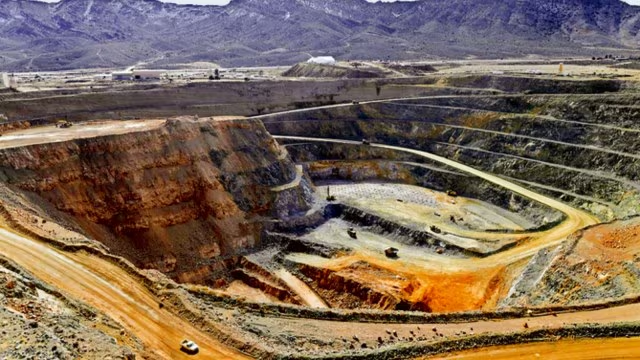
In a significant regulatory reversal, the Government of India has withdrawn Quality Control Orders (QCOs) on seven major non-ferrous minerals following sustained objections from industry bodies and downstream manufacturers. The minerals for which the QCOs have been revoked include aluminium, copper, nickel, tin, zinc, and refined lead.
The government had earlier mandated BIS (Bureau of Indian Standards) certification for these minerals, making it compulsory for manufacturers, importers, and distributors to obtain a Standard Mark before producing, importing, or selling these materials in India.
What QCOs Meant for Industry
A QCO, once implemented, restricts:
-
Import
-
Manufacturing
-
Distribution
-
Sale
of any product falling under its category without BIS certification. This was intended to prevent sub-standard material from entering the Indian market and to ensure uniform quality across industries.
However, the mandatory BIS certification norms were widely criticized for disrupting raw material supply chains, especially for industries heavily dependent on imports such as:
-
Electrical equipment and cables
-
Battery manufacturing
-
EV components
-
Defence manufacturing
-
Electronics and consumer goods
Why the Government Withdrew the QCOs
1. Heavy Backlash From Industry
Industry associations and manufacturing bodies argued that the QCOs placed an enormous compliance burden on businesses. Many global suppliers were not ready to undergo BIS certification, leading to supply shortages.
2. India’s Dependence on Mineral Imports
Minerals such as nickel and copper are significantly imported due to limited domestic availability. The QCOs were causing bottlenecks, disrupting production cycles for sectors ranging from electronics to automotive manufacturing.
3. Rising Costs for MSMEs
Smaller industries, in particular, reported cost escalations due to:
-
Certification delays
-
Need to switch suppliers
-
Limited availability of BIS-compliant materials
MSMEs warned that this could reduce their competitiveness in international markets.
4. Legal Challenges
Several stakeholders moved court challenging the QCOs, arguing that the norms were impractical and harmful to downstream sectors. The legal pressure added to the momentum for reconsideration.
Industry Reaction
The revocation has been welcomed across sectors:
-
Battery manufacturers said the move would stabilize raw material inflow and reduce cost pressure.
-
Copper and aluminium-based industries noted that their sourcing would return to normal without certification-related delays.
-
Export-driven industries expressed relief, as the norms had threatened their production schedules.
However, trade analysts cautioned that removing QCOs could trigger a surge in cheaper, lower-grade imports. They urged the government to strengthen monitoring and impose anti-dumping duties where necessary to protect domestic producers.
Impact on Key Sectors
-
EV & Battery Sector: Easier availability of lead and nickel will help reduce production costs for EV batteries, telecom backup systems, and solar storage units.
-
Electronics & Aerospace: Access to high-purity copper and nickel is essential for advanced electronic components and defence-grade systems.
-
Construction & Infrastructure: Aluminium and zinc are widely used in structural, transportation, and industrial applications.
The decision is expected to restore continuity in supply chains and provide breathing space to manufacturers who were struggling under the restrictive norms.
What Happens Next
While the rollback offers immediate relief, the government may still explore:
-
Strengthened market surveillance
-
Anti-dumping investigations
-
Safeguard duties
-
Revised quality norms that are industry-friendly
The balance will be between ensuring quality control and safeguarding ease of doing business.
The withdrawal of these QCOs signals a shift toward a more flexible regulatory environment, offering much-needed support to downstream industries that form the backbone of India’s manufacturing ecosystem.