
Vale looks to accelerate autonomous truck fleet to 150 in next two years

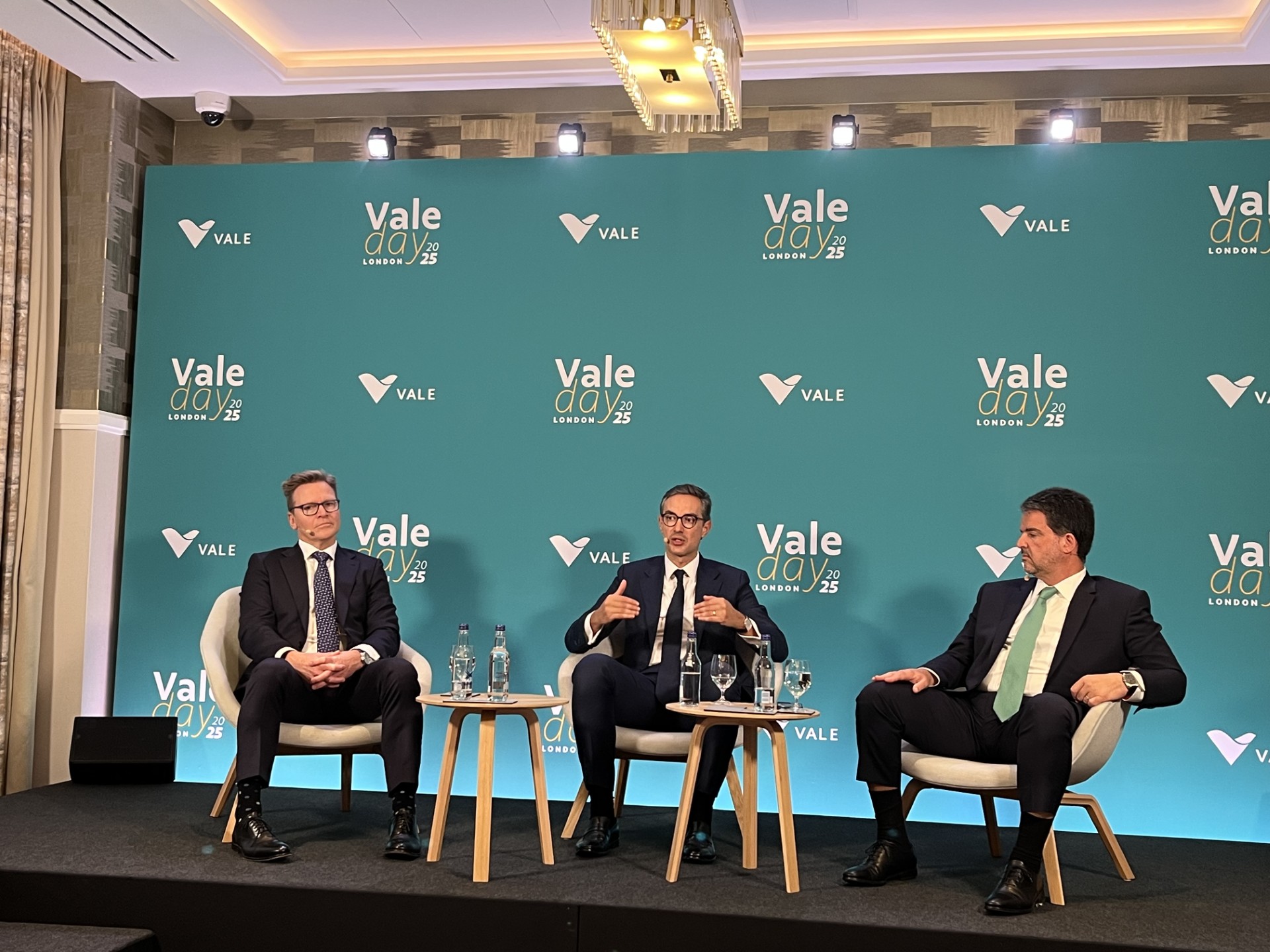
On December 2, IM Editorial Director Paul Moore attended the Vale Day 2025 event in London. In the opening slides delivered by Vale CEO Gustavo Pimenta, there was a focus on innovation supporting a safety culture and operational excellence and accelerating toward the future of mining in the global iron ore miner’s operations.
One of the areas highlighted was increasing autonomous fleets and remote-controlled machinery. Vale told IM on the sidelines of the event that today it has 90 autonomous machines working – of which 32 are large mining trucks – the remainder primarily being blasthole drills.
Autonomous Caterpillar 793F truck at Vale Brucutu
Those 32 trucks are spread across smaller operations – Caterpillar trucks using Command for Hauling at Brucutu (793F) and Capanema (789D); and at the N4E mine, one of the Carajas open pits, using Komatsu FrontRunner on 930E trucks. However, given that Vale’s AHS journey began at Brucutu in 2018 – you might think that this number of 32 should be higher for a miner of Vale’s scale.
A major reason is that the Carajas open pit mines have a large and diverse fleet of multiple truck models – mainly Caterpillar and Komatsu but also some others like Liebherr – of different size classes and different ages. This makes a traditional model of rolling out AHS retrofits challenging.
But the miner is now looking to scale up. CEO Pimenta responded to a question from IM about this during the Vale Day press conference, and pointed out that in the Northern System, S11D is already largely autonomous being primarily a truckless operation – but in terms of the other Northern System mines, including Carajas he added: “We are doing an incremental rollout, and are in the process of buying a new autonomous fleet to deploy there…Brucutu in the south of Brazil is already fully autonomous, so that is an example that we are trying to expand – so yes we do have different mines but we see an opportunity to roll out that program in Brazil.”
Marcelo Bacci, Executive Vice President – Finance and Investor Relations and, on an interim basis, People additionally stated to IM during the event: “With the autonomous trucks there was an important change in the industry more recently, where the autonomous kits that you buy are interchangeable between the different brands – so you can buy the kit from one brand and install on the truck you have from another brand. So that reduces a lot the CAPEX as you don’t need to change the whole equipment – only make autonomous the truck that you had before.” On AHS he also gave an indication of Vale’s ambitions – it plans to increase from the 32 number to 150 within the next two years.
This ability to install AHS on competitor trucks is something Caterpillar recently referenced during its Investor Day 2025 event. Caterpillar Resource Industries President Denise Johnson didn’t name Vale specifically but stated: “We had a large customer, looking for an autonomy solution to help them overcome productivity and utilisation challenges at two of the largest iron ore minesites in South America. They also needed technology to work across their mixed fleets which included both Cat trucks and competitive trucks onsite. We worked with our dealer to provide a customised proposal, and within that we developed a mixed fleet solution putting our autonomy on the Cat and the competitive trucks – a very flexible commercial model, moving from what would traditionally be a very CAPEX to an OPEX model; and an accelerated timeline for technology deployment. The solution was our differentiator, and we won the award to put our autonomy on more than 90 trucks. Deals like this position us well for future fleet replacements. Many sites around the world have mixed fleets and are looking to activate technology immediately.”
Moving on to biodiesel and ethanol, in the main Vale Day presentation, Grazielle Parenti, Executive Vice President of Sustainability stated: “It’s important to highlight that we are in Brazil, the land of biofuels. So there is not only way to decarbonise our operations. Sometimes it’s going to go electric, some time it’s going to be biodiesel or ethanol. And we are piloting and testing them to escalate this.”
On that same topic, Pimenta commented to IM: “It is a unique opportunity for Vale, because in Brazil it is something that the market already consumes – ethanol is deeply penetrated into Brazil’s transportation systems; so we are now looking at alternatives such as ethanol and biodiesel for us to deploy in our fleet. So differently to the other miners.”
He added that in Brazil it has a unique advantage to actually accelerate this – given that it has the potential to be a very cost effective option with much easier conversion versus going electric. Tests he added with ethanol – on which Vale is working on dual fuel programs with both Caterpillar and Komatsu/Cummins, looking at how engines perform; plus on using higher biodiesel blends – are going well which he said is very encouraging. Bacci added that working directly with its suppliers in this way is going to accelerate it being able to get to something that is efficient and economical.
From smart monitoring & AI to S11D expansion
This topic was discussed in some depth in the main Vale Day presentation by Carlos Medeiros, Executive Vice President – Operations. He stated: “Reliable growth is based on operational stability and the smart use of technology. We have managed to optimise our preventive maintenance scope and implemented a robust asset reliability strategy. Smart monitoring and engineering solutions help us mitigating critical and recurring failures. There is a steady decline on the amount of time dedicated to corrective maintenance as a consequence of ongoing improvements each year. And these efforts combined have led us to produce 14 million tons more between January and October this year compared to the same time frame in 2022.”
He added that Conceição II at Itabira has been selected as Vale’s model plant. “This project is a step change in iron ore processing because it has adopted several different technologies such as AI, gen AI, image processing, digital twins and a very sophisticated control system. This plant is expected to start up late December this year.”

Based on results so far the daily production rate has increased by 10% while physical availability is up by 13% or point. Iron content in the waste is down 20%. “And the best one, the amount of direct reduction feed production increased by 38%. These results, although preliminary, make us believe that when this plant is fully operational, it will set a new benchmark for performance. This technology is being rolled out as we speak to Brucutu and in 2027, it will be rolled out Vargem Grande.”
Another interesting example on how AI is helping Vale to solve problems is on the TML calculation. TML stands for transportable moisture limit. “This limit is crucial to us because if the cargo moisture exceeds the TML, it can liquefy and shift during the voyage causing potentially the vessel to capsize. Through AI, the TML and ore moisture can be calculated very accurately, and having this information beforehand helps us to have better adherence to our shipping plans, lower demurrage costs and obviously, a much safer operation. By adopting these two, our shipments in Q1 in the North, our most critical area, have increased by 8% comparing Q1 this year against Q1 2023.”
Vale has also enhanced Carajas mining plant flexibility through a new product portfolio. “This advancement has allowed us to eliminate the blending activity…ore recovery has achieved optimal levels and the strip ratio has reduced by 4% when compared with the mining plan prior the portfolio change. This new portfolio has also allowed us to build a small buffer to cope with eventual licensing delays and supporting operational continuity and resilience.”
Finally, he said that the +20 Project at S11D is moving according to schedule, and its completion is expected to be in December next year. That includes a second long-distance conveyor (TCLD) – which is a duplicate of the first. “We will have the loaded trials starting for this conveyor in the second quarter of next year. All the environmental permits have been retained for this project.”
The S11D compact crusher project has already been covered in detail in IM – this is also moving according to schedule, and Vale expects this to be finished also by the end of next year. Medeiros said this project will be the definitive solution for the jaspilite issue and that once these operational constraints are removed, Vale will be able to process all the material in the mine, as well as handling more waste.
The post Vale looks to accelerate autonomous truck fleet to 150 in next two years appeared first on International Mining.