

Support CleanTechnica’s work through a Substack subscription or on Stripe.
Despite this year’s sharp U-turn in federal energy policy, the renewable energy transition continues to branch out in new directions. One emerging factor is the relatively new area of floating solar. The field has already begun to scale up in some regions around the world, and innovative solar firms are carving out new opportunities here in the US as well.
Floating Solar Scales Up To Beat Fossil Fuels
Back in 2018 the US Department of Energy (such as it was back then) assessed the potential floating solar capacity of the US on reservoirs and other human-made bodies of water. After eliminating thousands of unsuitable locations, they still identified over 24,000 potential sites with the combined potential to provide for about 10% of annual US electricity generation at the time.
The appeal of floating solar lies partly in its ability to make space for renewable energy in land-constrained areas. Whether located on reservoirs and other built infrastructure, or on open water, floating PV arrays can also be moored in place with a minimum of site preparation, avoiding considerable expense for developers (see lots more floating PV background here).
Scaleup is already in evidence in some parts of the world, with the Asian Pacific Region (APAC) being a particular focus of attention. Last year the firm Wood Mackenzie surmised that APAC will account for the fast majority — 57 gigawatts — of an anticipated 77 gigawatts in global solar capacity by 2033.
A study published in the journal Energy & Environmental Science this year affirms the focus on APAC. “Offshore floating photovoltaic (OFPV) systems present a promising opportunity to expand global solar energy capacity, particularly for countries with limited land resources but extensive maritime zones,” the authors note.
The researchers modeled offshore floating solar potential based on economic datasets as well as geographic and climatic data. “The analysis reveals that up to 95% of analyzed offshore regions fall within conditions suitable for current FPV technologies, with Southeast Asia—particularly Indonesia and Malaysia—emerging as optimal early deployment zones due to favorable irradiance, bathymetry, and competitive LCOE,” they concluded, referring to Levelized Cost of Energy, a standard of comparison among different forms of power generation.
More generally, the new study found that in 84% of regions around the world, less than 2% of offshore water surface would be needed to meet current electricity demands.
Who’s Gonna Pay For All This?
The big question, of course, is cost. The floating solar industry has been maturing rapidly, but it is still a relatively new field of endeavor. Costs are expected to drop in the coming years, but even at this stage of the game the technology is competitive, or nearly competitive, with other power generation resources in some regions.
The competitiveness showing was particularly strong in Thailand and Malaysia, where most of the lowest-cost potential surfaced at less than 6 cents per kWh. More broadly, in 53% of the regions studied, the researchers calculated an LCOE below 15 cents per kilowatt-hour.
“As OFPV remains an emerging technology, it is expected that continued research and operational experience will enable optimization across manufacturing, system integration, and deployment, leading to further cost reductions over time,” the researchers concluded.
Meanwhile, Back In The USA
In terms of scale-up, the US has a long way to go. China, of course, has already put down record-breaking stakes in the offshore floating solar industry, having commissioned a 1-gigawatt array off the coast of Shandong Province last year. Meanwhile, the largest existing array in the US sits on a reservoir in New Jersey, clocking in at just 8.9 megawatts.
Still, even at a small scale, floating solar arrays can make a big difference in their host communities.
In New Jersey, for example, the borough of Bernardsville is considering a proposal to float solar panels on the site of a former quarry. As reported by the news organization New Jersey Hills, the project supports the state’s community solar initiative. Electricity ratepayers can voluntarily subscribe to the quarry project and receive a discount estimated at 30%, a significant benefit in today’s environment of skyrocketing energy costs.
NJH reporter Charlie Zavalick also takes note of land use advantages at the site. The quarry sits on private land with no public access and no current recreational use. According to the developer, surrounding communities do not have a view of the site that would be spoiled by the addition of solar panels.
The project could qualify as a community solar project under state law if 51% of its capacity is taken up by subscribers classified as low-income. That’s not a particularly easy benchmark to reach in parts of suburban New Jersey. However, Bernardsville has three affordable housing projects under way and additional projects are in the planning stages, which could help push low-income subscriptions over the goal line.
Floating Solar Is Coming For Your Fossil Fuels
Keep an eye on New Jersey for more floating solar news. Solar developers in the state dodged a bullet on Election Day this year, when the Democratic candidate Mikie Sherrill handily beat her Trump-allied opponent, assuring renewable energy stakeholders of a reliable ally in the Governor’s office for at least the next four years, if not longer.
Meanwhile, the prospective developer of the quarry project, Third Pillar Solar, is also pursuing industrial sites elsewhere around the US. Inactive bodies of water are just one opportunity. In Texas, the company has signed on with the firm Diamond Infrastructure Services to assess its portfolio of reservoirs under management for solar potential.
Based on a preliminary assessment, Third Pillar anticipates building a total of 500 megawatts in floating solar under Diamond’s purview. In addition to earning new revenue from existing sites, the projects are expected to save money for Diamond’s clients by preventing excess water evaporation.
Since everything is bigger in Texas, the state is also on track to host the first large-scale floating PV array in the US, at 391 megawatts. The proposed site is a human-made coastal lake under the jurisdiction of Port Arthur, where it is presumably shielded from interference by the Interior Department and other federal agencies.
Next Steps For Floating Solar
The shade from solar panels can help conserve water in natural bodies of water, too, but researchers point out that the array must be designed to minimize if not eliminate other impacts on the aquatic habitat and the wildlife it supports.
Among the recent studies to that effect, last summer a team of researchers at Cornell University assessed that if just 3.5% of the existing bodies of water in the Northeast were deployed for floating solar, they would generate 25% of the solar energy needs in the region by 2050 — with the additional benefit of conserving land for other purposes.
That 3.5% figure includes bodies of water with significant recreation and biodiversity roles. Weeding them out of the pool of qualified sites, the researchers found that floating solar would only contribute 5% of solar energy needs to the Northeast. Still 5% is a fairly substantial figure in a region strapped for open land, potentially reserving thousands of acres for other uses. The researchers also point out that 5% represents an increase of 194% over the current capacity of land-based solar arrays in the Northeast.
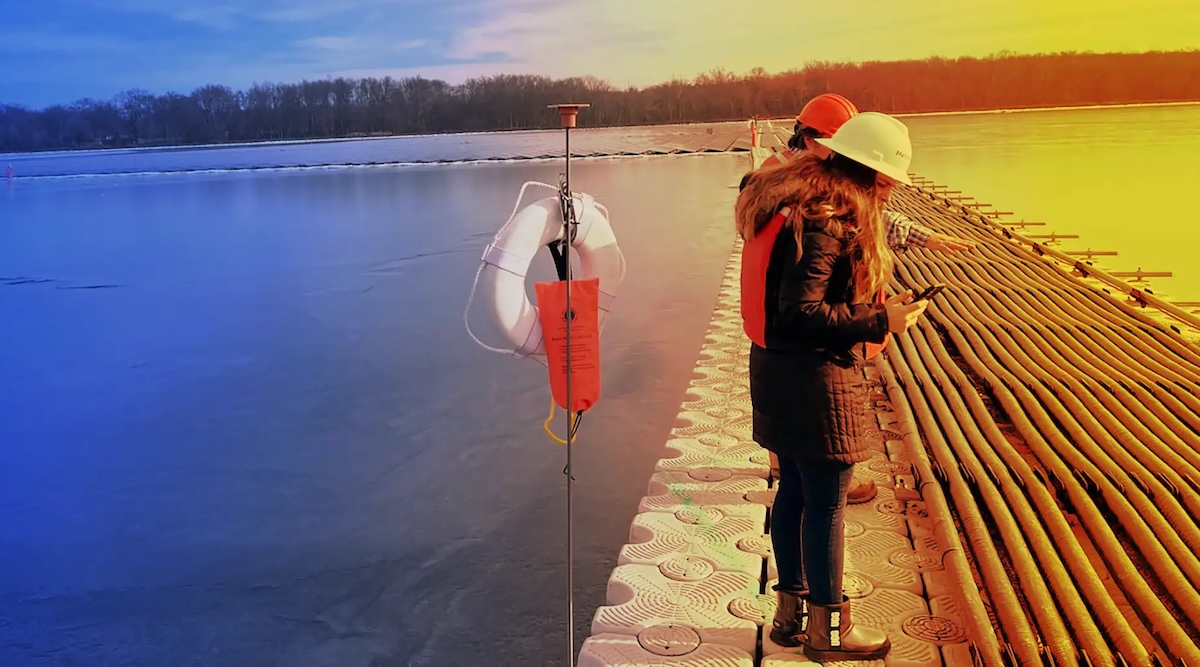
Photo: The floating solar movement continues apace in the US, despite this year’s sharp U-turn in federal energy policy (screenshot, courtesy of Third Pillar Solar).
Sign up for CleanTechnica’s Weekly Substack for Zach and Scott’s in-depth analyses and high level summaries, sign up for our daily newsletter, and follow us on Google News!
Have a tip for CleanTechnica? Want to advertise? Want to suggest a guest for our CleanTech Talk podcast? Contact us here.
Sign up for our daily newsletter for 15 new cleantech stories a day. Or sign up for our weekly one on top stories of the week if daily is too frequent.
CleanTechnica uses affiliate links. See our policy here.
CleanTechnica’s Comment Policy