

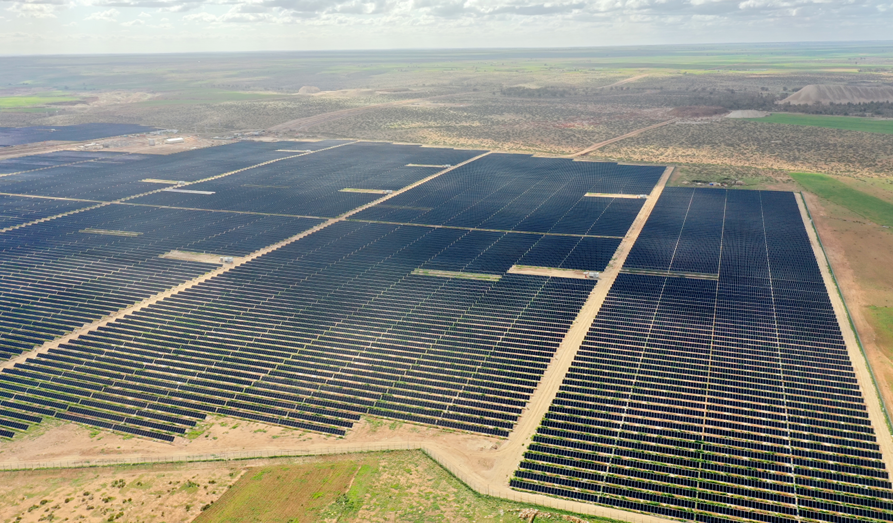
OCP Green Energy, a wholly owned subsidiary of phosphate mining major OCP Group dedicated to the production and storage of electricity from renewable sources, recently announced the commissioning of the first phase of its investment program, representing a total solar capacity of 202 MWp.
Now fully operational, this initial portfolio is distributed across three sites: Benguerir (67 MWp), Foum Tizi (30 MWp), and Oulad Farès in Khouribga. With 105 MWp installed, Oulad Farès is now the largest photovoltaic power plant in operation in Morocco.
These solar farms mark a major step forward in the OCP Group’s energy transition. They already cover a significant share of the group’s mining site energy needs, strengthen the group’s security of supply and resilience, and reduce the group’s carbon footprint. The low-cost electricity generated on sites – estimated at around 368 MAD/MWh – will be key in the industrial production of customised fertilisers.
These projects were developed under an authorisation granted by the Ministry of Energy Transition and Sustainable Development, within the framework of the self-production law and in accordance with current regulations, including decisions issued by ANRE governing conditions of access and use of the national transmission and distribution network, as well as the applicable technical and contractual terms for self-producers.
The implementation of this framework materialised through connection and access agreements concluded with ONEE, ensuring the transmission of electricity between production and consumption sites connected to the national grid. This regime enables optimal use of the low carbon electricity generated across OCP’s sites, powering OCP Green Water’s desalination stations as well as other strategic industrial facilities operated by the SBU Manufacturing, including those of the Strategic Business Unit Specialty Products & Solutions (SPS) and Nutricrops.
For the plants’ construction, OCP Green Energy adopted an execution strategy that strongly involved the local Moroccan industrial ecosystem across engineering, design, and construction. This approach ensured completion of this first phase on time, on budget, and in line with the highest international standards.
Representing an investment of nearly MAD 1.8 billion (US$195 million), this phase was directly managed by OCP Green Energy through a multi-lot EPCM model, led by JESA and engaging a broad network of Moroccan industrial partners.
JESA is an equally held JV between OCP and Worley – the company said that it is proud “to contribute to this strategic transformation through the delivery of 202 MWp of solar capacity, covering detailed engineering, procurement, and construction management. JESA proudly delivered this phase in close partnership with Moroccan companies, ensuring strong local participation throughout the project. This approach strengthened national industrial involvement and reinforced the capabilities of the Moroccan ecosystem.”
It added: “This program is building more than solar assets, it is shaping long-term competitiveness, technological advancement, and a stronger renewable energy ecosystem.”
The projects have also received international recognition. In April 2023, the International Finance Corporation (IFC, World Bank Group) granted €100 million in financing to support their development, demonstrating the quality of their governance and engineering.
The circle of partners has since expanded with the KfW (German Development Bank) to strengthen the Water–Energy nexus, a core pillar of OCP’s strategy. These financing arrangements also include contributions from the Clean Technology Fund (CTF), a program led by the African Development Bank (AfDB) dedicated to developing innovative energy storage systems.
“Integrating a solar plant at the heart of an active mining site, without disrupting its operations and while strictly complying with grid code standards, represented a major challenge. Thanks to OCP Group’s support, our teams’ commitment, and close collaboration with the IFC and other financial and industrial partners, we have delivered this project in line with the best international practices in safety, performance, and sustainability – demonstrating our ability to combine operational excellence with energy transition,” said Omar Kadir, Managing Director of OCP Green Energy.
In parallel to the commissioning of the three solar farms, OCP Green Energy is taking another step forward with the launch of the Battery Energy Storage System (BESS) Phase I project in Benguerir – the first confirmed order of LFP batteries in Morocco. This system, with a capacity of 25 MW / 125 MWh (five hours of autonomy), will be operational in 2026. It will store solar energy produced during the day and release it during peak hours, ensuring a continuous renewable supply, better demand management, and enhanced flexibility.
“Large-scale deployment of storage technology is a true inflection point that accelerates the rollout of renewable capacity. By leveraging this flexibility, we significantly reduce the intermittency of renewable sources, ensure better alignment with demand profiles, reinforce grid stability, and thereby secure greater integration into the national power system,” said Omar Kadir, Managing Director of OCP Green Energy.
With this first phase completed, OCP Green Energy says it has confirmed the robustness of its roadmap. The company continues to develop new capacity to reach 1.2 GW by 2027 and over 2 GW beyond, including at least 2 GWh of storage.
“This program illustrates the OCP Group’s energy transition strategy, which aims to produce more power locally at a competitive price, meet 100% of its industrial electricity needs from renewable sources by 2027 and achieve carbon neutrality by 2040. By anticipating its energy needs and investing in its own generation capacity, the OCP Group secures its power supply while strengthening its low-carbon competitiveness in international markets.”
The post OCP completes first phase of green energy investment program appeared first on International Mining.