

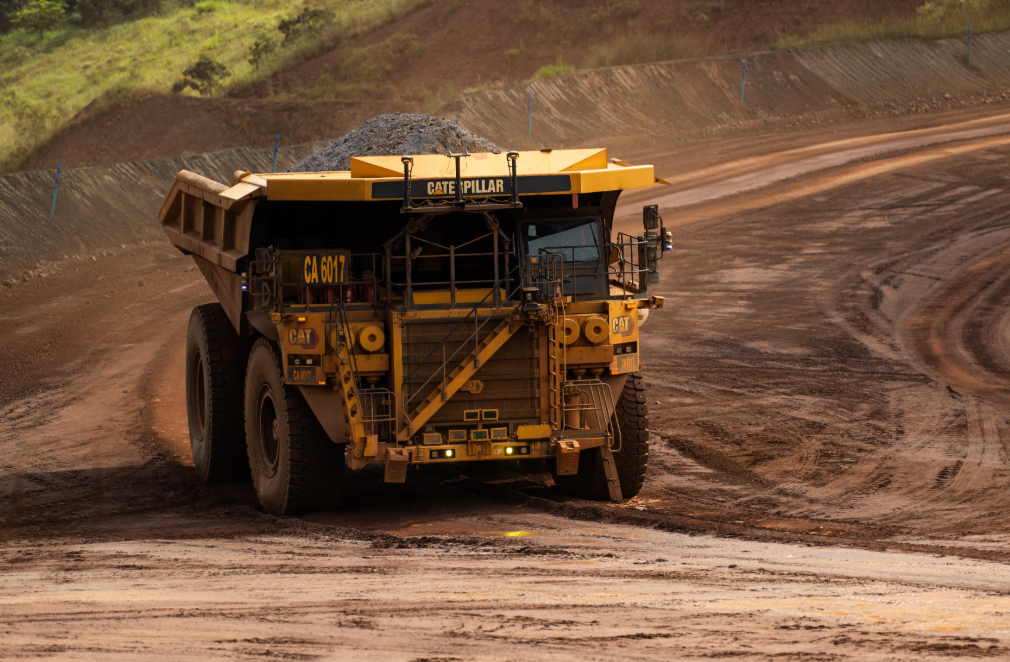
Vale, Caterpillar and Sotreq have signed an agreement to expand the fleet of autonomous haul trucks in iron ore operations in the Northern System, in the Carajas region, in Para state, Brazil. The announcement of this deal was predicted by IM following comments made by Caterpillar’s Resource Industries President Denise Johnson at its recent Investor Day 2025; and by Vale at its Vale Day event last week in London.
The technology will be gradually expanded over the next five years at the Serra Norte and Serra Sul units, further increasing the company’s operational efficiency, safety standards, and sustainability. Serra Norte includes the N4W, N4E and N5 mines, while Serra Sul includes the S11D operation.
The implementation will be accompanied by a plan to develop employees, preparing them to perform strategic functions in the digital environment.
Currently, the Northern System operation has 14 autonomous haul trucks with a capacity to carry up to 320 tons – these are Komatsu 930E trucks using its FrontRunner system at the N4E mine. This new agreement with Caterpillar expands the fleet to approximately 90 autonomous trucks in the region by 2028, operated by Cat® MineStar Command for hauling, including trucks with a capacity to carry up to 400 tons.
It will include conversion of both Caterpillar and competitor trucks. At the Vale Day in London last week, Marcelo Bacci, Vale Executive Vice President – Finance and Investor Relations and, on an interim basis, People, stated to IM: “With the autonomous trucks there was an important change in the industry more recently, where the autonomous kits that you buy are interchangeable between the different brands – so you can buy the kit from one brand and install on the truck you have from another brand. So that reduces a lot the CAPEX as you don’t need to change the whole equipment – only make autonomous the truck that you had before.”
At its Investor Day 2025, Caterpillar’s Johnson stated: “We had a large customer, looking for an autonomy solution to help them overcome productivity and utilisation challenges at two of the largest iron ore minesites in South America. They also needed technology to work across their mixed fleets which included both Cat trucks and competitive trucks onsite. We worked with our dealer to provide a customised proposal, and within that we developed a mixed fleet solution putting our autonomy on the Cat and the competitive trucks – a very flexible commercial model, moving from what would traditionally be a very CAPEX to an OPEX model; and an accelerated timeline for technology deployment.”
Vale said the initiative represents a transformational leap: autonomous trucks remove workers from hazardous areas, enabling safer and more inclusive environments, and increasing operational efficiency – as shown by results obtained in other Vale’s operations using autonomous vehicles – with gains of up to 15% in operational performance and a reduction of up to 7.5% in fuel, contributing to the reduction of the company’s carbon emissions.
Since the implementation of autonomous vehicles in the Northern System began in 2019, more than 260 professionals have been trained in the new roles created and in interacting with digital systems, following international best practices and global industry developments.
“The use of autonomous transport technologies in our operations in the Northern Corridor is a fundamental strategy to strengthen our culture of operational excellence and prepare our teams to lead the challenges of increasingly efficient, competitive, and sustainable mining,” says Carlos Medeiros, Vale’s Vice President of Operations.
With this expansion, Vale says it has reaffirmed its role as a leader in the mining of the future – more innovative, safer, more efficient, and more sustainable – and in the development of professionals prepared to lead this transformation.
“By integrating autonomous systems, artificial intelligence, and advanced data analysis, we are modernising our mining operations in the Northern Corridor, becoming a global benchmark in smart mining, promoting the transformation of the industry, and connecting us to international best practices,” says Rafael Bittar, Vale’s Vice President, Technical.
“We’re proud to introduce Cat Command for hauling at Vale’s Carajas site,” says Marc Cameron, Senior Vice President at Caterpillar. “By equipping Vale’s haul trucks with our autonomous technology, we will be delivering scalable solutions that meet their needs across a mixed fleet.”
In Serra Sul ie S11D, the trucks involved in the project will coexist with another technology consolidated at Vale – the truckless system, which uses a network of long-distance belt conveyors to transport ore from one point to another without fuel consumption and with a significant reduction in carbon emissions.
Vale’s autonomous program began in 2018 with the implementation of Cat autonomous trucks at the Brucutu mine in Minas Gerais. At Vale Day last week, the company told IM that it has 90 autonomous pieces of equipment in operation, including trucks, drills, and yard machines – of which 32 are autonomous trucks (including both the Northern and Southern System mines). It also said that it intends to increase its autonomous truck fleet to over 150 in total within the next two years.
The post Vale confirms autonomous truck fleet expansion deal with Caterpillar appeared first on International Mining.