

Support CleanTechnica’s work through a Substack subscription or on Stripe.
Ten years ago this month, 195 nations agreed to limit their greenhouse gas emissions in an effort to limit heating to no more than 2°C above pre-industrial levels, with 1.5°C being the best case scenario. The agreement was strictly voluntary, there being no world government with the power to enforce the provisions of the agreements.
Over the past ten years, there has been considerable backsliding by several world powers. China went on a coal-powered thermal generation binge. The US withdrew from the agreement in a huff (twice). Money promised by wealthy nations to assist poorer countries in reaching their goals often never materialized.
Texas and several US states sued banks and investment companies, claiming their environmental, social, and governance standards were the result of illegal collusion amounting to racketeering. Mark Carney, a former governor of the Bank of England, proposed a framework for sustainable investments that gained some traction but quickly fell apart when the new US administration came into power.
Looking On The Bright Side
All in all, critics — of which there are many — claim the Paris Climate Accords have been a failure, but Émilie Laurence Tubiana, a former French diplomat who was one of the primary architects of the Paris accord and is now chief executive of the European Climate Foundation, told The Guardian this week that in fact it has been a remarkable achievement. “The Paris agreement has set in motion a shift towards clean energy that no country can now ignore,” she said.
Renewable energy smashed records last year, growing by 15 percent and accounting for more than 90 percent of all new power generation capacity. Investment in clean energy topped $2 trillion — more than double the amount invested in fossil fuels.
Electric vehicles now account for about a fifth of new cars sold around the world. Low-carbon power makes up more than half of the generation capacity of China and India, with China’s emissions now flattening and most developed countries on a downward trend.
But wouldn’t that have happened even without the Paris agreement? Bill Hare, the head of Climate Analytics, told The Guardian, “The 1.5C limit and the net zero goal have reshaped policy, finance, litigation and sectoral rules, helping to rewire how states, markets and institutions work. Whether the agreement ultimately succeeds depends on whether political leaders and their governments have the courage to close the ambition gap, phase out fossil fuels, scale up finance for a just transition, and protect people already facing mounting loss and damage.”
Ed Miliband, the UK energy secretary, said global average temperatures were on track to reach 4°C before those agreements came into effect. After Paris, that increase fell to 3°C. Then COP26 in Glasgow in 2021 reaffirmed the 1.5°C pledge, and carbon reduction commitments since then have brought the projected temperature rise to about 2.8°C.
Today, the outlook is for temperatures to rise by 2.5°C if all existing promises are fulfilled. That is still a catastrophic amount of heating that will have severe impacts on ocean levels, more powerful storms, and desertification, but most humans will be able to survive the increased heat, and it is better than the 4°C the world was headed for prior to the Paris agreements.
“We’ve made progress as a world, but we also know that is far short of what we agreed at Paris,” Miliband added. “You’re trying to get 193 countries to agree to these big fundamental questions about the trajectory of their economies, their societies, the way their energy systems work. No wonder it’s difficult.
The Latest From Climate Analytics And PIK
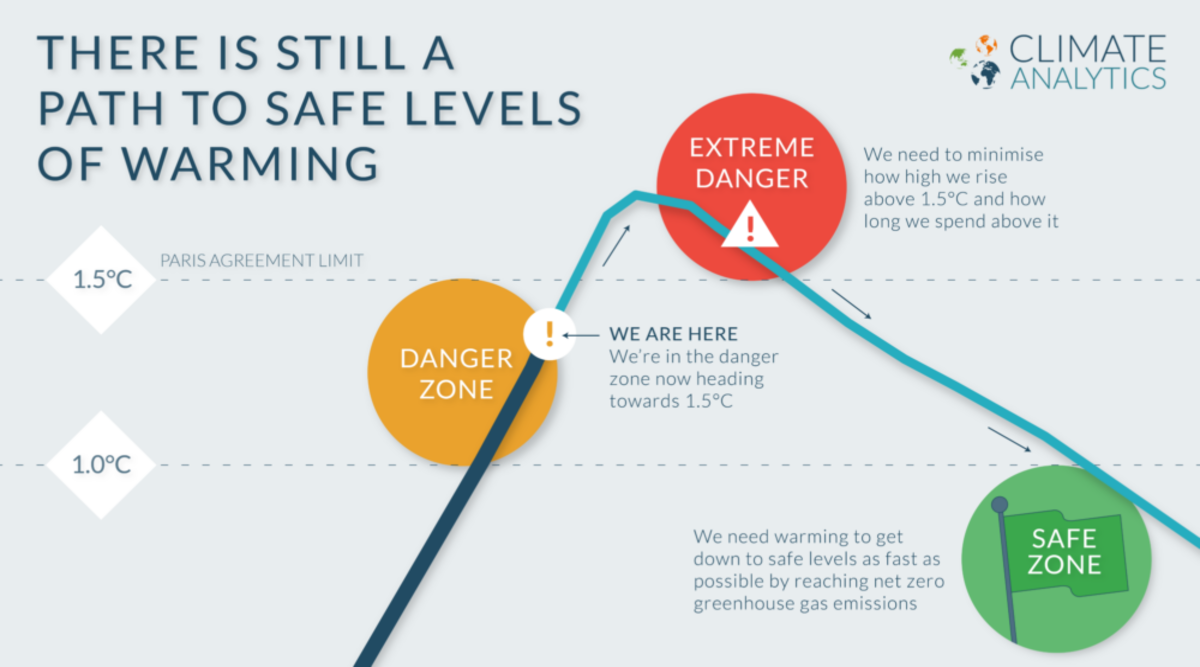
The latest report from Climate Analytics and the Potsdam Institute for Climate Impact Research published on November 6, 2025, issues a stark warning yet remains hopeful. It says the high risks and damage that will occur if the 1.5° C limit is breached “have been well established by the scientific community. Policy needs to now focus on limiting both the magnitude and duration of overshoot to bring warming back below 1.5° C before 2100.”
“Overshooting 1.5° C does not mean we need change the Paris Agreement’s goals, but rather double down on their implementation. 1.5° C was chosen for good reason. Ten years on from Paris, the science is starker than ever — 1.5° C is a planetary limit beyond which climate impacts escalate and risk triggering catastrophic tipping points.
“Legally, morally and politically, the Paris Agreement’s 1.5° C limit stands. It now acts as a North Star, guiding ambition and action for the world to avoid long term overshoot of 1.5º C and the catastrophic impacts this would entail.”
“Since IPCC was released 5 years ago, the world has failed to cut emissions, sending global temperatures racing towards the 1.5° C limit. However, in the last five years renewable energy and other zero-carbon technologies have decreased substantially in cost and are far more cost-competitive than anticipated and can be scaled up faster.”
The report lays out what is called the “Highest Possible Ambition scenario,” which it says provides an “updated evidence base on how to achieve the Paris goal, starting from where we find ourselves in 2025…. The shaky response to the Paris agreement from some key countries in its immediate aftermath has added significantly to the climate crisis we now face, and the failure of rich governments in more recent years to uphold their side of the bargain with the poorer world threatens to implode the global consensus.”
Highest Possible Ambition
The question the authors pose is, can countries learn from the mistakes of the past decade in order to keep the Paris agreement alive in the next? They can if they pursue the Highest Possible Ambition strategy, the researchers claim. Here’s the outline of that plan:
In the HPA scenario, global CO₂ emissions reach net zero before 2050, and total greenhouse gas emissions hit net zero in the 2060s — earlier and deeper than in the IPCC AR6 pathways. To achieve this outcome, power, transport and much of industry are rapidly electrified so that by 2050, nearly two thirds of all energy demand needs to be met with clean electricity. [That would include the power to run data centers, obviously.]
Fossil fuels are pushed out of the system, with a fossil-free global economy achievable by around 2070 and advanced economies getting there by 2050. Methane emissions need to fall sharply — 20 percent by 2030 and 30 percent by 2035 compared with 2020 levels, with energy sector methane more than halved this decade. Carbon removal — particularly technology based removal — will need to be scaled up to help bring temperatures back down from peak levels and reduce the duration of overshoot.
This is a tough ask, but notably, our analysis finds that even if carbon removal rolls out at only about half the speed assumed, the world could still get temperatures back below 1.5° C by the end of the century, provided we slash fossil fuel use and other emissions fast enough.
The Paris Agreement has bent the curve of future warming and has sent the signals that have begun to rewire the global economy…..Whether the Agreement ultimately succeeds now depends on whether political leaders and their governments have the courage to use the Paris Agreement to finish the job — closing the ambition gap phasing out fossil fuels rather than expanding them, scaling up finance for a just transition, and protecting people already facing mounting loss and damages
In the Highest Possible Ambition scenario, global CO₂ emissions reach net zero before 2050, and total greenhouse gas emissions hit net zero in the 2060s — earlier and deeper than in the IPCC AR6 pathways. To achieve this outcome, power, transport and much of industry are rapidly electrified so that by 2050, nearly two-thirds of all energy demand needs to be met with clean electricity.
Carbon removal — particularly technology based removal — will need to be scaled up to help bring temperatures back down from peak levels and reduce the duration of overshoot…..Even if carbon removal rolls out at only about half the speed assumed, the world could still get temperatures back below 1.5° C by the end of the century — provided we slash fossil fuel use and other emissions fast enough.
The next decade will decide the legacy of the Paris agreements, the authors wrote. “Ten years on, we can say that Paris is working. It has gotten the world about halfway towards 1.5º C, from the 3.5-3.6º C projected in 2015. But action is just not fast enough.
“The Paris Agreement has bent the curve of future warming and has sent the signals that have begun to rewire the global economy. It has anchored the 1.5°C limit in science, law and finance, and mobilized a wave of action that almost certainly would not have happened otherwise. But the Agreement is a bottom-up framework, and relies totally on the level of ambition put forward by each and every country.
“Whether the Agreement ultimately succeeds now depends on whether political leaders and their governments have the courage to use the Paris Agreement to finish the job: closing the ambition gap phasing out fossil fuels rather than expanding them, scaling up finance for a just transition, and protecting people already facing mounting loss and damage.”
For Tina Stege, climate envoy for the Marshall Islands, today’s changed geopolitics presents the biggest threat to the Paris consensus. “Climate change negotiations do not take place in a vacuum. They reflect the increasingly multi-polar world we live in,” she told The Guardian.
“Unlike some other multilateral processes, though, we continue to make progress against all odds. That this progress is incremental and not in line with needs on the ground is obviously extremely frustrating. [But] we are prepared to continue to work with all partners to secure a viable future for our people.”
For large and small countries, multilateral cooperation on the climate is the best hope, she added. “We do not have the option to go it alone.”
Dealing With Psychotic Leaders
The US at present is not only going it alone, it is hell-bent on forcing other nations to conform to its “burn, baby, burn” policies. We once thought the tobacco companies were the epitome of evil, but they look like saints compared to fossil fuel companies, who aggressively funded the current US administration and are working overtime to delay, divert, or dissuade other nations from pursuing low-carbon economies.
The industry has captured the US government, where the tired old man we elected king knows only two words — scam and hoax. These are phrases he repeats hundreds of times a week. But a curious thing is happening in many poorer countries, especially in Africa. Many countries on that continent are not wedded to the fossil fuel model that so-called developed countries have embraced with such ferociousness.
Many of them are preparing to leap over the fossil fuel stage and go straight to renewable energy as the basis of their economies. Africa has said “no” to Chinese coal-fired generating stations, but embraced its low-cost solar panels and wind turbines instead. The more countries that convert their economies to zero-emissions energy, the more the fossil fuel monsters will recede into irrelevance.
It can be said that what happened in Paris in 2015 lit the fuse that will destroy fossil fuel dominance once and for all. From that perspective, those climate agreements may be viewed by future generations as the turning point in the battle to keep the Earth habitable for humans.
Backsliding will doom us all to a future that is inhospitable to human habitation. Why the fossil fuel companies and their political lackeys want to destroy the Earth in their insatiable quest for profits is a question that has only one answer — a rampant and insatiable quest for profits at all costs. The epitaph for humanity could well be written in one word — GREED!
Sign up for CleanTechnica’s Weekly Substack for Zach and Scott’s in-depth analyses and high level summaries, sign up for our daily newsletter, and follow us on Google News!
Have a tip for CleanTechnica? Want to advertise? Want to suggest a guest for our CleanTech Talk podcast? Contact us here.
Sign up for our daily newsletter for 15 new cleantech stories a day. Or sign up for our weekly one on top stories of the week if daily is too frequent.
CleanTechnica uses affiliate links. See our policy here.
CleanTechnica’s Comment Policy