
The Global Centre for Maritime Decarbonisation’s Trial Shows Shipboard Carbon Capture Is a Dead End, But Refuses to Say So

Support CleanTechnica’s work through a Substack subscription or on Stripe.
The Global Centre for Maritime Decarbonisation’s Project CAPTURED life cycle assessment is one of the more important documents yet produced on shipboard carbon capture. Not because it proves the technology works, but because it finally grounds the discussion in measured data across an end to end value chain. For years, onboard CCS has been misleadingly presented as a simple and pragmatic bridge. Capture some CO2, store it onboard, offload it in port, and let someone else deal with it. The LCA shows what happens when that idea meets physics, logistics, energy systems, and accounting rules. The result is catastrophic and should be reflected that way, yet GCMD’s press release and executive summary present it very optimistically, and as a viable option. This framing is indicative of significant challenges at GCMD.
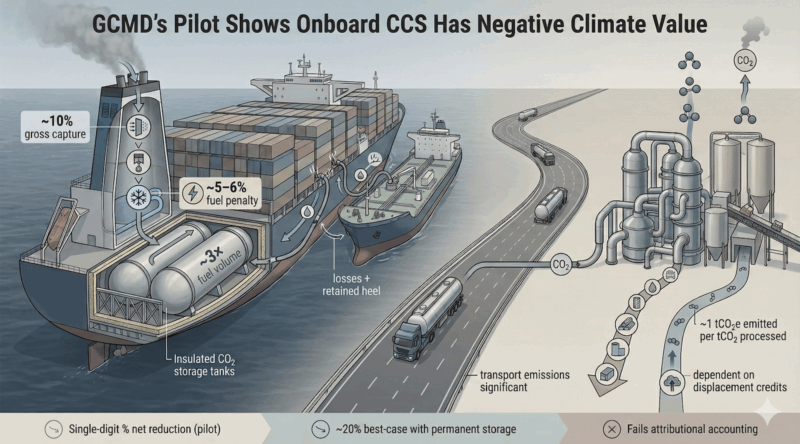
Project CAPTURED examined a real pilot. A vessel burning very low sulfur fuel oil was fitted with an onboard capture system. The system achieved a gross capture rate of a remarkably low 10.7%. The captured CO2 was liquefied, stored onboard, transferred ship to ship, transported long distances, and finally processed through mineralisation pathways producing precipitated calcium carbonate used in steel sintering. The study followed the CO2 through every step. Energy penalties, losses, venting, transport emissions, and processing emissions were all counted. The LCA was independently reviewed and verified. This was not a paper exercise.
The headline result from the actual pilot is a net lifecycle greenhouse gas reduction of an approaching homeopathic 7.9%. That number already includes downstream credits for displacing conventional materials. Without those credits, the value chain does not break even. Under attributional accounting, which is what regulators and compliance systems rely on, the utilisation pathway increases emissions rather than reducing them. Even when the study extrapolates to higher gross capture rates, the picture does not change much. At 40% gross capture, permanent storage delivers roughly a 21% lifecycle reduction. That is the best case for the storage pathway, and it assumes a set of conditions that do not exist today at scale and are very unlikely to ever exist.
These results matter because shipping needs deep reductions. Single digit or low double digit reductions are not transition pathways. They are marginal efficiency improvements. They do not align with the International Maritime Organization’s stated goals. They do not align with climate action requirements. They would require trivial operational changes with very low operational and capital costs to merit consideration. They do not justify adding complex systems, parasitic energy loads, new logistics chains, and new infrastructure requirements to vessels that already operate on thin margins.
The physics behind these results is straightforward and unforgiving. When fossil fuel is burned, the carbon in the fuel combines with oxygen from the air. The mass of the resulting CO2 is a little over three times the mass of the fuel burned. That mass must be handled onboard. Volume is an even larger problem. Liquefied CO2 occupies roughly four times the volume of the fuel that produced it. In gaseous form at ambient conditions, the volume is closer to 17 times. None of this is negotiable because physics. It defines tank size, ship layout, stability, and cargo capacity.
Capturing, compressing and liquefying CO2 is also energy intensive. The Project CAPTURED pilot showed a fuel penalty of about 5% to 6% associated with capture and conditioning. That energy comes from the same fuel the ship is burning. It reduces propulsion efficiency and increases upstream fuel demand. The LCA documents this penalty clearly. It also documents losses that arise because storage tanks are never fully emptied. About 28% of the captured CO2 remained in tanks as heel in the pilot, because physics. Liquid CO₂ cannot be pumped down like fuel because it must remain above a minimum pressure and liquid head to avoid flashing, cavitation, and loss of pressure control. As the tank empties, thermodynamic instability, pump limits, and pressure-vessel geometry force operators to stop unloading early, leaving a large residual “heel,” typically on the order of 20–30% with liquid CO2, lower with LNG. Another 2.4 tons were vented during transfers. These are not edge cases. They are operational realities of handling cryogenic liquids in a marine environment.
These constraints sharply limit the routes where onboard CCS might even be considered. Long voyages accumulate too much CO2 to store without sacrificing cargo or redesigning vessels around waste storage. Short voyages reduce the storage problem, but that immediately raises the question of why CCS is being considered at all when alternatives exist. To be clear, alternatives such as biomethanol and battery hybridification, vastly more commercialized already, also include tradeoffs, but the carbon emission reductions justify them.
As an example, a 24,000 TEU container ship crossing from Shanghai to Los Angeles will burn on the order of 2,600 tons of very low sulfur fuel oil (VLSFO), which becomes roughly 8,100 tons of CO₂ once oxygen from the air is added during combustion. If that CO₂ were captured and stored onboard, it would occupy about 7,500 to 8,000 m³ in liquid form, roughly three times the volume of the fuel consumed on the voyage, before accounting for the additional mass of pressure-rated tanks, insulation, and refrigeration systems. More importantly, it reverses the ship’s normal weight trajectory. Instead of finishing the crossing about 2,600 tons lighter as fuel is burned, the vessel would finish carrying roughly 8,100 tons of captured CO₂. The difference between these end states is a swing of about 10,700 tons, several percent of the ship’s deadweight. In practical cargo terms, storing the CO2 from a single Shanghai–Los Angeles crossing would occupy roughly 7,500 to 8,000 m³, equivalent to more than 200 TEU by volume. By mass, the roughly 8,100 tons of captured CO2 is comparable to 700 to 1,000 average loaded TEU on a transpacific route. Unlike containers, however, this is non-revenue payload that must be carried in insulated, pressure-rated tanks with safety spacing, making its effective space and stability impact larger than the raw numbers suggest.
That swing has to be managed longitudinally and transversely to avoid unacceptable trim and stability impacts. Because liquid CO₂ must be stored in insulated, pressure-rated tanks, it cannot simply be spread arbitrarily through the hull. Feasible locations are limited and compete directly with cargo space, ballast arrangements, machinery boundaries, and structural design. Concentrating large volumes near the engine room creates trimming moments, while distributing storage fore and aft requires multiple large tanks with their own foundations, piping, and safety zones. Even with careful placement, partially filled tanks introduce free surface effects that erode stability margins and impose operational constraints on tank management. All of this complexity is imposed to store a growing waste stream for the duration of the voyage, which helps explain why storage losses, retained heel volumes, and handling emissions appear as persistent features in the GCMD LCA rather than pilot anomalies, and why onboard CCS scales poorly as voyage lengths increase.
The logistics of moving captured CO2 are where the concept becomes weakest. In the pilot, CO2 was transferred ship to ship, then moved approximately 2,200km by truck to reach the utilisation facility. Transport emissions were a dominant contributor to the value chain footprint. The LCA reports around 375kg CO2e emitted per ton of CO2 offloaded just from offloading and transport. That number alone erases much of the capture benefit. The report treats pipeline transport and close co-location as optimisation scenarios, not as current reality. That distinction matters. Ports today are not equipped with CO2 pipelines, intermediate storage, or sequestration hubs. Very few are planning to build them. If this reminds anyone of the regular failure of hydrogen for transportation—long distance trucking of hydrogen causing significant and emissions costs—it’s not at all surprising. Both technologies have very similar downsides.
CO2 handling is waste management. It does not generate revenue unless someone is paid to take the waste or unless accounting frameworks assign value to avoided emissions elsewhere. Permanent storage has no intrinsic economic return. It requires subsidies or mandates. Utilisation pathways rely on displacement credits that assume perfect substitution of existing products. Those assumptions are increasingly scrutinised by regulators.
The broader carbon capture discourse confirms what the maritime lifecycle analysis implicitly shows about onboard CCS: carbon capture only delivers meaningful emissions outcomes when the chemistry, geography, and economics align in its favor, not when it is applied to dilute combustion exhaust on a moving ship. In my recent review of carbon capture’s realistic future, I present the argument that CCS only makes sense where carbon dioxide streams are from biogenic sources, are already concentrated, where the source sits near secure storage or short pipelines to storage, and where policy or market incentives give captured carbon real value. Everywhere else, capture is outcompeted by electrification, energy efficiency, or process substitution, because the energy, transport, and infrastructure costs outweigh the climate benefit. That framing underscores why capturing small fractions of exhaust on a container ship, compressing and transporting it long distances, and relying on downstream credits produces marginal lifecycle gains at best, and why the broader climate community increasingly sees carbon capture as a niche tool rather than a general solution to emissions.
The mineralisation pathway examined in Project CAPTURED illustrates this clearly. Processing the CO2 into precipitated calcium carbonate (PCC) emits close to 0.95 tons of CO2e per ton of CO2 processed once electricity, reagents, and losses are counted. About 35% of the CO2 entering the process is not fixed and is released. The pathway only becomes net positive because the produced material is assumed to displace conventional PCC and related inputs. Under consequential accounting, that displacement is credited. Under attributional accounting, which assigns emissions to the actor performing the activity, those credits are not available. In that framing, the CCU pathway increases emissions.
The report is careful and transparent about this distinction. It does not hide the accounting dependency. What it does not do is draw the strategic conclusion that follows from it. If a decarbonisation pathway only works under one accounting framework and fails under the one most likely to be applied, its viability is questionable.
To improve results, the study layers on a set of optimisations. Waste heat recovery is assumed to eliminate reboiler fuel use. Transport distances are reduced from thousands of kilometers by truck to a few hundred by pipeline. Venting losses are nearly eliminated. Tank matching is improved so that hundreds of tons of CO2 are offloaded per trip instead of tens. Mineralisation efficiency is raised from 65% to 90%. Electricity grid intensity drops from about 565g CO2e per kWh to under 200g. Each of these changes improves the numbers. Together, they produce headline reductions of 60% to 70% in hypothetical scenarios.
The problem is not that these improvements are impossible. The problem is that none of them are controlled by shipowners, most require parallel decarbonisation and infrastructure buildout elsewhere, and most of them are deeply unlikely. This is not a bolt on solution. It is a tightly coupled system that only works if ports, power grids, transport networks, and industrial processes all change in coordinated ways. That is a high bar, especially when simpler options exist.
Those simpler options are already being deployed. Inland and short sea shipping is electrifying. On the Yangtze River, 700 TEU container ships operate on routes of around 1,000km using containerised swappable batteries integrated into port operations. Fully battery electric ro ro vessels carrying up to 2,100 passengers and 700 cars are on order, and slightly smaller ones are undergoing sea trials. These ships deliver reductions on the order of 90% to 100% on a lifecycle basis depending on grid mix. They do not require waste handling infrastructure. They use ports that already handle electricity. They scale with grid decarbonisation rather than fighting it.
Against that backdrop, onboard CCS looks less like a bridge and more like a cul de sac. It offers very modest reductions at high complexity on routes where electrification is most viable. On long haul routes where electrification is harder, storage constraints dominate. This leaves a narrow and shrinking niche.
The distinction between the press release, the executive summary, and the body of the Project CAPTURED report matters because each tells a different version of the same results. Read end to end, the report shows that onboard CCS has no viable path to scale and functions as a distracting dead end, despite never saying so outright. The executive summary sits between the data and the narrative. It reports the key numbers accurately, but frames the shortcomings as matters of optimisation and future improvement rather than as structural limits. The press release goes further, leaning into best case scenarios and “potential” outcomes in a way that reads as validation. The problem is not that any of these layers are factually wrong, but that neither the press release nor the executive summary is blunt about what the evidence implies. When a real world pilot delivers single digit net reductions, depends on consequential accounting, and scales poorly with voyage length, that is not a minor implementation gap. It is a finding with strategic implications. In this case, clarity would have been more valuable than optimism.
What would a realistic, accurate and zero-spin press release / executive summary look like? Vastly different:
Using commonly applied attributional accounting rules aligned with current IMO guidelines, an independently reviewed life cycle assessment by GCMD’s Project CAPTURED finds that onboard carbon capture delivers no net greenhouse gas benefit and can increase total lifecycle emissions relative to operating without capture. Under these rules, downstream “avoided emissions” from potential CO₂ use are not credited, and the additional energy use, handling losses, and transport emissions dominate the results.
In the pilot, the system captured approximately 10.7% of onboard CO₂ emissions. After accounting for the energy penalty of capture and liquefaction, onboard storage losses, ship-to-shore transfer, and downstream transport and handling, the LCA shows no meaningful CO₂e takeout under standard accounting, and in some cases a net increase in emissions compared to the no-capture baseline.
Only when the analysis shifts to consequential accounting and assumes that captured CO₂ is reliably transported to industrial facilities that permanently bind carbon or displace high-emission materials does the system show a modest net reduction, on the order of single-digit percentages under pilot conditions. Achieving even these marginal gains requires extensive additional infrastructure that does not exist at scale today, including low-loss logistics, nearby utilisation or storage sites, and tightly coordinated handling systems.
Even in modelled improvement scenarios with higher capture rates and optimized logistics, improvements are in the low double digits and outcomes remain highly sensitive to assumptions and depend on building and operating a complex, capital-intensive shore-side value chain.
The assessment therefore indicates that onboard CCS is not a plug-and-play decarbonisation measure, delivers little to no benefit under prevailing accounting rules, and only becomes marginally positive under alternative accounting frameworks that assume substantial new infrastructure and idealised downstream outcomes.
GCMD recommends based on the extensive work done on this pilot that onboard carbon capture and sequestration schemes no longer be considered viable as a decarbonization approach. For its part, GCMD is terminating its shipboard carbon capture pilot efforts in order to devote more resources to approaches that have merit, such as electrification and biofuels.
The scope of the study didn’t include alternatives, so the basic choices don’t need to be spelled out, but at least mentioned. The complete failure of onboard carbon capture and the absurd level of infrastructure required to get to not nearly good enough is sufficient to make it not an option. GCMD should have said that, but didn’t.
A similar pattern appears in GCMD’s ammonia bunkering pilot, which suffered from the same narrowing of scope that blunted the value of the onboard CCS work. The pilot was framed so tightly around safe transfer procedures that its primary finding was that ammonia can be moved from shore to ship without spilling. That is not a meaningful discovery. Ammonia has been produced, stored, transferred, and transported globally for decades, including in large volumes by tanker, rail, and pipeline. Demonstrating that hoses, valves, and procedures can be designed to avoid leaks does not address the hard questions that determine whether ammonia is a viable marine fuel at scale. The pilot did not meaningfully engage with upstream production emissions, fuel cost, engine efficiency penalties, NOx control, crew safety over long voyages, port exposure risk, or the systemic challenges of building a global bunkering network for a toxic fuel. By constraining the experiment to what was easiest to prove, the pilot avoided the issues that matter most and ended up confirming only what was already well established. As with onboard CCS, the result was technically tidy but strategically uninformative, and it missed an opportunity to clarify whether ammonia is a serious decarbonisation pathway or another option that looks plausible only when examined in isolation. For anyone interested, ammonia isn’t remotely a viable choice as a maritime shipping fuel.
This matters because institutions do not just generate data, they set direction. When pilots demonstrate that a pathway delivers marginal reductions, scales poorly, and depends on accounting choices that are unlikely to survive regulatory scrutiny, saying so clearly is not optional, it is the point of doing the pilot. GCMD did the hard part well. The underlying work is careful, the data is solid, and the report is unusually transparent about losses, energy penalties, transport emissions, and the difference between consequential and attributional results. That makes the failure more consequential, not less. Having assembled evidence that strongly undermines onboard CCS as a decarbonisation pathway, GCMD chose not to draw the strategic conclusion its own analysis supports. By deeply downplaying the implications in the executive summary and amplifying optimistic interpretations in the press release, it shaped a narrative of potential where the evidence points to a scuppered ship. In doing so, it failed in its most important institutional role, which is not to promote activity, but to help the sector stop pursuing options that do not work and redirect capital, engineering effort, and policy attention toward those that do.
I had hoped GCMD would become a filter for the maritime sector, closing doors as well as opening them, and said so to Lynn Loo, GCMD founder and CEO a couple of years ago when we spoke. The ammonia and CCS pilots were both clearly for dead ends that couldn’t compete with electrification, efficiency, and sustainable biofuels on carbon reduction, safety or economics. Useful pilots would have been structured to test them, not justify wasting more time on them. The biofuels markers work shows more promise, grounded in real displacement rather than speculative chains. The challenge for GCMD now is institutional. Continuing to promote pathways that deliver single digit reductions risks delaying decisions that deliver order of magnitude improvements. My recommendation is that Loo and the GCMD Board reconsider their purpose and governance. The yawning chasm between the optimistic press release and the report makes it clear that they have backed into being a dead end promotion agency, not a credible tester of decarbonization pathways.
The Project CAPTURED LCA does not prove onboard CCS works. It shows why it it’s a dead end. The physics, the logistics, the energy penalties, and the accounting realities all point in the same direction. Onboard CCS is not a credible decarbonisation pathway for shipping. The data says so, very clearly. The yawning chasm between the optimistic press release and the details in the report makes it clear that GCMD has backed into being a promoter of dead ends that it is well funded to pursue, not a credible tester of decarbonization pathways.
Sign up for CleanTechnica’s Weekly Substack for Zach and Scott’s in-depth analyses and high level summaries, sign up for our daily newsletter, and follow us on Google News!
Have a tip for CleanTechnica? Want to advertise? Want to suggest a guest for our CleanTech Talk podcast? Contact us here.
Sign up for our daily newsletter for 15 new cleantech stories a day. Or sign up for our weekly one on top stories of the week if daily is too frequent.
CleanTechnica uses affiliate links. See our policy here.
CleanTechnica’s Comment Policy