

Support CleanTechnica’s work through a Substack subscription or on Stripe.
Or support our Kickstarter campaign!
It’s no surprise to see BYD rushing up the EV sales ladder in Europe, considering that the Chinese automaker is a rapid innovator, including an early adopter of new cell-to-body EV battery architecture that saves on weight and cost while improving performance. Volvo is also among the frontrunners.
Cell-To-Body Saves Money, Weight
Cell-to-body refers to the idea that the structural elements of EV battery cells can be integrated into the chassis, without the addition of pack structures.
“Instead of cells being contained in a traditional battery pack and then installed into the car, they are integrated into the car’s body. Tesla floated the idea in 2020, but more recently Chinese manufacturer BYD has been in the headlines for its pioneering use of the technology,” noted World Economic Forum Agenda Senior Writer Thea de Gallier in February 2024 (see CleanTechnica’s 2020 report on Tesla’s 2020 Battery Day event for more background on Tesla’s approach).
As noted by de Gallier, the cell-to-body approach reduces vehicle weight, frees up space, and cuts costs.
“Adhering cells directly to the body of the EV also makes for simpler assembly. Not only is the entire structure easier and more time-efficient for engineers to put together, but it also uses fewer materials,” de Gallier adds.
Here Comes The Massless EV Battery Of The Future
The steady march of cell-to-body progress also shows up in academic efforts. For example, researchers at Chalmers University in Sweden have been hot on the trail of cell-to-body construction since 2007, with a focus on deploying carbon fiber as a key material.
“By using the battery pack’s container and the battery cells themselves for rigidity, the overall weight of the vehicle can be reduced,” the Chalmers team observed in a 2021 update, using the term “massless EV battery” to emphasize the weight, size, and cost savings.
Want more details? Check out the article, “A Structural Battery and its Multifunctional Performance,” in the journal Advanced Energy & Sustainability Research.
The Carbon Fiber Massless EV Battery
The Chalmers researchers did not let the grass grow under their feet. Even as they published their 2021 results, they were already at work on a followup project funded by the Swedish National Space Agency.
“The aluminium foil will be replaced with carbon fibre as a load-bearing material in the positive electrode, providing both increased stiffness and energy density,” the team explained. “The fibreglass separator will be replaced with an ultra-thin variant, which will give a much greater effect — as well as faster charging cycles.”
The team also received funding from the Wallenberg Initiative Materials Science for Sustainability. That resulted in a follow-on paper described in the journal Advanced Materials under the title, “Unveiling the Multifunctional Carbon Fibre Structural Battery,” published in September of 2024.
The researchers replaced the aluminum foil in the cathode with carbon fiber, again coated with the LFP formula. “The carbon fibre used in the electrode material is multifunctional. In the anode it acts as a reinforcement, as well as an electrical collector and active material. In the cathode it acts as a reinforcement, current collector, and as a scaffolding for the lithium to build on,” the team explains.
Volvo Steps Up
Stay tuned for more news from Chalmers as the research progresses. In the meantime, Volvo is joining BYD in the cell-to-body movement. On January 19, Volvo issued a sneak peek of its forthcoming Volvo EX60 SUV, described as a “best-in-class 810km range and charging as fast as a stop for fuel and coffee.”
“We’re only a few weeks away from the reveal of the new, all-electric Volvo EX60 mid-size SUV,” the company enthused. “This is more than just the launch of another car — we’re delivering on the true meaning of freedom to move, with a fully electric SUV that is set to be a game changer for our customers.”
“The EX60 is designed to be a game changer,” emphasized Volvo Cars CTO Anders Bell. “With our new electric vehicle architecture, we directly address the main worries that customers have when considering a switch to a fully electric car.”
Volvo states that the EX60 charges faster than any other EV in its lineup, regardless of the weather. “Practically speaking, this means the EX60 can add up to 340km of range in just ten minutes, when using a 400kW fast charger,” Volvo explains, while taking note that charging times can vary.
“The key to the class-leading range is SPA3, our most advanced electric architecture to date, which underpins the EX60. It unlocks maximum efficiency in key systems inside the car and allows the company to achieve an electric range that matches cars powered by petrol engines,” Volvo adds.
“Integrating the battery directly into the structure of the car with cell-to-body technology and developing e-motors in-house makes the EX60 more energy efficient and cuts excessive weight,” the company elaborates. adding that the EX60 is “the first Volvo car built with the help of mega casting, whereby hundreds of smaller parts are replaced with a single, high-precision casting in the production process.”
Whither Tesla?
Auto industry observers agree that the iconic automaker was bound to run into competition after enjoying the EV field practically to itself for years. Now the chickens have come home to roost, and Tesla CEO Elon Musk is not helping matters much. Following on the heels of the Cybertruck flop, last week word dropped that Tesla will discontinue sales of its S and X models.
Nor does Musk seem to care. After all, he has other ventures with which to occupy himself, including another dive into the political pool and a head-turning merger between SpaceX and xAI.
We have not seen updates on Tesla’s cell-to-pack batteries for years. Is it something Musk and company are even thinking about any longer? There was supposed to be a regular Tesla Battery Day every year or so after that first one in 2020, but the idea was apparently dropped. Is battery innovation still a priority at Tesla, or is the company’s future simply resting on the shoulders of robots?
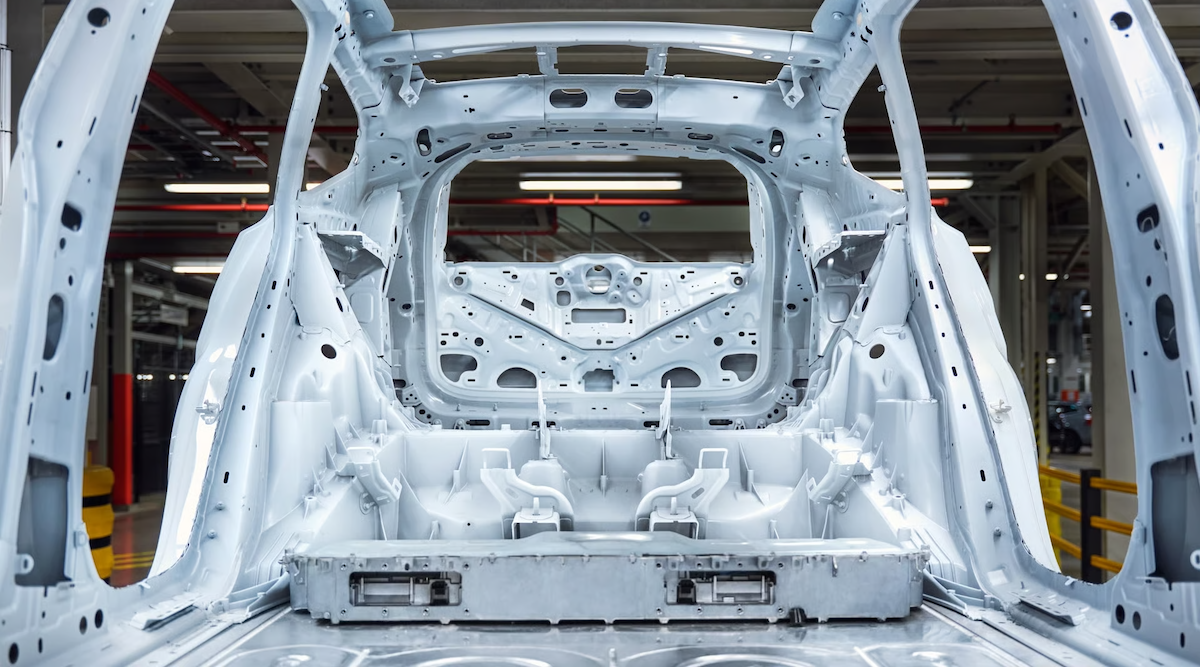
Photo: Volvo is among the EV makers adopting cell-to-body battery technology that saves weight and money while improving battery performance (cropped, courtesy of Volvo).
Support CleanTechnica via Kickstarter

Sign up for CleanTechnica’s Weekly Substack for Zach and Scott’s in-depth analyses and high level summaries, sign up for our daily newsletter, and follow us on Google News!
Have a tip for CleanTechnica? Want to advertise? Want to suggest a guest for our CleanTech Talk podcast? Contact us here.
Sign up for our daily newsletter for 15 new cleantech stories a day. Or sign up for our weekly one on top stories of the week if daily is too frequent.
CleanTechnica uses affiliate links. See our policy here.
CleanTechnica’s Comment Policy