

Support CleanTechnica’s work through a Substack subscription or on Stripe.
Or support our Kickstarter campaign!
AI is advancing fast. Digital education is expanding. Skills training, technical work, small business digitization, and creator economies are growing across the world — especially across Global South markets. But all of these futures share one very practical dependency: affordable computing devices.
Phones connect people. Computers enable them to build, design, code, analyze, create, and produce. Whether it is AI experimentation, engineering, education, data work, software learning, digital design, research, or online services delivery, full computing devices — laptops and desktops — remain essential tools. And for millions of students and first-time buyers, the biggest barrier is not awareness or willingness. It is entry cost for owning their first computer.
When device prices drop even modestly, adoption rises meaningfully. At global scale, small price differences change who gets to participate in the digital economy.
There is one quiet pricing layer inside most computer purchases that rarely gets discussed — and fixing it would be surprisingly simple.
Today, most new computers are sold with a paid operating system bundled into the purchase price by default. Buyers see one combined price for the machine. The software license component is usually not shown separately. Bundling itself is not the problem — convenience matters, and many users want a ready-to-use system out of the box. However, a gap remains that if a buyer does not want or need the bundled paid operating system license, there is usually no simple way to decline it and receive a refund.
A small consumer-choice correction would fix this cleanly: when a computer is sold with a bundled paid operating system (OS), the buyer should have the right to decline the software license at setup and receive a refund for that license component. No bans. No vendor restrictions. Just a refund option tied to license acceptance.
The scale of impact of this small fix is larger than it first appears. Independent technology pricing analysis — including breakdown discussions in major tech publications such as PCWorld — show that paid desktop operating system (OS) licenses carry substantial standalone retail prices, while OEM preinstalled licenses represent a discounted but still meaningful embedded cost in new PCs. When mapped against typical global laptop and desktop price bands, the effective software component presented to consumers commonly falls in the range of roughly 8–20% of total device price, and sometimes more on entry-level machines. That is a significant share of the upfront cost — yet it is rarely visible as a separate line item at purchase.
There is also a large, measurable user base that often does not use the bundled paid operating system at all.
Global desktop usage measurements consistently place Linux desktop share at roughly 4–5% worldwide (StatCounter/ZDNet). Industry analyst firms such as IDC and Gartner have estimated the global installed base of personal computers at roughly around two billion devices worldwide. That translates to roughly 80–100 million Linux desktop and laptop users today, with millions more added each year through new device sales and conversions. These users typically replace the preinstalled paid OS with their preferred system soon after purchase. Under current market practice, they generally have no practical way to recover the embedded software license cost they are not going to use.
Taken together, this points to a single unified benefit of refund-on-decline licensing: it lowers effective entry cost, improves component price transparency, and supports longer and more flexible device lifecycles — all at once. Lower entry cost expands access for students and first-time buyers. Transparent component value improves market efficiency and comparison. Separating hardware value from unused software value improves refurbish, redistribution, and second-life device economics. One small mechanism unlocks three aligned gains.
This also aligns naturally with right-to-repair and modularity principles already gaining ground in hardware policy. Right-to-repair gives owners control over parts and servicing. Refund-on-declined-license gives owners control over bundled paid software components. Both approaches increase user agency without outlawing bundled offerings.
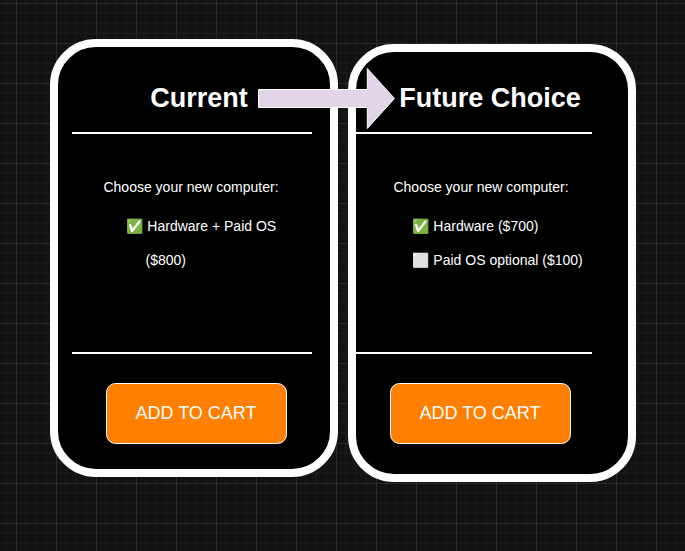
Importantly, this proposal does not remove bundled options or reduce convenience for buyers who want everything preinstalled. Computers can continue to ship with operating systems ready to use. Buyers who accept the license proceed exactly as today. The only addition is a fair exit path for those who decline. The image below shows how future shopping forms could be designed for personal computers.
This is also operationally feasible. Devices already have unique identifiers. Software activation is already tracked. License acceptance is already explicit. Refund workflows already exist across digital commerce. Compared to many regulatory interventions, this is a light-touch, technically straightforward requirement.
With roughly 270 million personal computers shipped globally each year, even modest percentage improvements in effective affordability translate into millions of additional capable users over time. Expanding who can afford to compute expands who can learn, build, and participate — which ultimately strengthens the AI, education, and digital production ecosystems we expect to power the next phase of economic growth.
An operating system is a personal choice. A fair market should let buyers choose what they run — and not charge them for software they decline to use.
Critiques, counterpoints, and support are welcome — add your perspective in the comments to help strengthen this proposal.
Support CleanTechnica via Kickstarter

Sign up for CleanTechnica’s Weekly Substack for Zach and Scott’s in-depth analyses and high level summaries, sign up for our daily newsletter, and follow us on Google News!
Have a tip for CleanTechnica? Want to advertise? Want to suggest a guest for our CleanTech Talk podcast? Contact us here.
Sign up for our daily newsletter for 15 new cleantech stories a day. Or sign up for our weekly one on top stories of the week if daily is too frequent.
CleanTechnica uses affiliate links. See our policy here.
CleanTechnica’s Comment Policy