

Support CleanTechnica’s work through a Substack subscription or on Stripe.
Or support our Kickstarter campaign!
When I was in elementary school, my classmates and I learned how New England mill owners sited their factories near mighty rivers. We know now those factories dumped their waste directly into public waters without any consideration to the pollution and damage they were causing. Sulfite and phosphorus. Sulfuric acid, muriatic acid, lime, and arsenic. Benzine and other solvents. Per- and polyfluoroalkyl substances. Mercury. Due to toxic chemicals, untreated waste, plastic debris, and sewer overflows, corporate pollution has contributed significantly to the death of marine life. And now Jeff Bezos’ Blue Origin wants to get permission from the state of Florida to dump its wastewater into one of the most pristine estuaries in the world.
Really? Have we learned nothing about biodiversity — the result of 4.5 billion years of evolution, increasingly influenced by humans?
Biodiversity is the foundation for food, water, medicine, a stable climate, and economic growth; indeed, over half of global GDP is dependent on nature. In the world’s oceans, rising temperatures increase the risk of irreversible loss of marine and coastal ecosystems. We need to solve the causes of biodiversity loss worldwide, including pollution, says the UN Secretary-General, instead of profiting from nature and treating it like a free, infinite resource.
Is anyone in FL state government listening?
I attended a lecture at the Florida Atlantic University this week where I learned that Blue Origin has sought permission from the Florida Department of Environmental Protection (DEP) for the continued operation of its industrial wastewater treatment facility. That facility is located at the OLS Manufacturing Complex on Merritt Island.
Such wastewater dumping affects the delicate balance of the Indian River Lagoon (IRL).
The IRL is a 156-mile long estuary designated as an “Estuary of National Significance,” one of 28 in the nation. The salinity, tidal influence, and degree of flushing characteristic of a particular portion of the lagoon depend in large part on its proximity to an inlet and to freshwater inputs from streams, rivers, ditches, and canals. The IRL watershed is home to more than 2,100 different species of plants and more than 2,200 animal species, including some 700 fish species and 310 bird species. Approximately 50 threatened or endangered species can be found in the IRL region, including 12 plants and 36 animals.
Work to protect the IRL is spearheaded by the Indian River Lagoon National Estuary Program (IRLNEP), which defend this ecologically significant estuary from threatens by degradation caused by human activity.
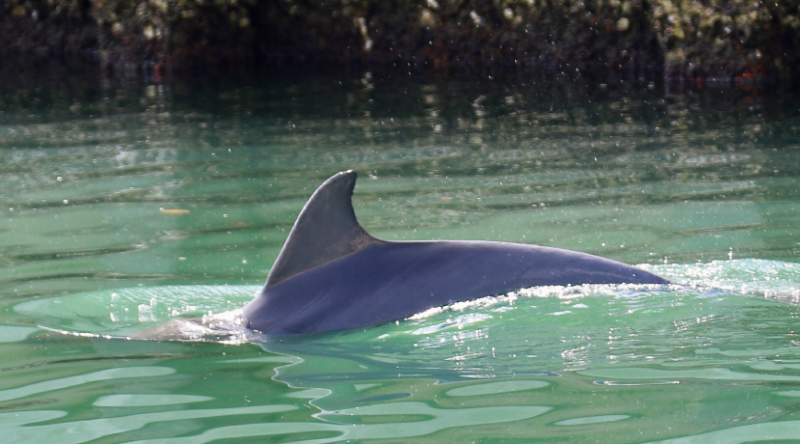
After the Harbor Branch lecture on Wednesday, I walked outside the education center to the canal, which opens to the IRL. Within minutes, I saw a pod of dolphins, gliding up and dipping back down into the waters. The previous week’s uncharacteristic cold brought a cluster of endangered manatees to the same spot — they poked their snouts up and peeked at me, then dove back down.

Blue Origin & Wastewater Disposal
Blue Origin, an aerospace company started by Amazon-founder Bezos, was created in 2000. Blue Origin has two launch sites: a ranch site in Blue Horn, TX, and at Cape Canaveral Space Force Station in FL. The FL location is where the company launches its large reusable rocket. Recently, Bezos’s Blue Origin has intensified its lunar push — it shut down its suborbital space tourism program to reallocate resources to its Blue Moon lander initiative, which is slated to launch an uncrewed mission to the lunar surface this year.
In its attempt to reach beyond the heavens, Blue Origin is threatening one of the most biodiverse estuaries on the planet — a fully avoidable contamination.
“If it is Blue Origin’s mission to ‘build a road to space for the benefit of earth,’” Jon Paul Brooker asked recently in Florida Today, “one has to wonder why they are applying for permits to dump 500,000 gallons of untreated industrial wastewater into Florida’s marine environment every single day.” Brooker is Ocean Conservancy’s director of Florida conservation.
A petition on Change.org argues that the IRL is already suffering from the near-daily impacts of rocket launches, including:
🚀 shockwaves and acoustic pressure affecting marine life;
🚀 fallout/particulate entering waterways;
🚀 heavy metals and chemical residues accumulating in sediment; and,
🚀 seagrass and fish nurseries disruptions from vibrations and turbidity.
What does the proposed permit entail? The permit authorizes a maximum allowable flow of 490,000 gallons per day, which represents the highest allowable flow “rather than a typical daily flow.” “The proposed action involves the renewal of an existing permit and does not change the conditions under which the facility has operated since 2020,” says FL DEP.
What is the source of the industrial wastewater? The industrial wastewater covered by the Blue Origin permit renewal is generated from “routine facility operations” using drinking water supplied by the city of Cocoa.
How does Blue Origin industrial wastewater interact with the Indian River Lagoon? The permit insists that the water does not come into contact with rocket fuel or other hazardous substances and is not discharged directly to the Indian River Lagoon. Instead, after completing its industrial use, it is managed through an on-site stormwater retention pond. But, “under certain conditions (that water) may discharge to an existing drainage system that ultimately connects to the Indian River Lagoon.” (emphasis added).
What’s the official permit language? Blue Origin is asking for a permit to: “discharge 0.467 MGD of process wastewater and discharge 0.015 MGD (millions of gallons per day) of non-process wastewater to a large onsite stormwater pond (402,981 square feet surface area).” The permit renewal request is currently under review before the department takes final action on the permit application.
Why is it likely that FL DEP will approve Blue Origin’s wastewater dump? You have to remember that FL is a state that prohibits reference to “climate change.” Bill HB-1217, which is now in the Commerce Committee, explains the state’s rationale to deny climate science. The “Prohibited Governmental Policies Regulating Greenhouse Gas Emissions” reads as follows.
“Prohibits governmental entities from adopting certain net zero policies; prohibits governmental entities from using government funds in any manner that supports, implements, or advances certain net zero policies; prohibits governmental entities from imposing tax, fee, penalty, charge, offset, or assessment to advance certain net zero policies; requires each governmental entity to annually submit to Department of Revenue certain affidavit; prohibits governmental entities from implementing, administering, or enforcing certain programs.”
Final Thoughts & Possible Solutions
The Indian River Lagoon has experienced decades of nutrient pollution, algae blooms, seagrass collapse, habitat loss, and record manatee deaths. The fragile estuary is at a turning point — it can be restored to an unaltered state, or it can continue to be decimated by pollution like Blue Origin’s 500,000 gallons of industrial wastewater per day.
State Ocean Conservancy’s director, Brooker suggests that there are alternatives to Blue Origins’ plans to dump wastewater that can impact the IRL.
- The company could work with state leaders to pave the way for advanced wastewater treatment technology in the Northern Indian River Lagoon system.
- It could not only treat its own discharge but also the discharges of local governments that should be shifted away from septic and onto public sewer systems with advanced wastewater treatment anyway.
- Blue Origin could transform the water quality of the Indian River Lagoon and accelerate the lagoon’s ecological recovery for the benefit of residents and businesses alike.
Blue Origin’s future could be reimagined if it were to revisit its original mandate, says Brooker.
“It is my hope that the company sees and understands that this is not just about Florida’s waters. Our ocean spans the globe. In fact, Blue Origin was named for our blue planet — blue because of the ocean that encircles us. I urge them to remember that, and urge investors, local residents and Florida tourists alike to hold them accountable to their lofty mission. As the brilliance of our space industry endeavors to explore the skies, they should also remember to protect our blue home.”
Resources
“2026 John & Barbara Ferrera Ocean Science Lecture Series.” Florida Atlantic University | Harbor Branch Oceanographic Institute.
“Biodiversity – our strongest natural defense against climate change.” United Nations | Climate Action.
“Blue Origin.” blueorigin.com. Retrieved February 13, 2026.
“Blue Origin permit renewal public meeting.” Florida Department of Environmental Protection. January 30, 2026.
“Blue Origin plan puts Indian River Lagoon at serious risk.” Jon Paul Brooke. Florida Today. February. 6, 2026.
“HB 1217 – Prohibited governmental policies regulating greenhouse gas emissions.” Florida House of Representatives. February 4, 2026.
“Indian River Lagoon — Facts and figures.” Florida Atlantic University.
“Stop Blue Origin from dumping wastewater into Indian River Lagoon.” Petition. Change.org.
Support CleanTechnica via Kickstarter

Sign up for CleanTechnica’s Weekly Substack for Zach and Scott’s in-depth analyses and high level summaries, sign up for our daily newsletter, and follow us on Google News!
Have a tip for CleanTechnica? Want to advertise? Want to suggest a guest for our CleanTech Talk podcast? Contact us here.
Sign up for our daily newsletter for 15 new cleantech stories a day. Or sign up for our weekly one on top stories of the week if daily is too frequent.
CleanTechnica uses affiliate links. See our policy here.
CleanTechnica’s Comment Policy