
FLS Knelson and gravity gold recovery in an era of high yellow metal prices

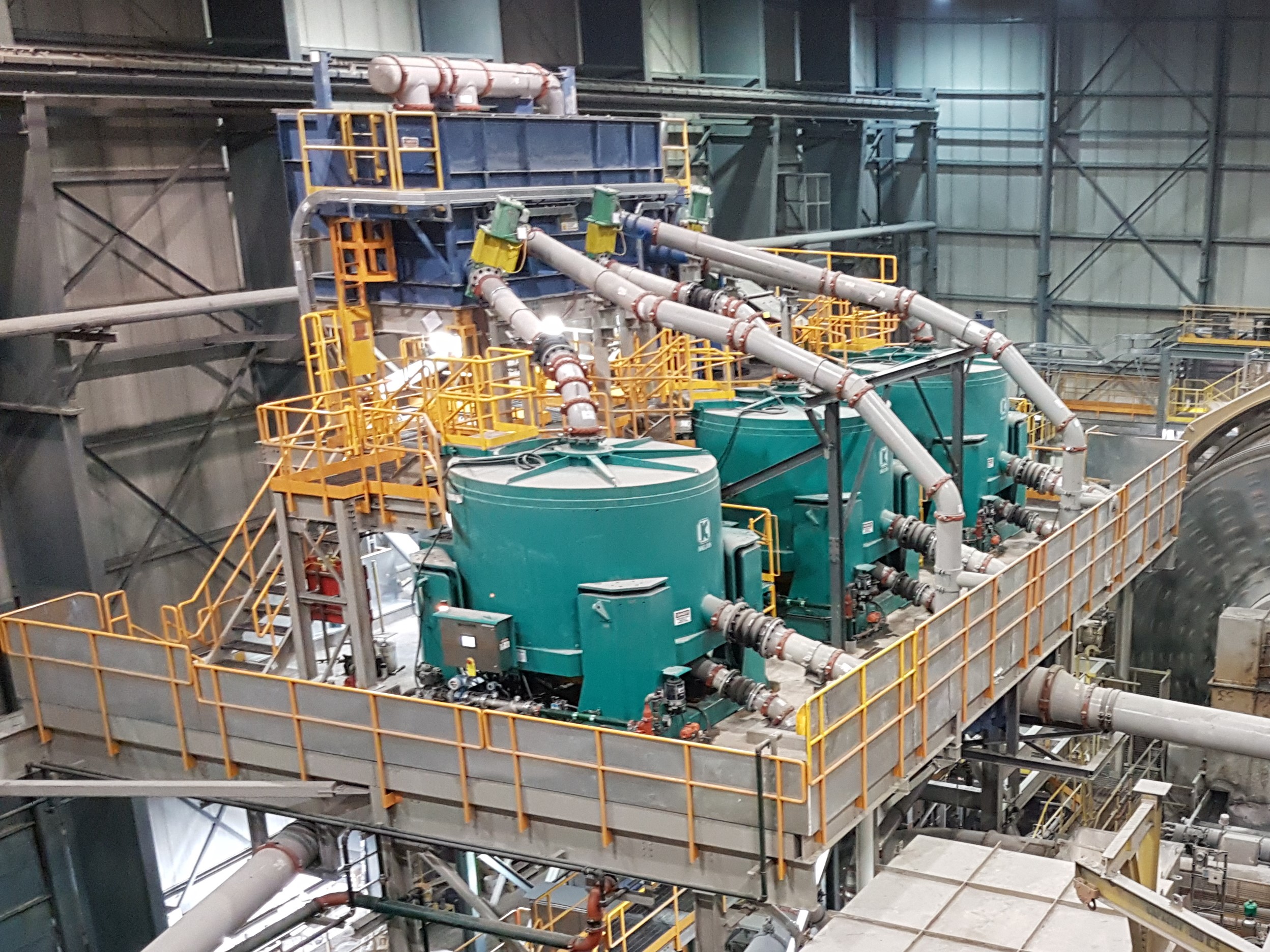
With gold trading near historic highs, recovery efficiency has become more valuable than ever. Chris Arnold, FLS Product Manager for Knelson Concentrators told IM that gravity circuits – particularly those using centrifugal concentrators such as Knelson Concentrators—play a critical role in capturing gravity-recoverable gold (GRG).
Traditionally, many plants treat only a portion of the mill circulating load through gravity, often 20-30% of cyclone underflow. Arnold: “This approach was primarily intended to boost recovery by capturing coarse gold that might otherwise be lost to over-grinding in the primary circuit. By treating a portion of the circuit, most of the coarse gold can be recovered before it becomes overground and more difficult to recover downstream.”
However, he adds that gravity recovery in a grinding circuit exhibits diminishing returns. “Treating ~1/3rd of the circulating load may yield most of the GRG. Increasing treatment by another ~1/3rd may yield only incremental recovery improvement and significantly less GRG than the first 1/3rd, while expanding treatment to the entire mill discharge may yield only a marginal further increase, requiring proportionally more equipment for relatively marginal gains. Much, but not all – given the efficiencies of downstream equipment – of this additional gold would likely be recovered downstream in any case.”
That said, he says there are distinct advantages to even small incremental recoveries – particularly in flotation plants. Gold recovered by gravity can be poured directly into doré bars, which are typically sold at higher returns (5-15%) than flotation concentrate products. Gravity circuits can produce doré at lower operating costs. At current gold prices, even small recovery improvements, less than half a per cent overall recovery, and the added comparative value of the gold in gravity concentrate can translate to payback periods measured in months or even weeks when shifting from partial treatment to full mill discharge.
For example, a 4 Mt/y plant operating at 2 g/t, a 1% improvement in overall recovery equates to roughly 2,500 additional ounces annually worth well over US$10 million at current prices. “The same can be said of base metal plants with only marginal gold content. Modest gravity circuits, primarily in pre-concentration areas such as flotation regrind circuits, can deliver highly cost-effective methods for concentrating even small amounts of gravity gold.”
Knelson‘s new GX technology Arnold says enhances the benefits of high metal prices. By building on more than 40 years of experience in fully fluidised cone technology, the new GX cone features balanced fluidisation water flow technology. It increases the per-pass efficiency of the gravity circuit, particularly for fine gold particles.
Further downstream, intensive leaching systems such as the Acacia Reactor can add another layer of value. “Operations have documented 2-3% increases in leach recovery from gravity concentrates compared with conventional leaching alone. Across a full carbon-in-leach circuit, uplift materially enhances total plant recovery.”
Featuring an up-flow fluidised reactor specifically designed for the leaching of Knelson concentrates, the Consep Acacia system FLS says creates an ideal solid-liquid interaction, maximising gold leaching reaction kinetics without the need for mechanical agitation or drum rotation, and typically achieving recoveries of more than 95%, often over 98%.
The post FLS Knelson and gravity gold recovery in an era of high yellow metal prices appeared first on International Mining.