


Support CleanTechnica’s work through a Substack subscription or on Stripe.
In a report dated February 17, 2026, Ember — a global energy think tank that aims to accelerate the clean energy transition with data and policy — claims the way we think about energy is topsy turvey, upside down, and just plain wrong. That’s important at a time when “energy dominance” is the latest catch phrase of the US government.
To some, having the most oil, or coal, or methane means “winning.” But if a significant amount of that energy is simply turned into waste heat and pollution, then little is accomplished and a lot of that blather about energy dominance is just spitting into the wind.
Bill McKibben has written that “Occam’s Razor…would lead us to say that many things the Trump administration does are simply designed to waste energy, because that is good for the incumbent producers, i.e. Big Oil. That’s not a particularly sophisticated rule for understanding their actions, but remember: Trump was bankrolled by the fossil fuel industry, and that industry has always wanted us to waste energy.”
A recent global poll of business executives found that 97% were eager to make the switch to renewable energy for their companies, on the grounds that, “Electricity is the most efficient form of energy, and renewables-generated electricity a value-add to businesses and economies. In many countries, fossil fuels, with their exposure to imports and volatility to geopolitical shocks, are a liability. For business, this isn’t just inconvenient. It’s dangerous. Volatility drives up costs, turns strategic planning into guesswork and delays investment.”
“That’s how sensible people with sensible goals think,” McKibben wrote. “But it’s exactly the opposite of how our government now imagines its role.” To drive home his point, he highlights a filing in the Federal Register recently that announces the goal of the Department of Energy is “bolstering American energy dominance by increasing exports and subsequently the reliance of foreign nations on American energy.” Translated, that tells foreign governments they can either rely on the sun and wind or on the US, whose policies are erratic and unreliable. “China, meanwhile, is essentially exporting energy security in the form of clean energy tech,” McKibben said.
Wasting Energy As A Business — & Political — Strategy
Finding, extracting, refining, distributing, and consuming oil and methane waste about 60% of the energy they contained at the well head. Then they get burned in devices that waste almost two-thirds of what energy is left. By the time humans are done maximizing their fossil fuel dream, only 10 to 15% of the energy contained in those fuels initially does any useful work. The rest is wasted in ways that have enormous negative consequences for the Earth. Does that make any sense?
Of course not — unless you are in the oil or gas business. Then wasting energy is precisely the point, because doing so leads to enormous profits that can be used to buy political influence. Great for the companies; not so great for you and me.
Let’s take a few examples. A heat pump produces two to three times as much heating or cooling as a similar device like a methane-fired boiler or a conventional air conditioner. So does it make sense to put a priority on obsolete technology in order to pursue the goal of “energy dominance?” Of course not. Whoever is saying that is spinning a web of lies and deceit. Shouldn’t we then dig a little deeper to figure out why they are doing that?
Automobiles are another example of profligate waste. The best conventional cars and trucks are no more than 30% efficient. In other words, they waste more than two-thirds of the energy in the gasoline or diesel fuel they burn. Only a fool would persist in such a profligate waste of precious resources, and yet doing so is an important pillar of the global economic system.
Peering Through The Wrong End Of The Telescope
The Ember report begins by saying:
Most analysts count energy from the perspective of the supplier, and that approach means we cannot appreciate the dramatic changes sweeping the energy system. We set out a different way to think about the energy system from the perspective of the consumer, and in simple terms.
Standard energy models track supply rather than demand. They begin with the annual ‘primary’ energy supply and work backwards to calculate the ‘final’ energy sold to energy consumers. Fossil fuels are 80 percent of primary energy supply, and the easy narrative is that fossil fuels are dominant in the energy system and will remain so in the future as we consume more and more energy.
However, there are a number of flaws in the orthodox approach. The focus on energy supply is peculiar if we are trying to understand the future of the energy system. We do not seek to understand bread demand by measuring wheat supply, nor do we count phone adoption by chip production.
The orthodox approach makes no allowance for quality, assigning equal value to one exajoule of primary coal and one exajoule of solar electricity, despite the fact that the solar produces three times as much final electricity as the coal.
Electricity is a high quality energy carrier capable of delivering precise work, whereas fossil fuels primarily deliver heat before they can perform useful tasks. For decades this efficiency gap was not very important because most of the growth in energy came from inefficient sources. But the collapse in the cost and the rapid growth of electro-tech over the last decade has altered the situation materially. In 2025 for example, solar and wind supplied almost all the growth in electricity generation, and in 2024 electricity was half the growth in final energy demand.
Finally, the orthodox approach only looks at the total supply rather than the change in supply, at stocks not flows. Again this is very unusual because stocks look backwards to the past and flows look forward to the future. In most other areas of analysis…..Successful analysts focus on flows in order to understand how the system is changing. We add in useful energy and start the analysis from the consumer perspective.
Ember claims that in 2023, roughly 380 exajoules — nearly two-thirds of all primary energy inputs — were not converted into useful energy and were therefore wasted. “A coal fired power station converts less than 30 percent of its fuel into final electricity, wasting the rest as heat. These losses stem from fundamental physics. Combustion releases heat in all directions — capturing it for useful work requires additional conversion steps, each governed by thermodynamic limits.”
“Electro-tech sidesteps this problem. An electric motor converts electricity to motion at over 90 percent efficiency. A heat pump supplies thermal energy at 300 to 400 percent efficiency relative to electrical energy input. Therefore, meeting future energy demand requires far less new supply than conventional metrics suggest, provided that supply comes from efficient electric technologies. What appears to be a daunting energy challenge becomes considerably more manageable once the efficiency advantage of renewables and electricity comes into focus. [Emphasis added.]
Turn The Telescope Around

The Ember analysis reverses the analytical direction of thinking about energy. Instead of starting with fuels and tracking them downstream, it begins with useful demand and works upstream. “This shifts the fundamental question from ‘how much fuel must we supply?’ to ‘how much useful energy do we need?’ Anchoring the system on outcomes exposes how much of today’s upstream energy exists merely to compensate for conversion losses.”
Today, humans consume about 75 gigajoules of primary energy per person, but only 26 gigajoules of that is for useful energy — most of the rest is lost in conversion. “Organizations such as Shell argue that 100 gigajoules per person of energy is required for high levels of human development, but these projections assume continuity of the inefficiencies of combustion-based systems,” Ember says.
“With electro-tech, 26 gigajoules per person of primary energy can supply the same amount of useful energy, largely because the gains from heat pumps offset losses elsewhere. The discrepancy reveals the extent to which current metrics conflate genuine human needs with the structural waste of fossil systems. The pathway to universal prosperity requires far less primary energy than conventional projections suggest.”
Ember says the energy we use fundamentally involves only two functions — doing work or supplying heat. “Final energy can be understood as two distinct types — electrons and molecules. Electrons deliver work with minimal loss. Molecules must surrender most of their energy to entropy before performing the same task. This is not a matter of technology maturity or cost; the advantage is rooted in thermodynamics. Systems built around electrons will always outperform systems built around molecules when delivering work, and increasingly outperform them for heat as well.”
“Most energy analysis focuses on total energy demand for oil or gas, which is a stock, rather than the change in demand, which is a flow. But financial markets are driven by flows not stocks, and in most markets analysts will focus on flows to see where the system is headed. For example, we seek to understand the car market not by examining the number of cars on the road (a stock) but the number of cars that are being sold (a flow).” Michael Barnard’s latest article supports this message.
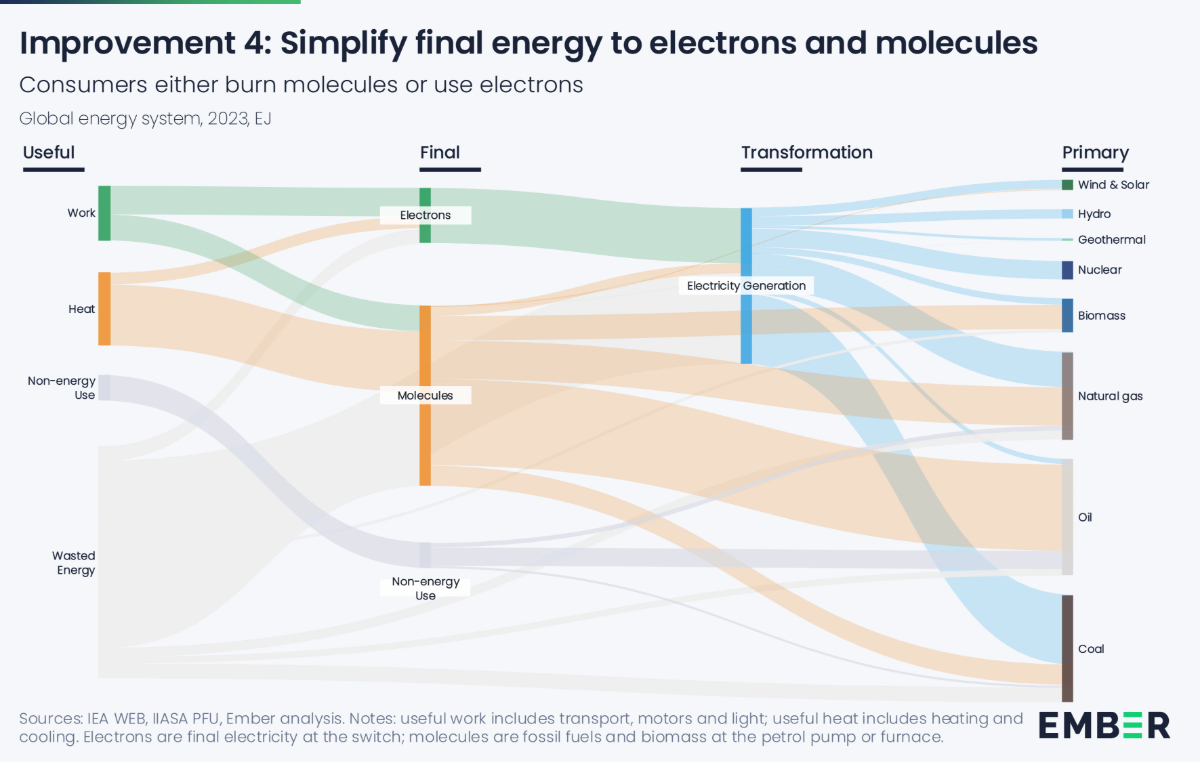
Efficiency is not the only determinant of success, Ember says, but it is an important way to distinguish between the competing energy solutions. On average today, electricity converts final electrons to useful work at 68% efficiency. Molecules are only 29% efficient. What is most notable is the loss of over two-thirds of energy whenever heat crosses the divide to work.
In the conclusion to its report, Ember says, “The orthodox approach to energy accounting constrains how we understand the energy transition. It obscures both the scale of current waste, and the efficiency gains available. The framework outlined here provides a clearer language for energy systems. With that new language, we can express new insights about the energy transition’s speed, scale, and implications.”
As the world is exploding because of a disastrous war that at least partly attributable to archaic notions about energy, now would be an excellent time to apply some of those insights to illustrate the utter folly of wars for oil.
Sign up for CleanTechnica’s Weekly Substack for Zach and Scott’s in-depth analyses and high level summaries, sign up for our daily newsletter, and follow us on Google News!
Have a tip for CleanTechnica? Want to advertise? Want to suggest a guest for our CleanTech Talk podcast? Contact us here.
Sign up for our daily newsletter for 15 new cleantech stories a day. Or sign up for our weekly one on top stories of the week if daily is too frequent.
CleanTechnica uses affiliate links. See our policy here.
CleanTechnica’s Comment Policy