


Support CleanTechnica’s work through a Substack subscription or on Stripe.
My attention was drawn to a Facebook post announcing that an EV support group was launching a register of strata title (condo) buildings that offered charging for tenants with an electric vehicle. I contacted Peter Campbell and we had a great conversation via email and phone. Mind you, I may have opened a can of worms which will mature into several articles.
First, some background: “Peter Campbell has had many years on the executive committee of a strata development, sometimes as chair or treasurer, and is a long-standing member of the ACT (Australian Capital Territory) branch of AEVA (Australian Electric Vehicle Association). He has been driving electric since 2009, first with a home conversion and most recently a 2023 Hyundai Ioniq 5.”
Australia’s Capital Territory (which contains the nation’s capital, Canberra) has an impressive uptake of plug-in vehicles — leading the nation in Electrical Vehicle penetration per capita. As of the end of February 2026, the ACT has 14,340 registered EVs (almost 4.2% of the vehicle stock). On a monthly basis, over 22% of new cars sold have a plug. This compares well with the national average of about 16%. “The Australian Capital Territory leads in market share, while New South Wales, Victoria, and Queensland dominate in total volume, with Western Australia showing high growth rates.”
This high uptake of plug-in cars in the ACT (most of which are BEVs) is disruptive not just to the car dealers, but also to the real estate market. “Does the apartment come with charging?” This is a frequently asked question from people looking to rent or buy. The ACT branch of the Australian Electric Vehicle Association is attempting to provide the answer:
“AEVA ACT has launched a register of ‘EV Friendly’ strata sites in the Canberra region. It demonstrates the diversity of solutions chosen by different Owners Corporations and may help potential buyers and tenants to find units that provide charging at home. We invite any advice about further sites that could be added to the register.” Owners Corporations are sometimes referred to as Body Corporates.
Who is AEVA, you may well ask. “The Australian Electric Vehicle Association (AEVA) LTD is a volunteer-run, not-for-profit organisation dedicated to the cause of switching Australia’s transport networks to electric drive as quickly as possible. Formed after the oil price shocks of 1973, the AEVA is the longest continuously running EV society in the world. We represent all EV users and enthusiasts, current and prospective.” All Australian states and territories have a branch.
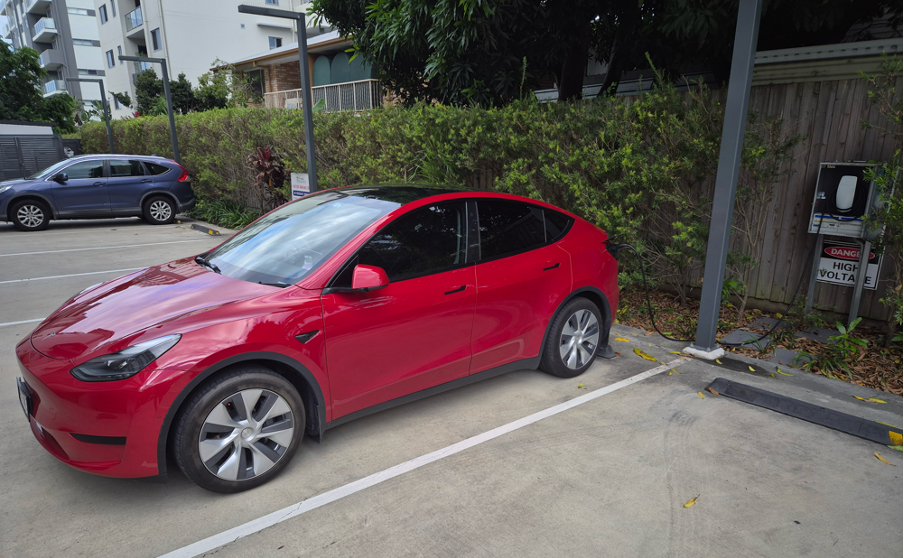
In a recent press release, Dr Peter Campbell announced: “We have created a publicly available register of EV-friendly strata sites that are attracting tenants and new owners by enabling EV charging on-site. We have heard through our members of apartment buildings that obstruct the installation of EV charging facilities, making these buildings unsuitable for EV users. The register highlights, instead, those strata complexes that choose to offer these facilities.”
The register is quite detailed and comes with this disclaimer: “The following information has been compiled from information provided by AEVA members, owners corporations or their strata managers, and public sources such as PlugShare. It could be inaccurate or out of date. Details such as billing arrangements and responsibilities for repair and maintenance have not been included. Please contact the owner’s corporation directly to confirm.”
The diversity of choices across the 22 strata complex sites listed in the register include: individual charging outlets wired to the meters of individual units; individual outlets connected to a common property supply with sub-metering or a small number of dedicated, shared charging points, often managed by a third-party operator who bills the user and reimburses the body corporate for the electricity used. “Individual charging outlets are the most convenient option for residents, but, depending on the size and physical constraints of a building, a few shared charging points might be a reasonable and inexpensive interim solution, or perhaps all the building ever needs,” said Dr Campbell.
Peter’s own experience echoes this, as he shared with me from his recent presentation to AEVA. He has carried the roles of chairman and treasurer at various times over the past ten years or so at a set of 105 townhouses with diverse parking arrangements in Canberra. He assisted in the development of the site’s EV charging plan in 2018 for a gradual rollout. Now, 15 units have EVs. Some charge from their own meters; some charge from common property supplies. More units are “EV Ready.”
Julie Campbell, Chair of the “Evoque” Owners Corporation, contributes more: “We installed two EV charging stations two years ago so that our residents could conveniently charge at home at reasonable rates. Updating our building facilities gives our residents more confidence to switch to an EV and makes our building more attractive to future buyers and tenants. By listing on the AEVA register, we hope it will help people to find somewhere to buy or rent with modern, climate-friendly facilities.”
Robin Eckermann, Chair of the Owners Corporation Network (ACT) Environmental Sustainability Working Group, adds: “We welcome the publication of a list of buildings supporting some form of EV charging. Strata owners deserve the same convenience of in-house charging that detached home-owners enjoy – and complexes that do not facilitate this will fall behind in their appeal to purchasers and renters.”
The message coming through is that availability of EV charging may lead to value adding. In Australia’s tight real estate market, future proofing your strata block may make the difference for a sale.
Peter told me of one apartment block which already had the core infrastructure installed for EV charging. Individual owners would then have to connect their own charger, but had to seek permission first from the Body Corporate. This permission was withheld, and, even on appeal, the occupant could not install a charger. The follow-on effects have been almost ludicrous, with elderly residents now banned from charging their mobility devices in the garage, nor can the Lycra-clad electric bike riders charge their bikes. Oh well, at least the Body Corporate is being consistent — no charging in the underground garage. Those with curiosity and a legal mind can read their appeal here.
Peter comments that this is a perverse outcome: “They apparently still allow the charging of Personal Mobility Devices within units in the building without any special provisions, even though the Insurance Council of Australia (ICA) regards that as ‘high risk’, but do not allow the charging of Road Registered Vehicles, which the ICA regards as ‘very low risk’.”
AEVA ACT is to be applauded for this service. Hopefully it will be emulated by AEVA’s branches in other states of Australia. Peter tells me: “I have no problem with you expressing this hope! I think it would be a good idea if other branches want to do the work.” It would certainly help those who are fighting this battle here in Queensland.
Sign up for CleanTechnica’s Weekly Substack for Zach and Scott’s in-depth analyses and high level summaries, sign up for our daily newsletter, and follow us on Google News!
Have a tip for CleanTechnica? Want to advertise? Want to suggest a guest for our CleanTech Talk podcast? Contact us here.
Sign up for our daily newsletter for 15 new cleantech stories a day. Or sign up for our weekly one on top stories of the week if daily is too frequent.
CleanTechnica uses affiliate links. See our policy here.
CleanTechnica’s Comment Policy