


Support CleanTechnica’s work through a Substack subscription or on Stripe.
Earlier today, BYD launched its second-generation Blade Battery and Flash Charging system. While the specifications that we have seen so far for the battery and charging pile are impressive on their own, the integrated approach pushes electrification forward. The “chicken or egg” dilemma is avoided with more capable chargers combined with more capable vehicles using them. Attention was clearly paid to implementation and usability. BYD highlights that the project leverages its 120,000+ engineers across a wide range of specialties, from solar and storage to electronics and semiconductors to batteries and powertrains … all collaborating to create a system-level solution.
Overall, the second-generation Flash Chargers (BYD terminology for chargers capable of over 1 MW) use T-shaped charging piles with two suspended charging guns, each capable of supplying 1500 kW of power. Across a range of vehicles, the charger can take the battery from 10–70% in 5 minutes and 10–97% in 9 minutes under normal temperatures. BYD says that the last 3% is left out for regenerative braking, but LFP batteries also tend to slowly cell balance in the last few percent of charge, so that could also be a factor. Under the extreme cold of -30°C (-22°F) for 24 hours, no preconditioning, charging up to 97% takes less than 12 minutes. Cold weather performance has historically been a weak point for LFP batteries, so that is a significant step forward.
BYD claims that the average ICE vehicle in China has a range of only 500–600 km on a full tank of gas. BYD has expanded the driving range of its latest BEVs significantly, sometimes to twice that amount. However, BYD also acknowledges that the added weight, cost, and resource consumption associated with the larger batteries needed to supply that range add up. The spread of faster charging can potentially reduce the anxiety that fuels consumer demand for those larger batteries.
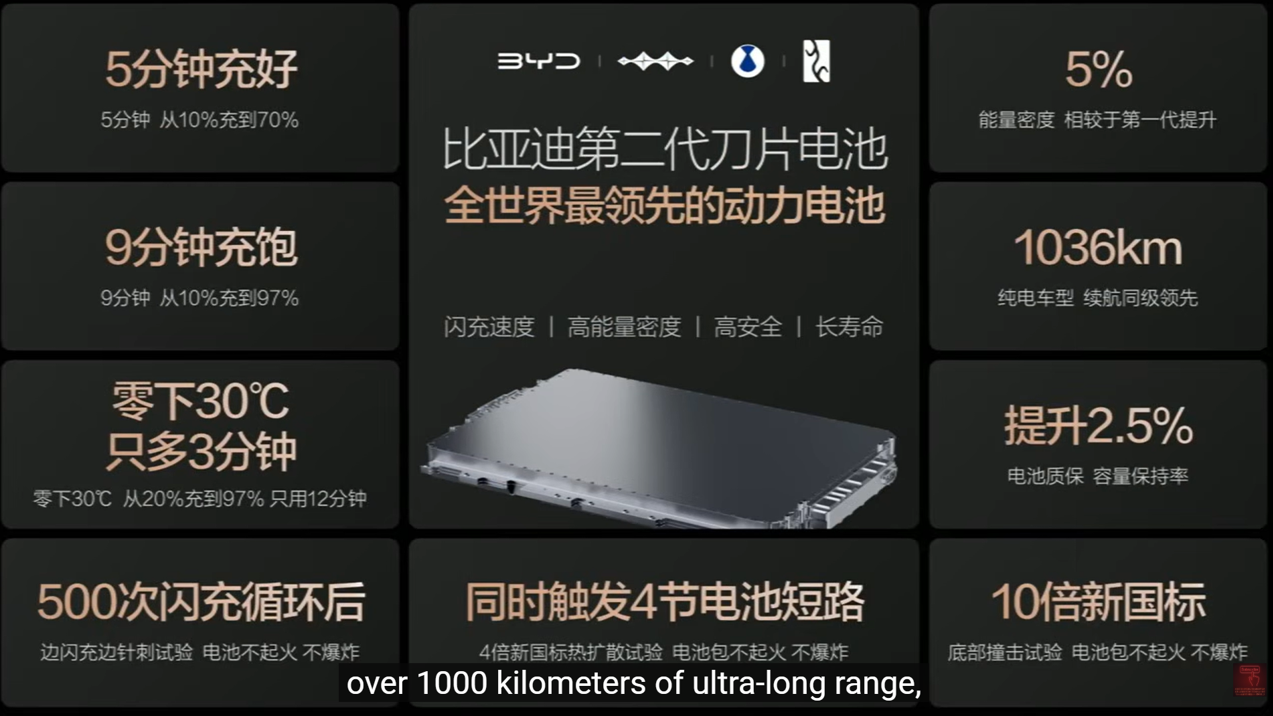
While the ability to charge faster tends to add weight, BYD’s new batteries are 5% more energy dense than before. That energy density is not amazing compared to some solid-state battery claims, including those made by BYD itself. However, the new Blade battery charges faster than the claims of many solid-state batteries. If the faster charging convinces people to get a smaller battery, then that could help close the weight gap. In addition, BYD claims that battery life is not significantly impacted by flash charging, and they improved their warranty terms for 2.5% less capacity loss.
China currently has multiple times more public fast charging stations than it does gas stations. While EVs now make up the majority of new car sales, they are currently a fraction of the vehicles on the road. Still, people have run into backed up charging queues, especially during holidays and in cold regions. That leads to anxiety. Faster charging can lead to fewer challenges without the need to add more stations. The payment system has also been streamlined to cut down on time at the charger, allowing people to pay by plugging in, like what Tesla owners enjoy with Superchargers.

BYD is planning to roll out 20,000 Flash Charging stations in China this year. Each charging pile has two guns, meaning multiple vehicles can charge at each station, even if it has only one pile. 18,000 will be in urban areas, with chargers averaging less than 3 km away in first and second tier cities and 90% of urban drivers falling within 5 km of a station. 2000 are slated for highway stations, covering 1/3 of highway service areas with station spaced every 100 km by the end of the year. 1000 highway stations are to be installed before the May 1 holiday. In addition, 4239 charging stations have already been installed, many at dealerships. All of the chargers will be open to the public, with some using existing public charging locations. BYD expects to be the leading automaker in charger installations in China by the end of the year.
For a traditional charger to reach that kind of speed, there would need to be significant grid updates to provide peak power. However, BYD uses large storage batteries to level out the load (no specifications given yet). According to BYD, they are already the leader in shipped ESS battery capacity, so this will leverage that strength. They claim that their chargers put no more peak load on the grid than a standard 150 kW charger. Peak power capacity does not need to increase. China has over 4.8 million public DC chargers. Converting them over to flash charging replaces the old pile, using the same utility connection, connecting the new pile and battery. The system is designed to be as easy to install as an air conditioner. In fact, if four owners of flash charging vehicles request a station and if site conditions are met, a Flash Charging station can be installed within a week, according to BYD.
BYD is also offering a free year of flash charging to customers, with a Song Ultra promotion extending the free charging to 18 months. After the free period, BYD claims that charging rates will not be more than surrounding DC chargers, despite the increased speed. China relies heavily on imported oil, which is subject to price volatility. Flash charging in China will already be less expensive than gas, and that gap could widen significantly.
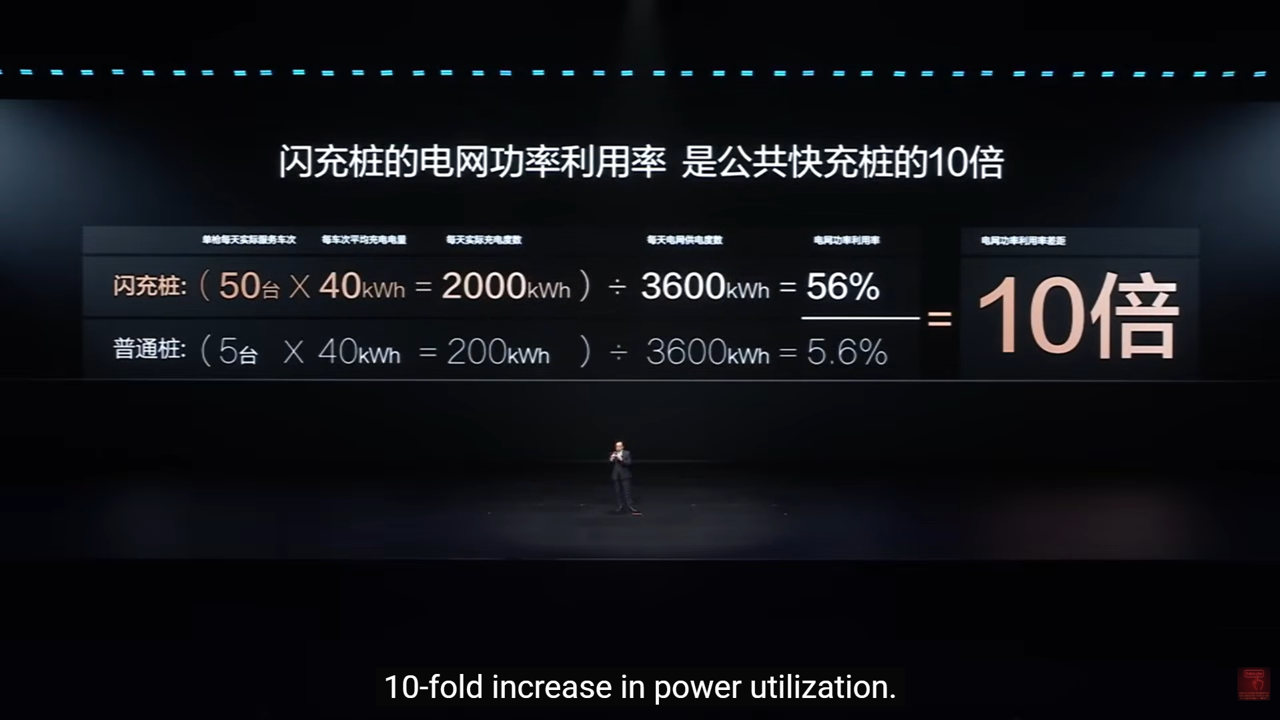
Based on research, BYD estimates that ten times as many vehicles can be charged per day on the new chargers compared to the most prevalent existing DC fast chargers. While the storage batteries undoubtedly add some cost, BYD figures that the increased utilization of each utility connection and charging space will save overall, reducing the footprint needed for charging and reducing copper consumption.
Battery safety is also claimed to improve, with tests going far beyond those required in China, which are the strictest in the world. We have seen the nail penetration test before, but they are now conducting it after 500 full flash charging cycles, with the nail penetration happening during flash charging, with no significant increase in temperature. For a 1000 km range vehicle, that test is being done on a battery with the equivalent of over 500,000 km (310,000 mi) on it. They also multiplied the force in impact tests to 10X what is required. And they multiplied the number of shorted cells tested, sending peak temperatures above 700 C, without fire or structural failure.

We will need to follow up on some of the vehicles, but they are becoming increasingly compelling. The Denza Z9GT EV now starts at 269,800 RMB (~$41k) with other models offering over 1000 km of range or 0-100 km/h in 2.7 s. The super-premium Yang Wang U7 now also offers over 1000 km of range and even more technology at 658,000 RMB ($95k). BYD also does not seem to be keeping flash charging exclusively to BEVs, bringing it to the U8 and U8L PHEVs. Fang Cheng Bao showed an upgraded version of its Ti3 and a new EV version of its hot-selling Ti7, although details were a bit scarce. The new Great Tang/Datang was shown with 950 km of range, as was the Seal 08 with over 1000 km of range, but we will have to wait for more details and pricing. Meanwhile, the new Song Ultra starts at 155,000 RMB ($22,470), while offering a larger and more powerful vehicle compared to a significantly more expensive RWD Model Y. The similar updated Sealion 06 came in at 159,900 RMB, while the new Seal 07 with 705 km of range came in at 169,900 ($24,632). Lidar-based ADAS systems are proliferating. And there are a lot of other vehicles that I haven’t touched on or are on the way.

Overall, BYD seems to be rolling out this technology across its lineup in China. Prices tend to be a little less for a similarly equipped vehicle. In general, there is a significant increase in power and performance, in addition to charging speed. The reduction in weight is likely due to more than just the 5% improvement in battery energy density, and the overall increase in range is also due to an overall improvement in efficiency. We will have to wait to learn more about the motor (variable flux?) and other efficiency measures being used.
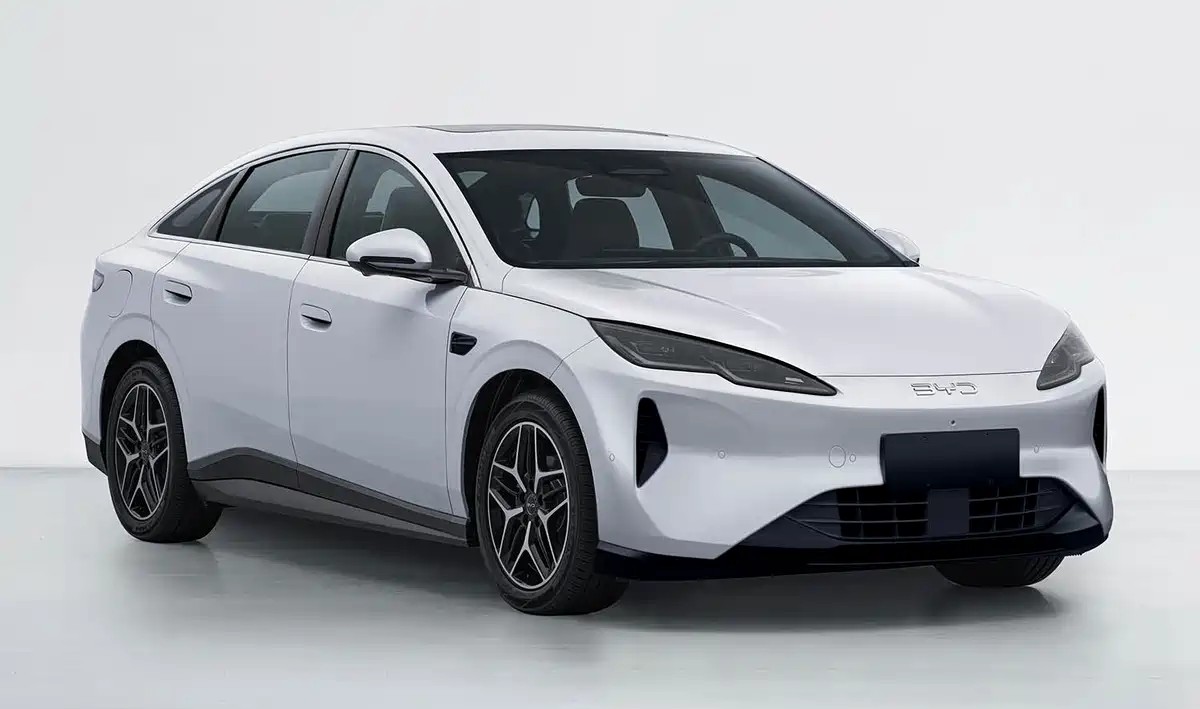
We will also have to see when it reaches more entry-level models (although it appears to be on the Qin Max and Seal 06 Max, based on regulatory filings). Could a 1000v flash charging RWD Yuan, Dolphin or Seagull model be on the way? We will also have to wait to see which models are brought to other markets. I have a feeling that BYD will keep its second-generation blade battery far away from any technology sharing requirements associated with localized production in several countries. At least for the next few years. The IP is just too valuable now. But we could see models exported from China, even if that means added tariffs. It will also be interesting to see which technologies are picked up by the automakers that BYD supplies. And it will be interesting to see what competitors come up with in response.
Even after watching hours of presentation video, there is still a lot more information to come. This seems like the beginning of the next generation of electric vehicles and charging. But it also could be the end of many excuses used justify ICE. EVs are now more convenient, fuel faster, cost less, have more power, offer more range, offer better objective handling and offer a smoother subjective ride. Then, when the excuses are covered, people can become comfortable with the technology, stop thinking about it as much and pick what best fits their needs. It may be another generation before countries that are already a generation behind see anything close to the kind of system-level EV ecosystem that is emerging now in China. But with a better EV experience across the board, why would anyone want to keep burning fossil fuels?
Sign up for CleanTechnica’s Weekly Substack for Zach and Scott’s in-depth analyses and high level summaries, sign up for our daily newsletter, and follow us on Google News!
Have a tip for CleanTechnica? Want to advertise? Want to suggest a guest for our CleanTech Talk podcast? Contact us here.
Sign up for our daily newsletter for 15 new cleantech stories a day. Or sign up for our weekly one on top stories of the week if daily is too frequent.
CleanTechnica uses affiliate links. See our policy here.
CleanTechnica’s Comment Policy