


Support CleanTechnica’s work through a Substack subscription or on Stripe.
You might have missed this, among all the overheated rhetoric about an unhinged US president taking a meat cleaver to the Middle East, but there was a funeral service for Jesse Jackson in Chicago this week. Barack Obama was there to celebrate the civil rights hero and, thanks to Heather Cox Richardson, we have access to a transcript of his remarks, replete with thoughts and ideas that may resonate with our readers, who are all well above average.
Richardson reports some of the details of Jackson’s life and his involvement with Martin Luther King, Jr. Her account begins with a voter registration drive in Dallas County, Alabama, home to the city of Selma. While there were more Blacks than Whites in the county, 99 percent of the registered voters were White.
In 1964, Congress passed the Civil Rights Act, but the measure did not adequately address the problem of voter suppression. In Selma, a judge had stopped protests over voter registration by issuing an injunction prohibiting public gatherings of more than two people. So much for the right to peaceably assemble and petition for redress of grievances!
“To call attention to the crisis in her city, Amelia Boynton, a member of the Dallas County Voters League, acting with a group of local activists, traveled to Birmingham to invite the Reverend Martin Luther King Jr. to the city,” Richardson writes. “King had become a household name after delivering his ‘I Have a Dream’ speech at the 1963 March in Washington, and his presence would bring national attention to Selma’s struggle.”
For seven weeks beginning in January, Black residents tried to register to vote. County sheriff James Clark arrested almost 2,000 of them on a variety of charges, including contempt of court and parading without a permit. A federal court ordered Clark not to interfere with orderly registration, so he forced Black applicants to stand in line for hours before taking a “literacy” test. Not a single person passed.
Jimmie Lee Jackson Is Shot & Killed
Then, on February 18, white police officers, including local police, sheriff’s deputies, and Alabama state troopers, beat and shot an unarmed 26-year-old, Jimmie Lee Jackson, who was marching for voting rights at a demonstration in his hometown of Marion, Alabama, about 25 miles northwest of Selma. Jackson had run into a restaurant for shelter along with his mother when the police started rioting, but they chased him and shot him in the restaurant’s kitchen. He died eight days later.
The leaders of the Southern Christian Leadership Conference in Selma decided to defuse the community’s anger by planning a march of 54 miles from Selma to the state capitol to draw attention to the murder and voter suppression. The march began on March 7, 1965.
“As they crossed the Edmund Pettus Bridge, which was named for a Confederate general, Grand Dragon of the Alabama Ku Klux Klan, and a US senator who opposed Black rights, state troopers and other law enforcement officers met the unarmed marchers with billy clubs, bullwhips, and tear gas. They fractured future U.S. representative John Lewis’s skull and beat Amelia Boynton unconscious. A newspaper photograph of the 54-year-old Boynton, seemingly dead in the arms of another marcher, illustrated the depravity of those determined to stop Black voting.”
Bloody Sunday
Images of “Bloody Sunday” shocked the nation. As supporters began to converge on Selma, King returned to Selma from Atlanta and asked faith leaders to join him. One who did was Jesse Jackson, who had begun his studies at Chicago Theological Seminary in 1964.
“The marchers set out again on March 9,” Richardson reports. “Once again, the troopers and police met them at the end of the Edmund Pettus Bridge, but this time, King led the people in prayer and then took them back to Selma. That night, a white mob beat to death James Reeb, a Unitarian Universalist minister who had come from Massachusetts to join the marchers.”
On March 15, President Johnson addressed a joint session of Congress to ask for the passage of a national voting rights act. “Their cause must be our cause too,” he said. “[A]ll of us … must overcome the crippling legacy of bigotry and injustice. And we shall overcome.” Two days later, he submitted to Congress proposed voting rights legislation. That legislation has now been effectively repealed by the right-wing activist judges installed on the US Supreme Court through the tireless efforts of so-called Senator Mitch McConnell and his racist allies in the Republican Party.
When the marchers set off for a third time on March 21, they had the protection of 1,900 members of the nationalized Alabama National Guard, FBI agents, and federal marshals. Covering about ten miles a day, they camped in the yards of well-wishers, their ranks growing as they walked. When they arrived at the Alabama State Capitol on March 25, they numbered about 25,000 people.
Living With Our Conscience
On the steps of the capitol, speaking under a Confederate flag, Dr. King said: “The end we seek is a society at peace with itself, a society that can live with its conscience. And that will be a day not of the white man, not of the black man. That will be the day of man as man.” That night, Viola Liuzzo, a 39-year-old mother of five who had arrived from Michigan to help after Bloody Sunday, was murdered by four Ku Klux Klan members who tailed her as she transported demonstrators out of the city.
For readers who may not be familiar with this ugly period in American history — one of many — the 1990 movie The Long Walk Home does an excellent job of accurately presenting the tumult surrounding racial equality in Selma in the 1950s.
At a ceremony for the signing of the Voting Rights Act of 1965, President Johnson spoke of “the outrage of Selma,” and said, “This right to vote is the basic right without which all others are meaningless. It gives people, people as individuals, control over their own destinies.”
Jackson Returns To Chicago
Before leaving Selma to go back to Chicago, Jesse Jackson asked Ralph Abernathy, a pastor and civil rights activist who was King’s closest friend and advisor, for a job with SCLC to prepare to spread the civil rights movement from the South into northern cities. King hired Jackson to lead Chicago’s Operation Breadbasket, a campaign that created economic opportunities in Black communities by boycotting businesses that would not hire Black employees. In 1967, Jackson became the national director of Operation Breadbasket.
Following disagreements with Abernathy, Jackson launched his own organization for economic empowerment in 1971. It was called Operation PUSH (People United to Save Humanity). In 1984, Jackson left the organization to run for president. In a speech at the 1984 Democratic National Convention, after Republican President Ronald Reagan had turned the country sharply away from the liberal programs of the past thirty years, Jackson reminded Americans: “Our flag is red, white, and blue, but our nation is a rainbow — red, yellow, brown, black, and white — and we’re all precious in God’s sight.”
“America is not like a blanket — one piece of unbroken cloth, the same color, the same texture, the same size,” he said. “America is more like a quilt: many patches, many pieces, many colors, many sizes, all woven and held together by a common thread. The white, the Hispanic, the black, the Arab, the Jew, the woman, the Native American, the small farmer, the businessperson, the environmentalist, the peace activist, the young, the old, the lesbian, the gay, and the disabled make up the American quilt. [W]e have experienced pain but progress, as we ended American apartheid laws. We got public accommodations. We secured voting rights. We obtained open housing, as young people got the right to vote.”
Obama Speaks
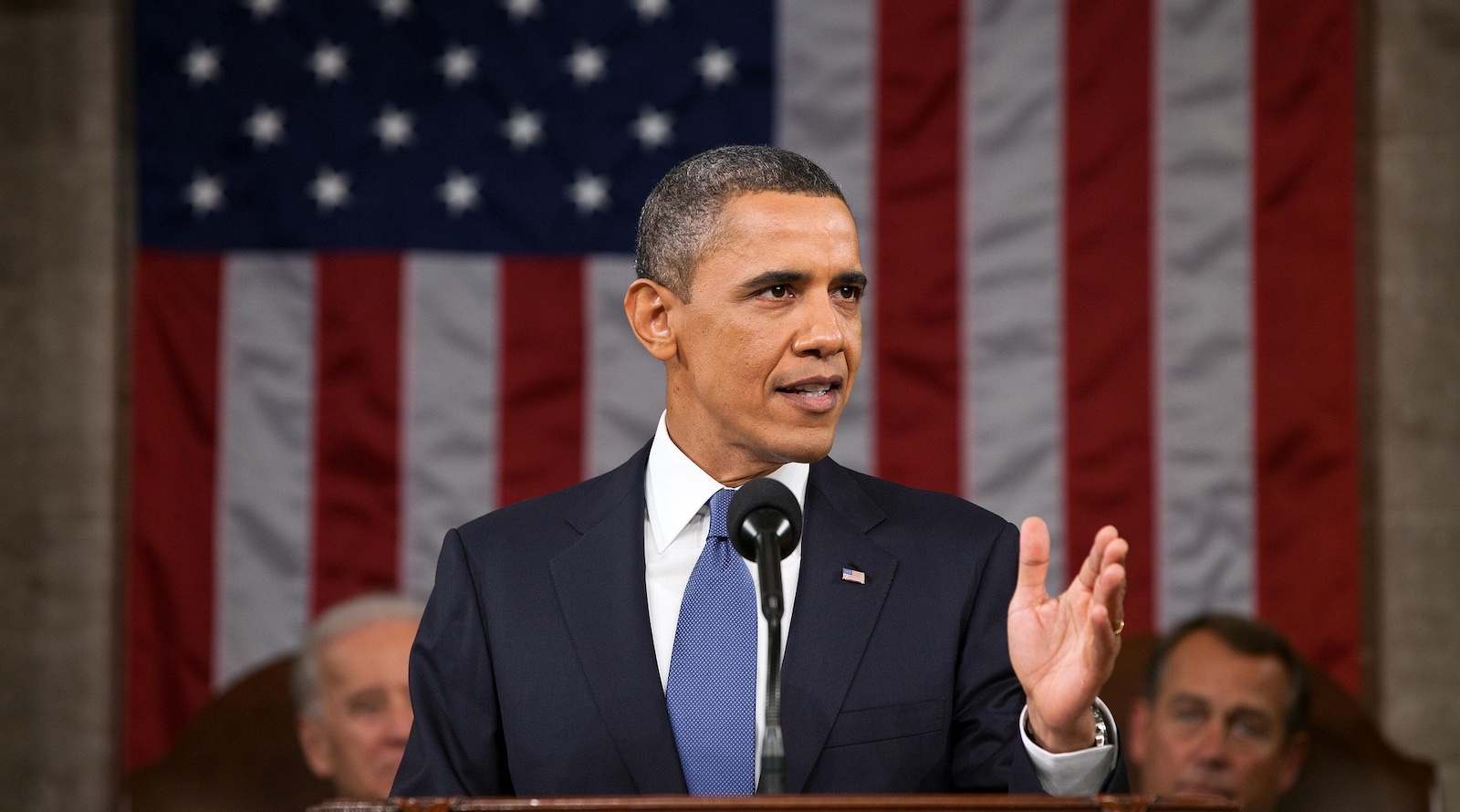
At the funeral service in Chicago this week, President Obama recalled how Jesse Jackson paved the way for people like him by promising everyone “that they mattered, that their voices and their votes counted. He invited them to believe. He invited us to believe in our own power to change America for the better.”
“He was talking about everyone who was left out, everyone who was forgotten, everyone who was unseen, everyone who was unheard. And in that sense, he was expressing the very essence of what our democracy should be, the ideals at the very heart of the American experiment — the belief that regardless of what we look like or how we worship, regardless of where our ancestors come from or how much money we got, we’re all part of the American family.
“We are all endowed with the same inalienable rights to life and liberty and the pursuit of happiness. We’re all obligated to answer the call and step forward and take responsibility for making wrongs right and for caring for our neighbors, and bringing the reality of America a step closer to its glorious ideals.”
“We are living in a time when it can be hard to hope,” Obama said. “Each day we wake up to some new assault on our democratic institutions, another setback to the idea of the rule of law, an offense to common decency. Every day you wake up to things you just didn’t think were possible.
“Each day, we’re told by those in high office to fear each other and to turn on each other, and that some Americans count more than others, and that some don’t even count at all. Everywhere we see greed and bigotry being celebrated and bullying and mockery masquerading as strength.
“We see science and expertise denigrated while ignorance and dishonesty and cruelty and corruption are reaping untold rewards. Every single day we see that, and it’s hard to hope in those moments. So it may be tempting to get discouraged, to give into cynicism. It may be tempting for some to compromise with power, and grab what you can, or even for good people to maybe just put your head down and wait for the storm to pass.”
Jackson’s life, Obama said, “inspires us to take a harder path. His voice calls on each of us to be heralds of change, to be messengers of hope. Wherever we have a chance to make an impact, whether it’s in our school or our workplaces, or our neighborhoods or our cities, not for fame, not for glory, or because success is guaranteed, but because it gives our life purpose, because it aligns with what our faith tells us God demands, and because if we don’t step up, no one else will.”
Spreading Hatred
The moron running amok in Washington — and all around the world — carries a message of hatred, a loathing for all whose skin color marks them, in his eyes and those of his supporters, as sub-humans. We see it in his slashing of health insurance and food assistance programs. We see it in his nominating of someone who supports deporting babies to be the head of Homeland Security. We see it in his assault on people of color all across the United States, calling them rapists and murderers so his base will raise their voices as one to demand their removal from society.
Remember the words of LBJ when he said, “This right to vote is the basic right without which all others are meaningless. It gives people, people as individuals, control over their own destinies.” If you do not recognize that a major component of the MAGA game plan is to do away with elections, you are simply floating in a bubble. You may applaud when your Hispanic neighbor is unable to vote in November, but you may feel differently when you are the one turned away.
Jesse Jackson told the truth — America is a quilt of many colors — but the MAGA faithful want to make it all one color — white. Make no mistake, the hatreds and cruelty on display in Selma in the ’50s and ’60s are still there, waiting for a time when they can explode and spread their venom across the land once more. They are there every time “Sweet Home Alabama” plays on the radio.
Do we not see the resemblance between the white police beating Blacks in Selma and the rogue ICE agents beating people in Chicago, Los Angeles, and Minneapolis? America, it seems, will never recover from its racist beginnings. America today is a cauldron of bigotry and hate. Perhaps it always has been, despite the efforts of King, and Jackson, and so many others.
This is heavy-duty stuff. Maybe humor can help break down some of the barriers to equality. Tom Lehrer, the satirist who used the piano as his weapon of choice — he called it an “88 string guitar” — wrote the wickedly funny tune “National Brotherhood Week.” Give it a listen if you have the time.
Sign up for CleanTechnica’s Weekly Substack for Zach and Scott’s in-depth analyses and high level summaries, sign up for our daily newsletter, and follow us on Google News!
Have a tip for CleanTechnica? Want to advertise? Want to suggest a guest for our CleanTech Talk podcast? Contact us here.
Sign up for our daily newsletter for 15 new cleantech stories a day. Or sign up for our weekly one on top stories of the week if daily is too frequent.
CleanTechnica uses affiliate links. See our policy here.
CleanTechnica’s Comment Policy