
Why Are EV Prices Only Coming Down Now? The Answer Is More Political Than You Think


Support CleanTechnica’s work through a Substack subscription or on Stripe.
High upfront prices remain the biggest barrier to drivers switching to electric cars. After years of steady increases, that trend has finally reversed. This shift did not happen by accident.
Why BEV prices kept rising despite cheaper batteries
For years, average BEV prices increased even as battery costs hit record lows. Between 2020 and 2024, the average BEV price rose by around €5,000 to roughly €45,000, an increase of 13%.
The main driver was product strategy resulting from profit optimisation. Carmakers increasingly focused on large, premium electric vehicles. The share of these higher-priced models more than doubled, from 28% of BEV sales in 2020 to 64% in 2024.
Without this shift towards bigger vehicles, the average BEV price would have been about €33,100, almost identical to the average combustion car price!
During this period, carmakers repeatedly blamed “weak demand” for electric cars. In reality, the outcome was predictable. With no new EU CO₂ targets to meet, manufacturers prioritised larger, higher-margin EVs rather than scaling affordable models. Unsurprisingly, profits surged.
2025: the predictable price reversal
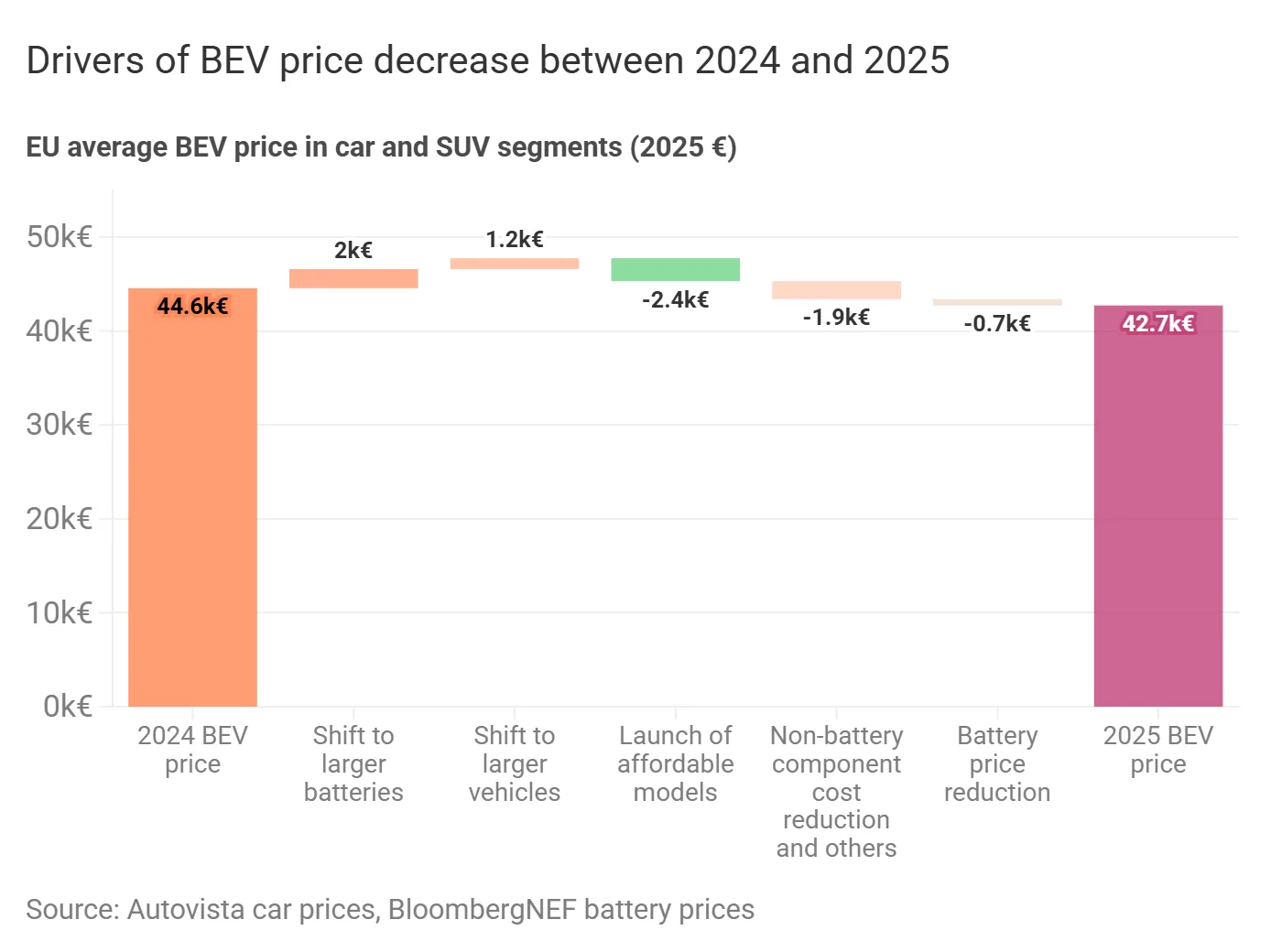
In 2025, the trend flipped. As T&E’s latest EV Progress Report shows, average BEV prices fell by €1,800, or 4%, to €42,700.
Again, this was not a surprise. In October 2024, T&E predicted that BEV prices would fall in 2025.
Why this sudden expected drop? It’s the direct consequence of the new 2025 EU car CO₂ targets entering into force.
Faced with binding targets, carmakers shifted priorities. Sales strategies moved away from maximising margins towards increasing BEV volumes, accelerating the launch of more affordable electric models.
And it happened despite a continued shift towards larger vehicles, pushing prices upwards. Without this upsizing, BEV prices would have fallen by around €5,000, to roughly €40,000.
The BEV price parity tipping point depends on the fate of EU’s 2030 target
The EU CO₂ targets are already delivering results. They are pushing BEV prices down and bringing affordability closer to a tipping point.
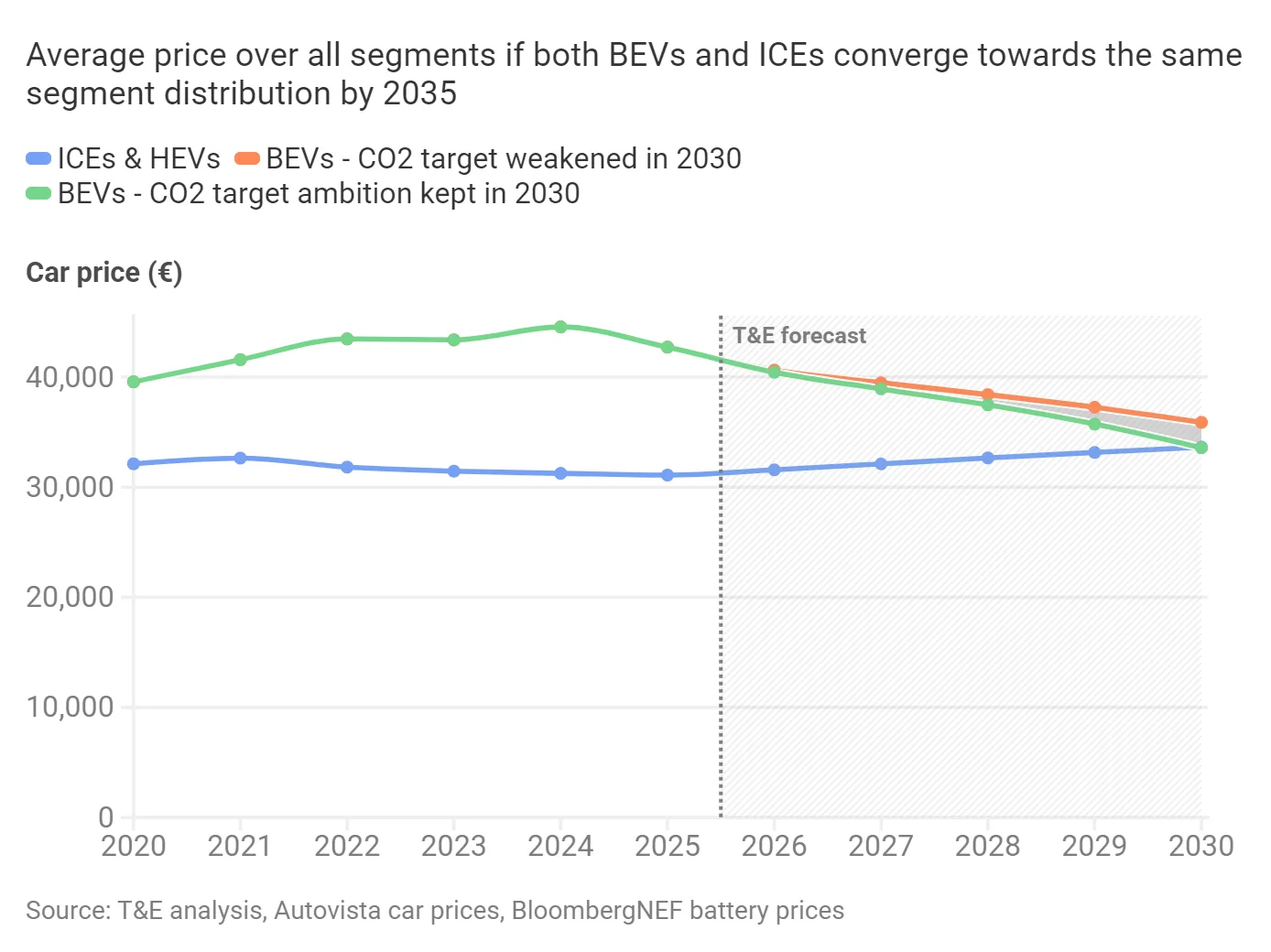
How soon BEVs reach full price parity with combustion cars now depends on what EU legislators decide for the next car CO₂ target milestone in 2030.
If the EU keeps the 2030 target in place, carmakers will continue to invest in affordable BEVs and large-scale industrial capacity, reinforcing the price decrease momentum seen in 2025. Under this scenario, BEVs can reach price parity with combustion cars across all segments by 2030. (In the large car segment, parity has already been reached.)
If the 2030 target is weakened, as the car industry is asking for, the opposite will happen and history will repeat. Just like in 2020–2024, carmakers will once again prioritise margins over volumes, delaying BEV price parity well beyond 2030.
The EU is currently searching for new initiatives to boost affordable small BEVs. But the evidence from 2025 is clear. The most effective small BEV initiative is ambitious car CO₂ targets.
Targets force competition, bring affordable electric models to market, and deliver real benefits to consumers. If Europe wants electric cars for the masses, it should accelerate the transition, not hit the brakes.
Next time you go to the dealership looking for an electric car, remember the price tag you see will tell a political story.
Article from T&E. By Lucien Mathieu, Director, Cars.
Sign up for CleanTechnica’s Weekly Substack for Zach and Scott’s in-depth analyses and high level summaries, sign up for our daily newsletter, and follow us on Google News!
Have a tip for CleanTechnica? Want to advertise? Want to suggest a guest for our CleanTech Talk podcast? Contact us here.
Sign up for our daily newsletter for 15 new cleantech stories a day. Or sign up for our weekly one on top stories of the week if daily is too frequent.
CleanTechnica uses affiliate links. See our policy here.
CleanTechnica’s Comment Policy