

Support CleanTechnica’s work through a Substack subscription or on Stripe.
Chery Automobile has evolved from a single domestic Chinese automaker into a large multi-brand automotive group with brands targeting mainstream, premium, EV, off-road, export, and luxury segments. Some are global facing, while others remain mostly China focused.
Chery increasingly resembles a Chinese version of a multi-marque automotive group similar to Volkswagen Group where different brands target different demographics, technologies, and export strategies simultaneously. Coming into Canada will allow Chery to expose more of its brands to North America, especially since the first time around, it didn’t do quite well in the maple leaf nation.
Its major brands currently include:
- Omoda, which is its global “neo-tech” youth-oriented crossover brand, and has become one of Chery’s primary export weapons in Europe, Southeast Asia, Latin America, the Middle East, and parts of Oceania. The Omoda C5 is among its best-known products internationally.
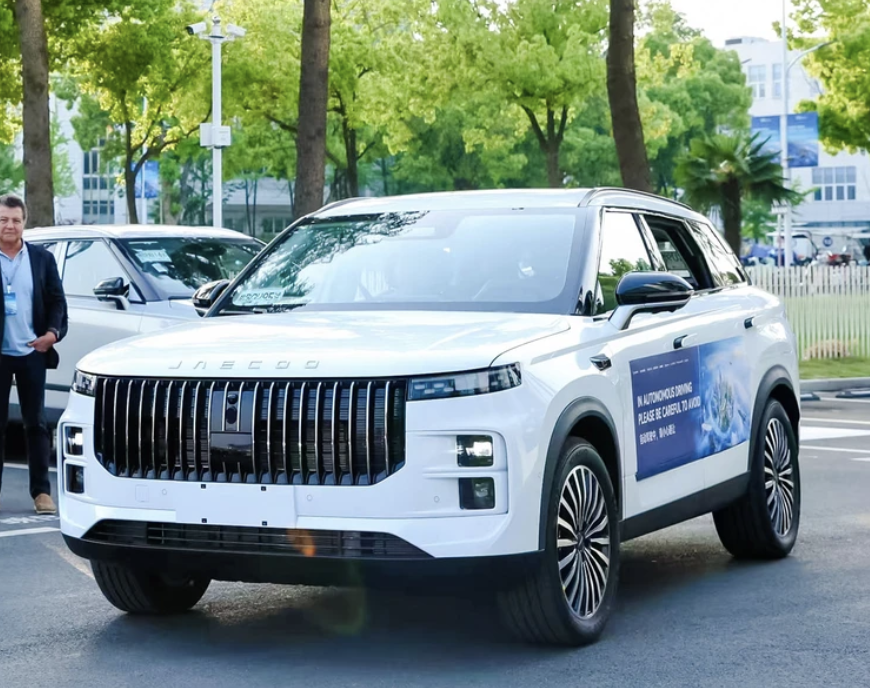
- Jaecoo is positioned slightly more premium and rugged than Omoda, focusing on SUVs with upscale styling and off-road-oriented branding. Internationally, Omoda and Jaecoo are often marketed together under the “O&J” strategy. This strategy is sometimes confusing in markets like the Philippines where Reddit calls it the Orange Juice brand (not considered derogatory).
- Exeed is Chery’s premium and near-luxury division. It competes against brands like Geely’s Lynk & Co and some entry-level premium Japanese and European offerings. Exeed vehicles emphasize advanced interiors, ADAS systems, and higher-end drivetrains.
- Luxeed is Chery’s joint venture EV brand developed with Huawei under Huawei’s Harmony Intelligent Mobility Alliance ecosystem. Luxeed focuses on smart EVs with deep Huawei software and autonomous driving integration.
- iCAR is Chery’s mostly domestic, dedicated EV and lifestyle-oriented sub-brand focused on younger buyers who are targeted because of the price and size of the vehicles. The lineup includes compact EV crossovers and rugged-looking urban electric vehicles.
- Jetour began as a Chery sub-brand before growing into a major standalone marque focused on SUVs, crossovers, and “travel+” lifestyle positioning. Jetour has expanded aggressively in export markets and increasingly competes directly with mainstream global SUV brands.
- Karry handles Chery’s light commercial vehicles, vans, and logistics-oriented products.
- Kaiyi is positioned as a budget-conscious brand for younger buyers, focusing on reliable sedans and compact crossovers like the X3 Pro.
Historically, Chery has also operated or participated in several joint ventures and experimental brands, including:
- Freelander, a 50:50 joint venture between Chery and Jaguar Land Rover (JLR) that is the newest addition to Chery’s brand matrix. Officially reborn in June 2024 and launched as a standalone global brand in early 2026, it has the vibe of the Defenders and Range Rovers. Freelander is part of its current portfolio.
- Rely — once an obsolete brand from the Chery stable, the brand was brought back to focus on a new lineup of global intelligent BEVs, PHEV/EREV pickup trucks, with the R08 Pro and “Himla” models launching in late 2025 and 2026. This happened after Geely launched the Riddara (formerly Radar Auto) luxury pickup truck.
- Qoros, a once highly ambitious premium-oriented joint venture with Israel Corporation that targeted Europe before largely fading commercially.
- Cowin, originally a budget-focused Chery sub-brand that later evolved independently in China. It was put to sleep in 2022 and replaced with the Kaiyi brand.
- Riich, an attempt at luxury segmentation that was eventually discontinued.
The “VW-style” multi-brand architecture is more than just a marketing gimmick; it is a calculated survival strategy designed to insulate Chery from shifting trade policies and consumer fickle-mindedness. By operating through several distinct identities, Chery can pivot its entire Canadian presence without the massive costs associated with rebranding a single, monolithic company.
Leveraging the 2026 Trade Quota
The recent shift in Canadian trade policy has created a specific window for this multi-brand strategy to thrive. Under the 2026 framework, which replaced the previous 100% surtax with a 6.1% tariff for an initial annual quota of 49,000 units, Chery can use its various brands to “fill the slots” strategically.
-
Maximizing Quota Value: Instead of filling the 49,000-unit quota with low-margin budget cars, Chery can prioritize higher-priced models from Exeed or Jaecoo. This ensures that each car sold under the favorable tariff rate generates maximum revenue.
-
The “Affordability” Balance: Because the Canadian government is pushing for more accessible EV pricing (aiming for sub-C$35,000 options), Chery can deploy iCAR or Kaiyi models to satisfy regulatory pressure for “affordable mobility” while keeping their premium brands untouched.
Behind the scenes, the “VW-style” structure means that a technician at a Canadian Chery dealership — potentially a multi-brand “boutique” hub — only needs to learn a few core platforms. Whether they are working on a Jaecoo J7 or an Omoda E5, the underlying E0X or M3X architecture remains largely the same.
This modularity significantly reduces the overhead for parts distribution and service training in a country as geographically vast as Canada. It allows Chery to scale rapidly across the provinces by offering three or four “different” brands that are, mechanically speaking, part of a single, highly efficient family. By late 2026, Chery won’t just be another new entry; it will be a diversified automotive ecosystem ready to compete on multiple fronts simultaneously.
Sign up for CleanTechnica’s Weekly Substack for Zach and Scott’s in-depth analyses and high level summaries, sign up for our daily newsletter, and follow us on Google News!
Have a tip for CleanTechnica? Want to advertise? Want to suggest a guest for our CleanTech Talk podcast? Contact us here.
Sign up for our daily newsletter for 15 new cleantech stories a day. Or sign up for our weekly one on top stories of the week if daily is too frequent.
CleanTechnica uses affiliate links. See our policy here.
CleanTechnica’s Comment Policy