

Support CleanTechnica’s work through a Substack subscription or on Stripe.
The global green hydrogen industry has had its share of ups and downs, with downs playing a featured role in some regions due to high costs and off-taker skittishness. Just a few years ago, for example, the EU and UK developed plans to decarbonize the hydrogen supply chain, only to see the path littered with failed projects and missed goals. Still, the war in Iran has added a national security wrinkle to the case for green hydrogen, and a new wave of activity has begun to stir.
Europe And The Green Hydrogen State Of Play
Green hydrogen refers to hydrogen pushed from water with a jolt of electricity from renewable sources, providing a more sustainable alternative to conventional hydrogen derived from natural gas or coal. Various kinds of biomass and waste materials also offer more sustainable sourcing, but much of the public and private investor dollars have gone into water electrolysis.
In the years leading up to and following Russia’s invasion of Urkraine, proposals for integrated “hydrogen valleys” surfaced in the EU (here’s another example), consisting of green hydrogen production facilities networked with transportation, storage, and offtakers.
The green movement began running out of momentum as costs continued to remain stubbornly high relative to conventional hydrogen, and off-takers failed to materialize in force. Still, some measure of activity continued to trickle through the years.
The gas price spike that followed US President Donald Trump’s war against Iran could help bring the cost of green hydrogen closer to parity with its fossil-sourced cousin, but some analysts advise that may not stick. BloombergNEF analyst Martin Tengler, for example, is among those pointing out that temporary surges in the cost of natural gas have faded, and so has interest in green hydrogen.
“The more likely scenario is that mainstream green hydrogen discussions will die back until the next energy crisis,” Tengler concluded in a recent analysis, though he did entertain the possibility that EU policy makers could re-commit to green hydrogen for long term energy security, rather than waiting around for another natural gas price shock. As if on cue, stakeholders in the defense supply industry have begun making the case for a deploying locally sourced, locally produced green hydrogen in the Europe as a hedge against Russian aggression.
Signs Of Life Continue To Trickle In
With that in mind, let’s take a look at some recent news coming out of the EU and the UK. One development of particular interest involves the US fuel cell and green hydrogen startup Plug Power.
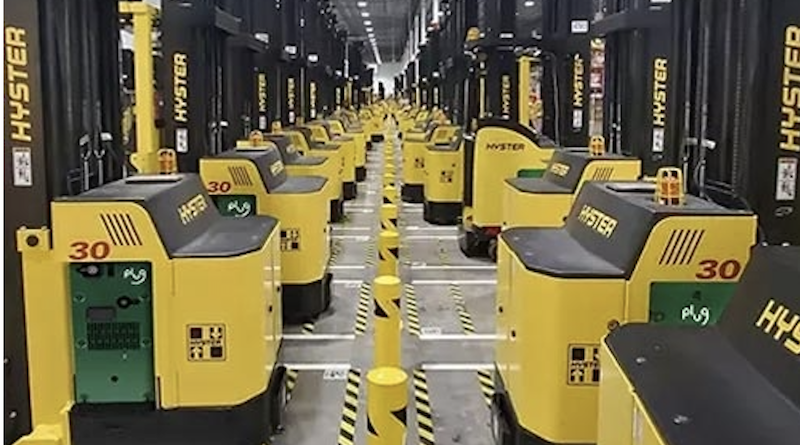
Plug Power launched with an initial focus on hydrogen fuel cell forklifts and soon branched into the water electrolysis field. The company has had its share of ups and downs over the years, with one recent disappointment being Trump’s decision to cancel a $1.6 billion loan guarantee earmarked for multiple green hydrogen projects here in the US.
Still, it’s a big world out there, and Europe beckons. That includes the UK’s 30-megawatt Barrow Green Hydrogen project in Barrow-in-Furness, Cumbria, featuring six of Plug’s GenEco™ 5-megawatt electrolyzers. On May 20, Plug noted that the Barrow project has reached the crucial FID (Final Investment Decision) stage.
The Barrow project is under the wing of a joint venture called Green Hydrogen Energy Company (GHEC), pairing the energy management firm Schroders Greenoat with the British firm Carlton Power. “The Barrow project will supply c100GWh of green hydrogen per annum to Kimberly-Clark’s manufacturing plant in the town,” Plug notes, adding that the project will cut natural gas consumption at the facility by 50%.
The Barrow project is one leg of a three-legged series of green hydrogen projects planned for the UK by GHEC. The other two are still in the pipeline. If the other two materialize, Plug’s total among the three projects will come to 55 megawatts.
“Europe remains one of Plug’s most strategic growth markets,” Plug explains. “The company is advancing multi-gigawatt electrolyzer projects across the U.K., Spain, and other European markets, supported by a global opportunity pipeline exceeding $2 billion.”
Estonia Takes Center Stage
In other news from Europe, the Estonian firm Stargate Hydrogen is also on the move. The company surfaced on the CleanTechnica radar last September when it engaged its new electrolyzer system with Saudia Arabia’s Research, Development, and Innovation Authority.
More recently and closer to home, on May 19 Stargate announced that it has delivered a 1-megawatt alkaline electrolyzer to Fortum, a Finnish state-owned energy firm. The system is taking up residence at Fortum’s new Kalla Test Center in Loviisa, which doubles as a pilot scale hydrogen production plant as well as a test bed for new technologies.
“The facility marks a major milestone for both companies, as Stargate Hydrogen proves its reliability, and Fortum begins its long-term operational testing of hydrogen production,” Stargate notes.
“The successful deployment of the company’s electrolyser technology at Kalla demonstrates its readiness to support industrial applications and strategic energy projects across Europe,” the company emphasizes.
More Green Hydrogen For The EU
In other news from Europe this month, the Norwegian firm Nel ASA announced the launched of a next-generation, cost-cutting alkaline electrolyzer, and the Dutch startup Power2X described its plans for constructing a 20-megawatt green hydrogen plant in the port city of Delfzijl, with a 2,000-tonne-per-year output earmarked for industrial firms in the region.
“The Djewels project, with its innovative technology, produces hydrogen at higher pressure and current densities. This technology enables more efficient hydrogen production, and, when fully proven, enables a lower footprint and costs for future larger scale facilities,” Power2X notes.
“Low carbon and green hydrogen projects in the Netherlands and across Europe – when built at scale over the coming years – will provide diversified energy security and new industrial competitiveness, whilst reducing CO2,” they add for good measure.
Activity has also been stirring the field of “artificial leaf” systems, in which electrolyzers are eliminated in favor of a photoelectric cell. On April 30, for example, Germany’s Karlsruhe Institute of Technology recapped the progress of its spinoff Photreon. The startup aims to mass-produce photoreactor panels that require no electrolyzers, grid connections, or other sources of electricity. “With the panels, hydrogen can be produced cost-effectively in a scalable manner from sunlight and water – suitable for both distributed applications and large-scale systems in sunny regions,” KIT explains.
What About The USA?
Yes, what about it? Former President Joe Biden left office with the wheels in motion to establish a coordinated network of seven “Regional Clean Hydrogen Hubs” in the US, funded with $8 billion through the 2021 Bipartisan Infrastructure Law. The program included carve-outs for natural gas with carbon capture as required by the BIL, but the primary focus was on diversifying the nation’s hydrogen supply chain with water electrolysis and biomass.
The vision of a newly expanded, newly diversified domestic hydrogen industry went to pieces after Trump took office last year, leading to a trail of broken dreams on the green hydrogen end. However, Plug Power is not the only US green hydrogen stakeholder to keep, well, plugging along. Keep an eye out for the Massachusetts firm Electric Hydrogen, among others.
Photo: The US firm Plug Power started with hydrogen fuel cell fork lifts before staking out territory in the emerging global green hydrogen industry (cropped, courtesy of Plug Power).
Sign up for CleanTechnica’s Weekly Substack for Zach and Scott’s in-depth analyses and high level summaries, sign up for our daily newsletter, and follow us on Google News!
Have a tip for CleanTechnica? Want to advertise? Want to suggest a guest for our CleanTech Talk podcast? Contact us here.
Sign up for our daily newsletter for 15 new cleantech stories a day. Or sign up for our weekly one on top stories of the week if daily is too frequent.
CleanTechnica uses affiliate links. See our policy here.
CleanTechnica’s Comment Policy