

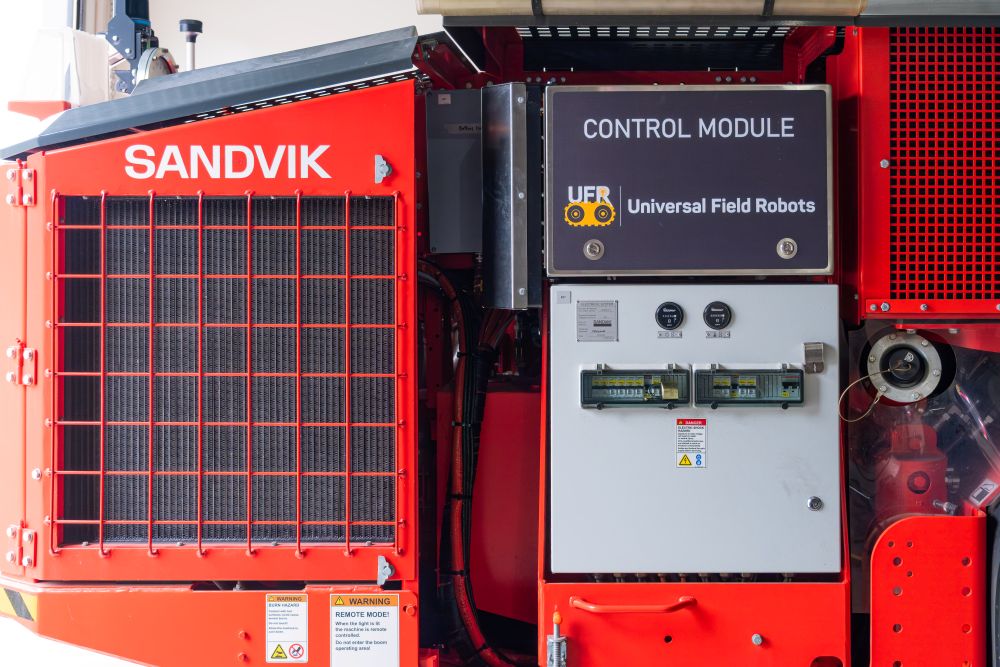
Anyone tracking developments with Sandvik AutoMine® over the last decade would not have been surprised by the OEM’s move to acquire Universal Field Robots (UFR) in 2024; a move that further opens its renowned automation platform.
In fact, one could see such a transaction happening all the way back in 2018: the year Sandvik Mining released its Interoperability Policy, outlining the principles by which Sandvik systems can communicate within a digital ecosystem including data accessibility, fleet data compatibility, data rights and control, and data privacy.
In 2019, Sandvik followed this up with the release of the AutoMine Access API, a system server interface that includes hardware components and software functionality packaged by Sandvik. This allows non-Sandvik equipment to be connected to AutoMine via a standard structure in the control room environment as defined by Sandvik, with the API interface definition including a requirements specification for compatible third-party equipment.
Then, in 2023, the release of AutoMine Core provided, among other things, users with multiple levels of interoperability for Sandvik and third-party OEM fleets.
The OEM followed this up a year later with the AutoMine Interoperable ACS, which increased the flexibility between Sandvik automated equipment and third-party equipment by allowing access to a shared automated zone at different times. This allows each machine to be independently controlled by its own system while operating within the unified AutoMine Interoperable ACS system to maintain a safer working environment.
What was missing was the on-board infrastructure, mechatronics expertise and software integration piece to expand and open the AutoMine platform even further for any type of equipment, according to David Hallett, Vice President of Automation at Sandvik Mining.
UFR provides exactly that.
In the original press release announcing the acquisition in August 2024, Sandvik commented that UFR would significantly expand the number of compatible third-party equipment types, providing customers with flexible opportunities to optimise the performance of their full mining equipment fleets, regardless of the OEM.
Having visited the UFR facility just outside of Brisbane in mid-March, it became clear how this would work in practice.
“We want to offer a seamless, one platform experience within AutoMine,” Hallett said.
This will see UFR – now a part of the Digital Mining Technologies division within Sandvik Mining – create the onboard infrastructure fitted on third-party – or non-iSeries Sandvik – equipment, plus the software and interface integration piece, to allow such machines to be visible in the AutoMine environment.
The ability to offer such an equipment-agnostic approach could see many more equipment types come into designated automation zones, interacting with Sandvik iSeries loaders, trucks and drills, plus allow Sandvik to enter new application offerings like low-profile mining.
Riku Pulli, President of Sandvik’s Digital Mining Technologies division, said this represents a big strategic decision for the company.
“AutoMine was, in theory, the only part of Sandvik Digital Mining Technologies that wasn’t open prior to this transaction,” he said. “We could see the huge opportunities that would come by making it an OEM-agnostic platform.”
Zero-entry ambitions
Hallett said the key focus areas, as far as these opportunities go, are tied to expanding fleet coverage and establishing “zero-entry applications” in underground and surface mining.
Elen Toodu, Director, Business Development for Sandvik’s Digital Mining Technologies, explained that the company is taking a phased approach to the latter, recognising that the company cannot pursue all opportunities at once.
“What we have started to do though is map the various points where we feel we can make an impact towards zero-entry mining, with the understanding that no-one is going to be covering everything in the near term,” she told IM.
Dush Wimal, UFR Director, is confident that Sandvik can take a leadership position in the zero-entry market, automating equipment that the industry did not think was possible.
Referencing large mass mining applications, he pointed to increasing the level of automation to tackle hang-ups and secondary blasting needs.
“The DB331 project we’re working on currently is a good example of that,” he told IM.
This non-iSeries mobile drill-and-charge unit has been fitted with UFR on-board hardware and integrated into the AutoMine software platform to enable tele-remote operation from the surface or less-hazardous areas than the current status quo.
“This isn’t a theoretical exercise,” he added. “Four of these DB331 units are heading to a customer in Indonesia to be integrated into their wider AutoMine ecosystem.”
Asked whether this is a cost-effective option for mine sites carrying legacy, non-iSeries equipment, Wimal said: “Absolutely. And it’s not just cost-effective when it comes to our own non-iSeries equipment.
“For example, one of the customers we have in Africa is currently running a fleet of iSeries trucks, and they wanted to extend this to also incorporate remote loading in a mixed-fleet environment.
“We did not have a native Sandvik remote loading option available for the machines that they’re operating, but now, with the UFR and AutoMine integration, we have been able to offer them tele-remote loading and autonomous trucking within the same existing system that they have today. The infrastructure didn’t need to be replaced, and, for the safety systems, the back end of the autonomy solution can also be utilised.
“We can seamlessly integrate the machines directly into the existing system.”
When it comes to surface opportunities, Hallett said the effort is focused on removing people from high-risk areas like the bench. “AutoLog is a good example of that,” he added.
AutoLog, developed by UFR and IMDEX, is a semi-autonomous robotic platform for blast hole sensing. This product formed the baseline for BLAST DOG , a semi-autonomous system that helps optimise blasting based on high-resolution 3D material models built from sensor data. In this setup, UFR AutoLog drives on the mining bench to hole locations as directed by autonomous drills, uses robotic vision to check the hole location and then winches a wireline sensor down the blast hole.
This can positively influence blast designs – lowering costs, increasing product recovery and reducing ore dilution. That’s before considering the ability to move people out of a dangerous zone to improve safety and productivity, and reduce risk.
“That is a really good example of keeping people off the bench and automating a dangerous task as well as a laborious one,” Hallett said. “Also, you very often can’t carry out this process at night due to visibility. AutoLog removes that constraint and provides close to real-time, consistent data of what is actually being blasted.”
The ability to have this type of auxiliary equipment within the AutoMine ‘visibility’ zone moves the sector that much closer to envisaging the autonomous and digital mine of the future – something other OEMs are catching onto, according to Toodu.
“We are finding that other companies are coming to us and looking to collaborate knowing that their machines could be visible in the AutoMine platform and be operated within this ecosystem,” she said, adding that MacLean was one such company looking to see how its production support and utility vehicles could be integrated into the AutoMine ecosystem.

New automation niches
While mass mining operations are obvious candidates to expand the AutoMine universe via UFR’s expertise – and have been a target area for other OEMs (Epiroc teaming up with MacLean via its own automation platform to tackle secondary breaking operations at the Newmont-owned Cadia operations mine in Australia, for example) – there are other non-traditional areas that are keeping Hallett and Wimal busy.
The combination of Sandvik’s global network and UFR’s mechatronic engineers and software developers also has the OEM on the cusp of solving a major underground hurdle in the blast hole preparation stage.
Underground blast hole cleaning and surveying is a serious safety issue for miners, requiring overhead work with the risk of dislodging material that can fall on operators. It is dirty and noisy work that is best carried out by robotic machines, with UFR AutoPrep looking to fulfil that need.
UFR has been working with Gold Fields at Agnew mine for several years to develop and implement this technology, which currently moves two out of three operators to the surface and out of harm’s way, while minimising the incidence of re-drilling thanks to the data collected during surveying that optimises drill and blast design.
“In the trials of AutoPrep we have done, we’re now seeing the ability to get a single robot to perform both hole prep and surveying in this phase of drill and blast,” Wimal said.
Trials at one mine site, conducted over three months, saw a 97% reduction in operator exposure hours by compressing these two tasks into one.
Wimal said the company has since moved onto a second site for a more concentrated trial, where the system refinements made after trial one will really be put to the test.
“This latest site will really put the technology to the test,” he said. “It has a much bigger drilling campaign than the first, so we’re able to put the vision system, the positioning system, etc under much closer scrutiny and test its full capabilities.”
The orebody knowledge solutions that UFR, in partnership with IMDEX, have embarked on – winning contracts with the likes of Fortescue, for instance – are another potential avenue for Sandvik to pursue with intent.
Other areas currently under consideration include higher levels of autonomy on wheel loaders for stockpile management, as well as conversations around automated dozing, Wimal said. This will, no doubt, leverage the gains made through the UFRautonomy agnostic and interoperable autonomous haulage project involving Epiroc MT65 trucks that UFR has been involved in at Gold Fields Granny Smith mine in Western Australia.
Wimal added: “This is on top of the roughly 30% of work we do outside of mining through our Automation as a Service platform, where the focus is now mainly on quarrying and the solar generation markets.”
He added: “Even with this external work, we will end up owning the patents and potentially creating some mining-specific adaptations down the line. There are definite synergies to be had.”
While Sandvik set the wheels in motion to open up AutoMine a decade ago, the introduction of UFR feels like the process is only just starting. The UFR-infused AutoMine platform will be underwriting further safety and productivity gains well into the future, while the latest AutoMine release, Aura, released today, has cemented Sandvik’s leading automation offering.
The post UFR-Sandvik AutoMine integrations opening up automation possibilities appeared first on International Mining.