

Support CleanTechnica’s work through a Substack subscription or on Stripe.
Ever since the automobile was invented, the competition for space to park them in cities has been fierce. Drivers want to be able to step from their cars directly into stores or businesses. One could argue that a major attraction for housing developments in suburbia is the ability to park in your own garage and access your house without battling the elements.
Cars are the ultimate expression of our personal freedom. They go where we tell them to go and wait patiently for us to return once we reach our destination. Robert Moses made New York City a utopia for motorists by building parkways, and GM reportedly turned Los Angeles into a car lover’s paradise by buying the nascent trolley system and junking it.
Cars vs. Bicycles In Paris
A constant source of friction in cities today is between motorists and bicyclists. During her 12 years as the mayor of Paris, Anne Hidalgo added hundreds of kilometers of bike lanes, converted many streets next to schools into pedestrian-only areas, and banned cars from certain parts of the city. Her efforts have influenced leaders in other cities like Barcelona, London, and Berlin. Last year a delegation from the German capital visited Paris to learn more about Hidalgo’s efforts to make the city less car-centric.
Experts say the transition to more bicycle infrastructure in Paris was made easier by its tight administrative boundaries that give its suburbs less say over its transportation systems than in other capitals. Paris is surrounded by a ring road — the Boulevard Périphérique — that makes accessing the city center from surrounding communities a challenge.
Previous mayors also helped to lay the groundwork for Hidalgo’s expansion of space for pedestrians and bicyclists. “But still, courage was needed to push through policies that inconvenienced motorists while introducing shared social and environmental benefits,” said Ajit Niranjan of The Guardian in April.
Infrastructure Wars In Berlin
Berlin is one of the most congested cities in Europe. “Driving in Berlin is a nightmare for me,” Anne Mecker told New York Times reporter Christopher Schuetze “Too many cars, too much traffic, too many accidents — everything’s such a mess.” The city of Berlin does not make congestion data publicly available, but statistics from the TomTom Traffic Index show levels of congestion that are almost as high as they are in New York City, even though Berlin has roughly half as many people and cars. Recently, the city of New York instituted a controversial congestion pricing plan that even its critics admit reduced the number or cars and trucks entering the city by about 27 million during its first full year of operation.
Translating what Paris did to Berlin has led to political friction. According to the Times, Berlin today has many bike lanes, carpooling services, and an extensive public transportation system. In recent months, some Berlin residents have proposed taking things to the next level. A petition to limit private vehicles from entering the city more than 12 times a year gathered tens of thousands of signatures.
Oliver Collmann, who helped launch the petition drive, has suggested that some on-street parking spaces be converted to spaces for cafés, playgrounds, and urban gardens — ideas that have found favor in other world cities. “Fewer cars, More Berlin,” became the slogan for the campaign.
Opponents agree congestion is a problem but have a different solution. They want to reduce the number of bike lanes and eliminate some of the other environmentally friendly innovations in the city that they say make traffic worse. Their banner reads, “Ban the banning of cars.” The issue is likely to be a focal point in the citywide elections scheduled for September.
An Appeal To Motorists
Conservatives and the far right Alternative for Germany (AfD) party are gaining traction in the municipal election campaigns by promising to keep Berlin safe for motorists. It is a strategy that relies on getting the votes of conservatives who live outside the city and commute to work. That pits them against a central city population that is historically more open to green policies and better served by public transportation. “No car is illegal,” say the signs AfD has erected along major commuting roads — a play on the pro-migrant slogan “no human is illegal.”
Pro-car groups appear to be leading in the early polls. Conservatives in Europe tend to pitch plans to restrict cars and trucks as attacks on drivers, Conrad Kunze, a sociologist who supported the ballot initiative, told the Times. He added that conservatives say limits on cars are part of broader claims that “mainstream society is under attack.” That sort of rhetoric should be familiar to people in the US, where the MAGA crowd likes to wrap itself in a racist “culture war” banner and use “fear of the other” as a campaign tool.
Benefits Of Bicycles
Bicycles emit far fewer emissions than cars, trucks, or buses. The Guardian reports that Paris is one of 19 global cities that have achieved significant reductions in both carbon dioxide and fine particulate pollution since 2010. It is difficult to assign a precise number to how much of that decrease is attributable to more bicycles in Paris, but there clearly has been some positive effects.
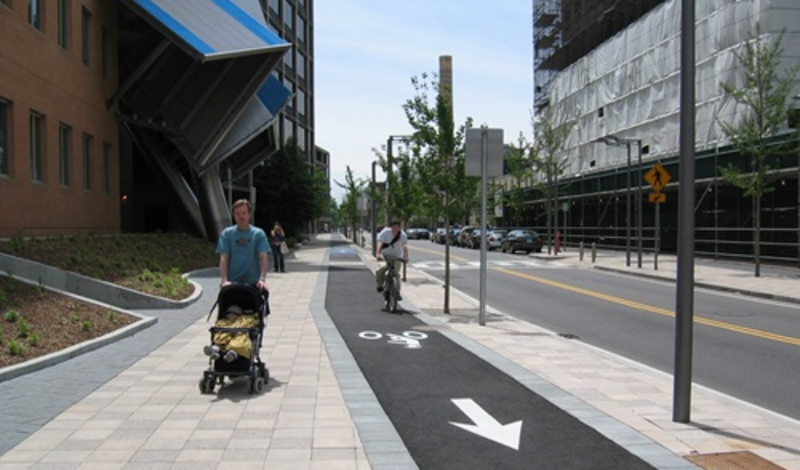
The biggest issue for bicycles in cities is keeping them physically separate from lanes for motor vehicles. Painting a yellow line on the pavement does not make a bicycle lane. Physical barriers are required to prevent cars and bicycles from trying to occupy the same space at the same time. Bicyclists always come off second best in those situations.
One controversial suggestion is to ask, “Do we really need so many private cars?” That question was posed by The Conversation a while back and it deserves to be revisited today. Here is what it had to say:
“To focus on these problems is not to suggest the new policies on electric vehicles are unimportant, or that they don’t stand to have some positive environmental impact. The point is, private EVs are not a solution to the combined challenges of reducing our urban environmental footprints and making better cities for all and they have their own problems.
“Instead, we should develop a good mass public transport system with extensive and frequent coverage. Alongside urban development with a more even distribution of jobs, services and opportunities, investing in better public transport could reduce car dependence in our cities.
“This would have a range of environmental and social benefits — making more space available for people instead of machines, extending the benefits of mobility to people who can’t or don’t drive, and reducing demand for finite minerals.
“Ultimately, it’s important that a transition to electric vehicles doesn’t dominate the discussion we need to have about urban transport. Our challenge is to simultaneously reduce the carbon footprint of different forms of transport, while also thinking much more broadly about the sustainability and justice of the system of mobility that’s so central to daily life in our cities.”
That article gets to the heart of the matter — are there any limits to personal vehicle ownership? Reasonable people may disagree about the answer, but it is a conversation almost every city needs to have. The burden on public resources to build and maintain all those roads, streets, highway, thruways, bridges, tunnels, and parking lots is staggering. Is that really the highest and best use of our tax dollars? Food for thought.
Sign up for CleanTechnica’s Weekly Substack for Zach and Scott’s in-depth analyses and high level summaries, sign up for our daily newsletter, and follow us on Google News!
Have a tip for CleanTechnica? Want to advertise? Want to suggest a guest for our CleanTech Talk podcast? Contact us here.
Sign up for our daily newsletter for 15 new cleantech stories a day. Or sign up for our weekly one on top stories of the week if daily is too frequent.
CleanTechnica uses affiliate links. See our policy here.
CleanTechnica’s Comment Policy