
Uruguay EV Sales Report: ICEV Sales Start Melting Down as BEVs Surpass 40% Share in May!

Support CleanTechnica’s work through a Substack subscription or on Stripe.
Latin America’s small champion is breaking all expectations.
Uruguay surpassed Costa Rica as the regional leader in 2025, reaching an impressive 20% BEV market share for the whole year, up from 8.5% in 2024. 2026 has seen the continuation of high growth levels in the Uruguayan market, bringing the yearly total above 35% and having BEV sales alone account for an outstanding 41% in May.
However, more important — and impressive — than overall EV sales growth, Uruguay has become the first Latin American market where, despite a significant increase in vehicle sales, we see combustion-only powertrains suffering significant losses. The end for fossil-fuel based transportation in Uruguay has now begun.
Let’s look at the numbers!
Market overview
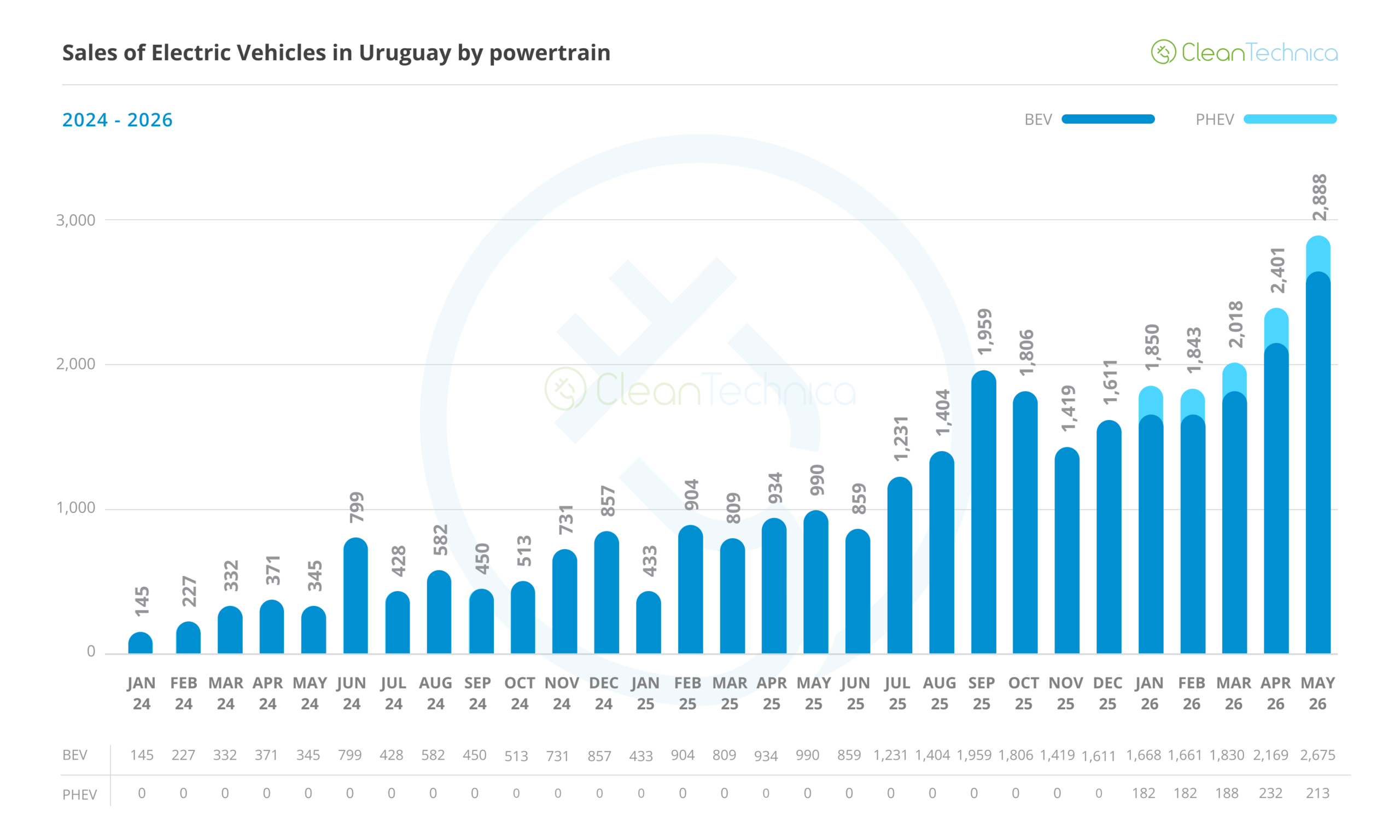
Already presenting decent sales in May 2025, Uruguay’s market tripled year on year, reaching and all-time high record of 2,888 EVs sold in May 2026. This marks the third month in a row with sales over 2,000 units. Though, we do have to clarify that the country (finally) started presenting PHEV sales, so they are included in the total, whereas previously it was only BEVs.
Now, before you all enlist your pitchforks, no, PHEV sales are not significant. In prior years, we knew total hybrid sales (MHEV, HEV, PHEV and EREV) rarely reached 5% market share, meaning plug-in hybrids and extended-range electric vehicles were certainly below that. This could be verified in 2026, with total PHEV+EREV sales in May reaching a mere 213 units, whereas BEVs stood at 2,675 units sold.
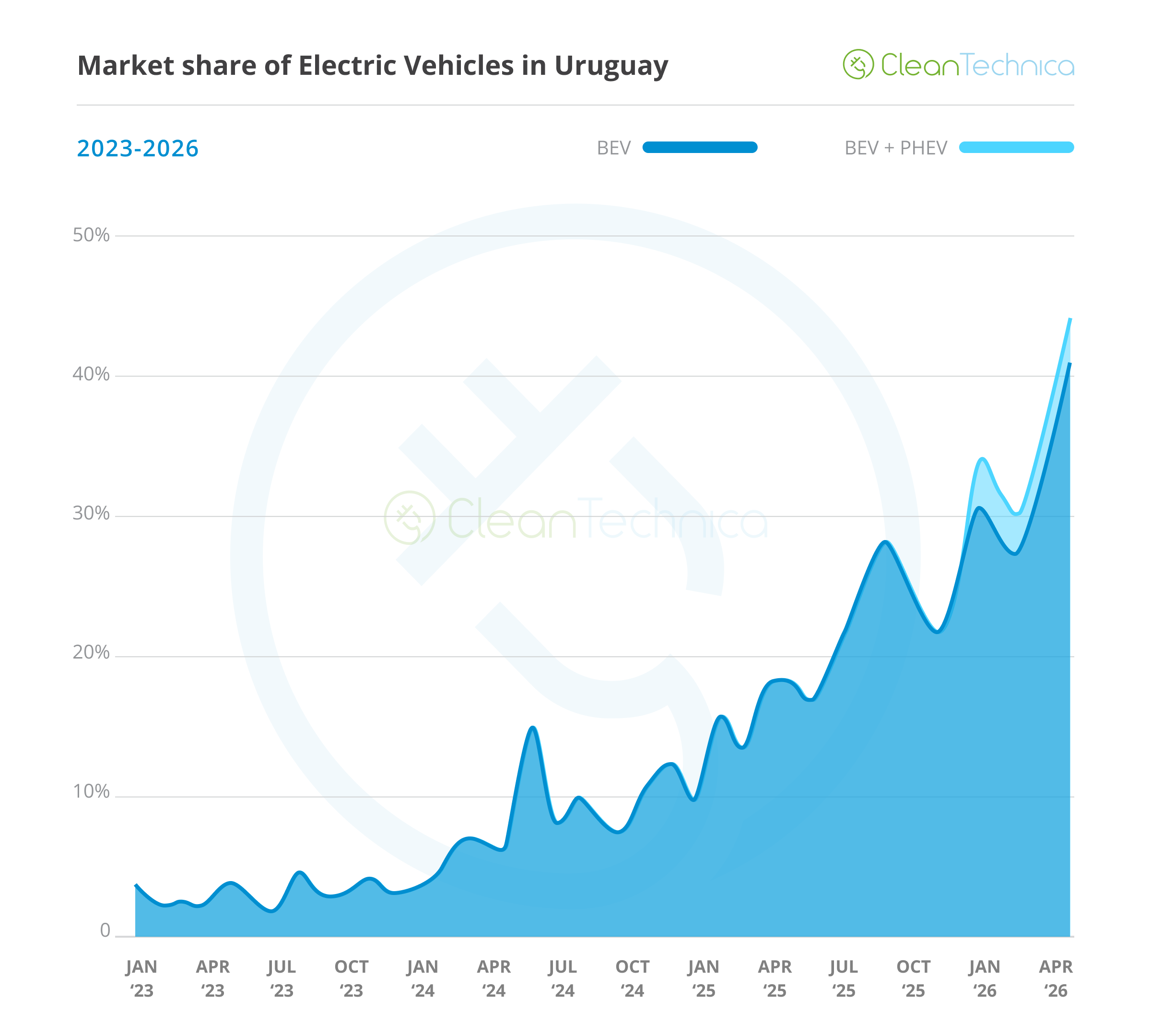
Market share has also increased through the year. In January, it surpassed 30% BEV for the first time (+3.3% PHEV), surpassing that record in April (33% BEV, 3.6% PHEV) and again in May (41.2% BEV, 3.3% PHEV). Uruguay is now very close to 50% plug-in market share, placing it not only as a regional leader, but also as a global one!
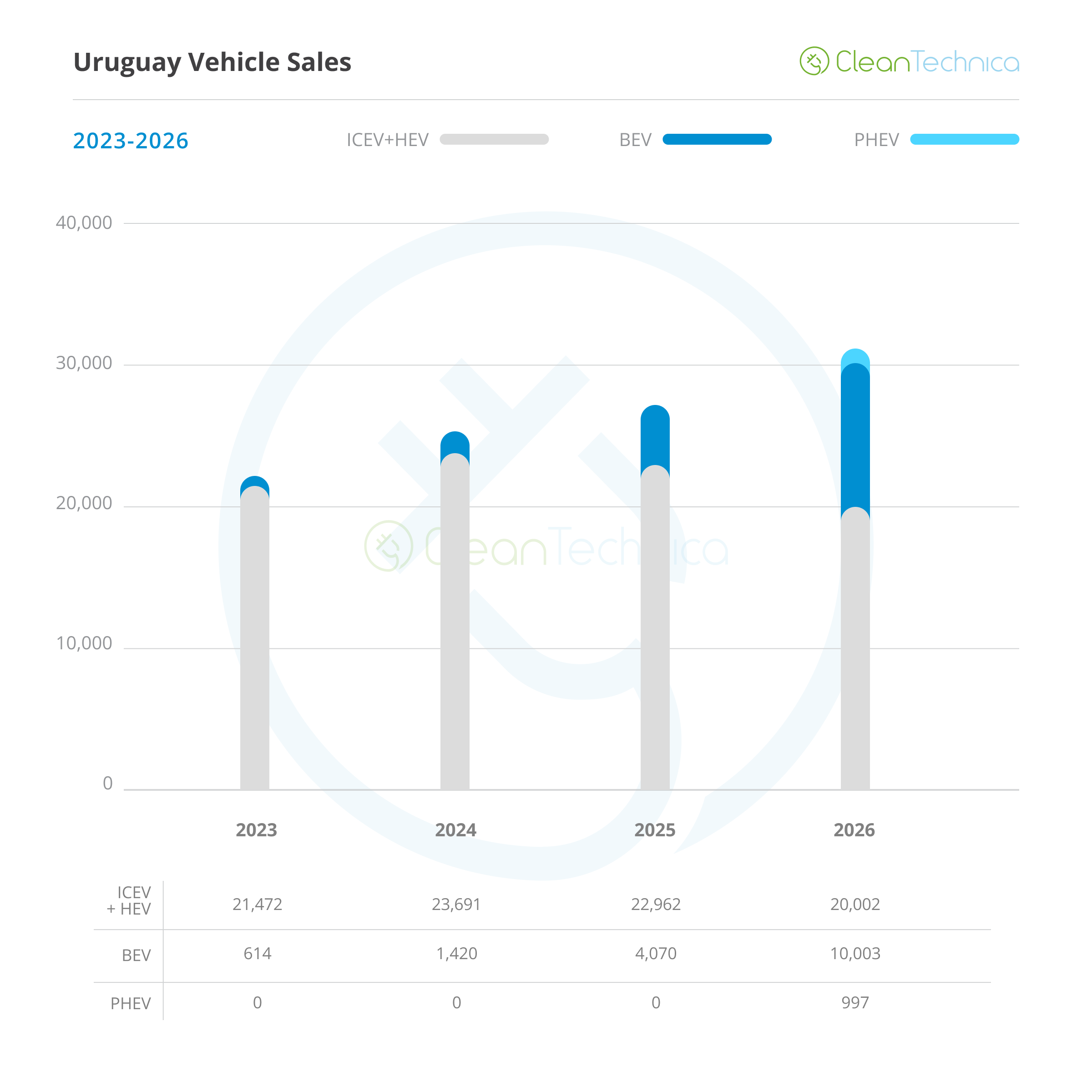
This massive growth has brought something we’re still waiting to see in most of the region: a significant downturn in combustion-only vehicle sales. Despite a booming market, with overall sales growing by 23% between 2024 and 2026, combustion sales (ICEV + HEV) have fallen by a substantial 15% in this same period. If current trends continue, we can expect combustion-only sales to fall well over 50% from this peak by the end of the decade.
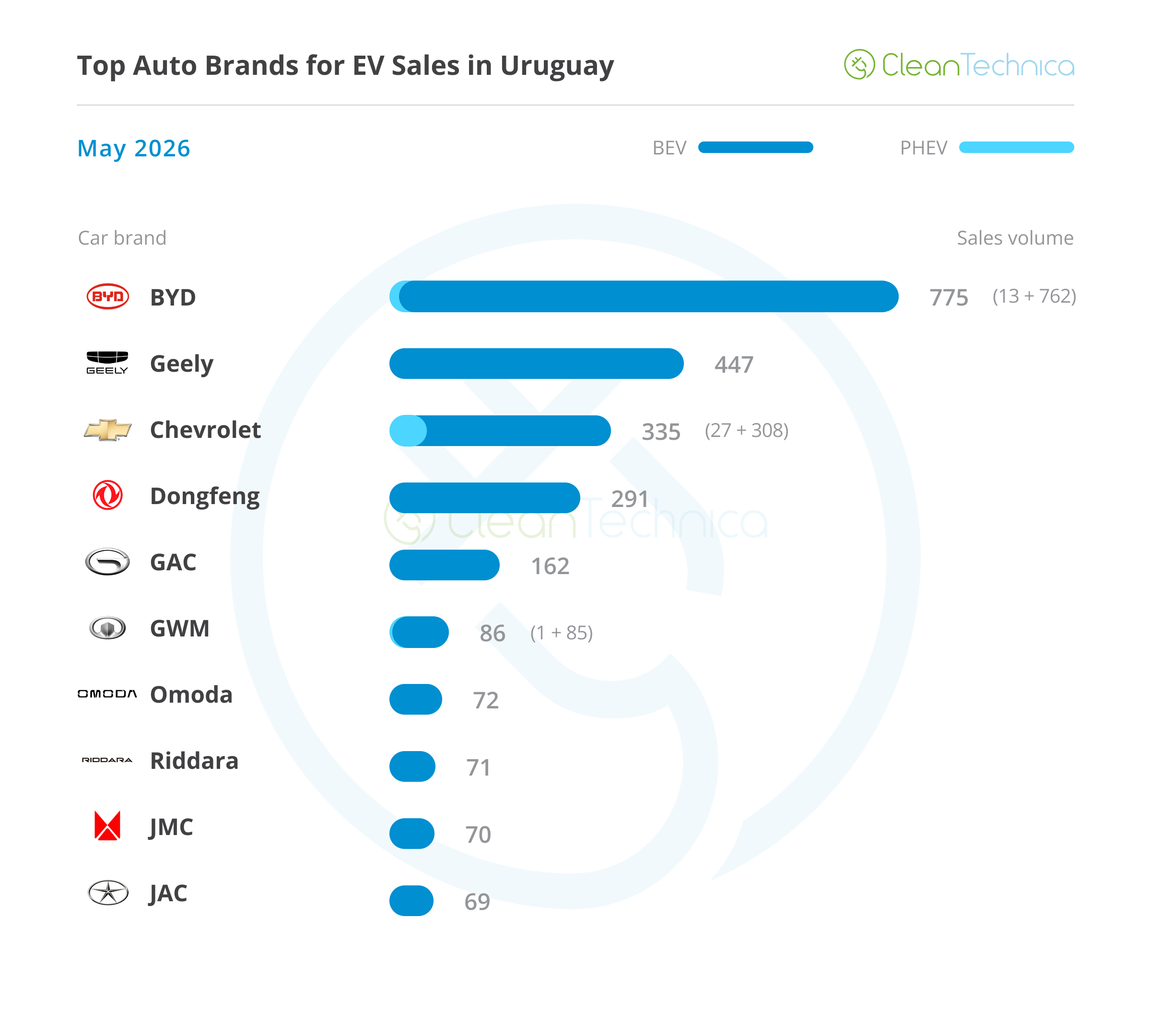
Looking at brands, we see BYD leading the market with far less advantage than it once had. If we go back to 2024, BYD had 70% of the Uruguayan market for itself. Last May, that number went down to 27%, even though sales have kept growing. Geely, currently undertaking significant efforts to expand in Latin America, won the silver, and Chevrolet won bronze thanks to its rebranded Baojun Yep Plus Chevrolet Spark EUV and Wuling Starlight S Chevrolet Captiva EV.
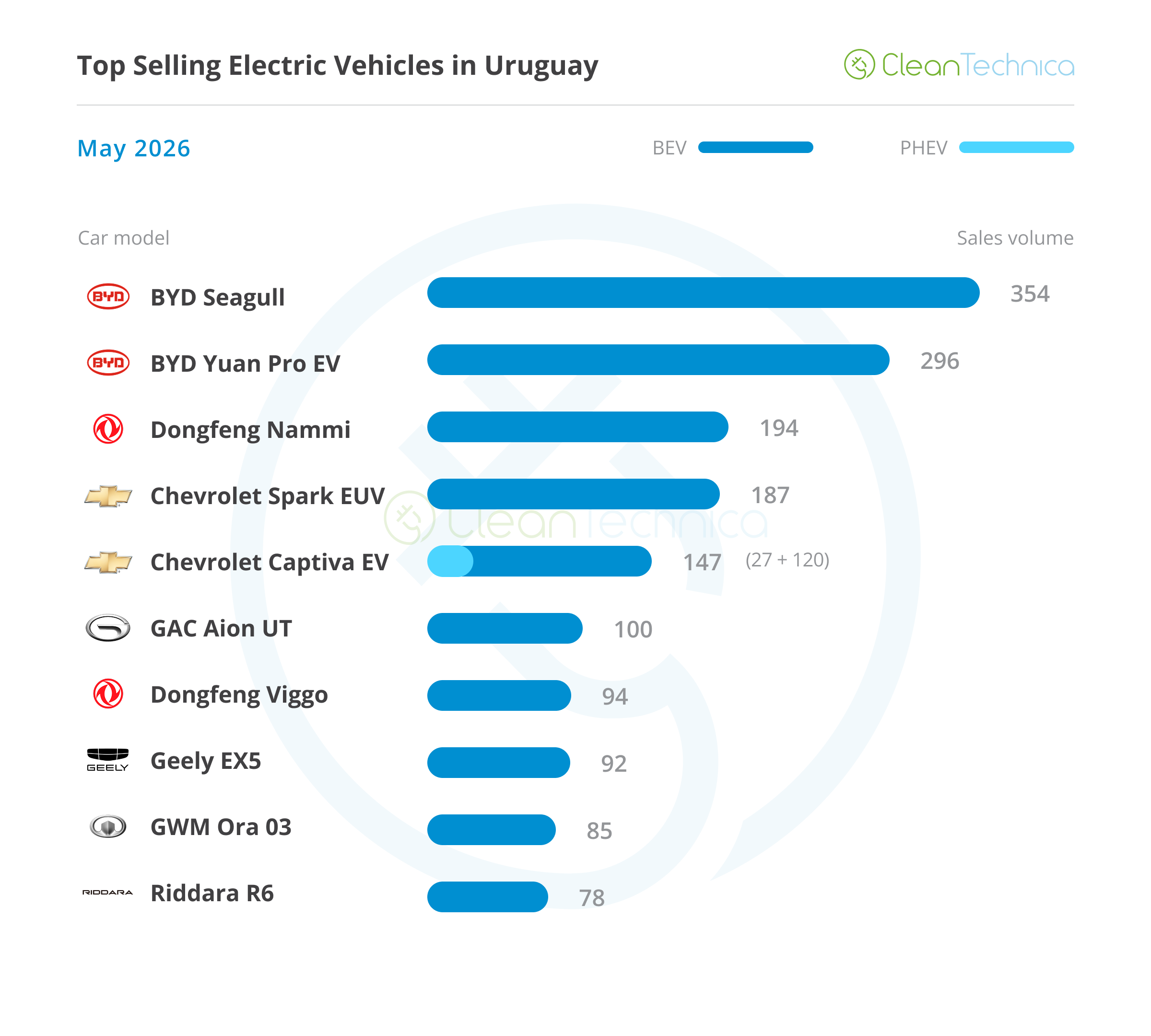
Model-wise, the leading BYD Yuan Pro and BYD Seagull are followed by a surprising arrival, the Dongfeng Nammi, which has been a success in the market. Following come the Spark EUV and Captiva EV. Notable mention to the Dongfeng Viggo, a representative in the segment of hyper-affordable SUVs, available in Uruguay from $26,000.
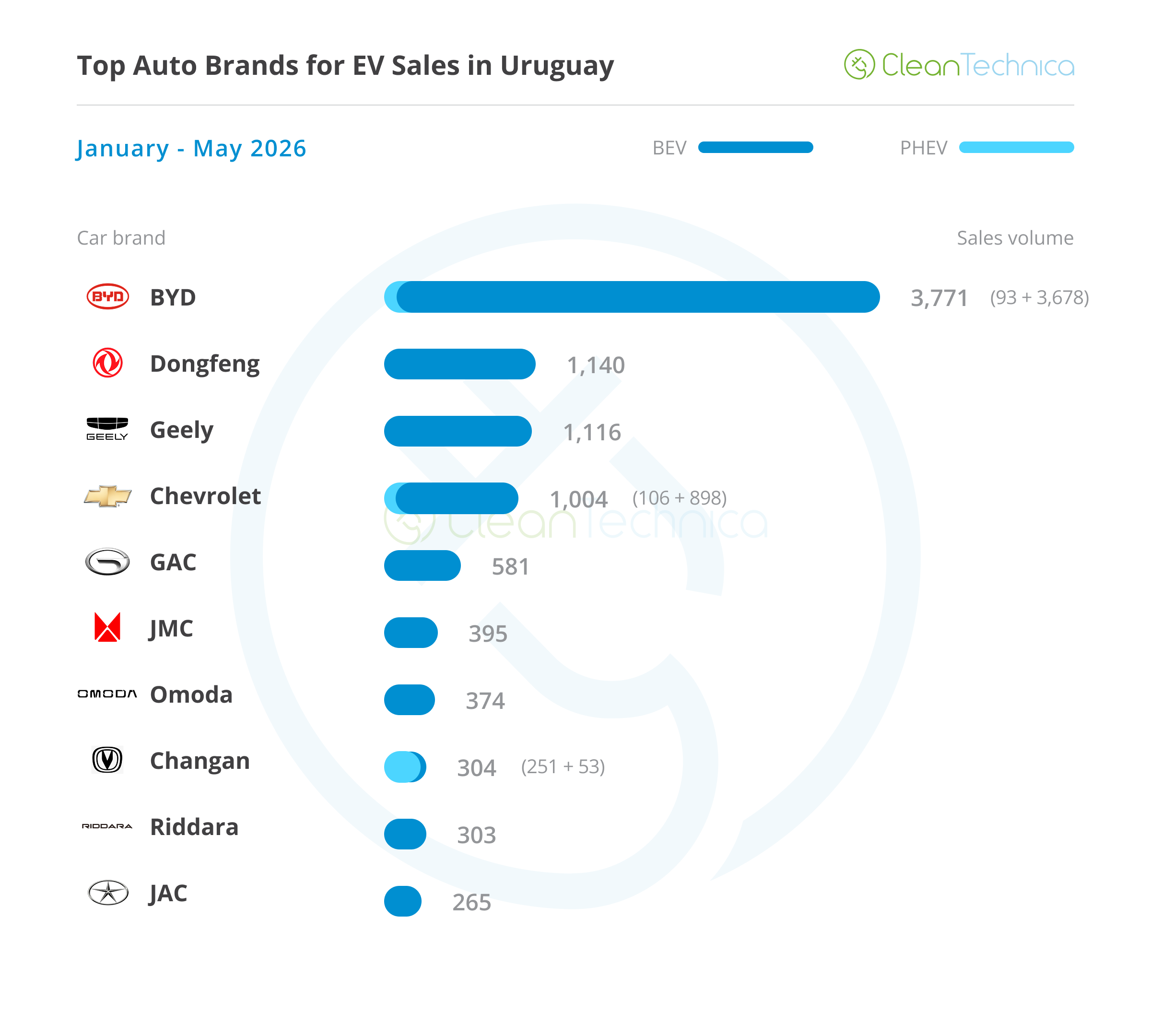
Year to date, we find a pretty similar top 10 EV brands, with Dongfeng winning silver and Geely winning bronze, and Chevrolet getting fourth place. The only difference in the list is that Changan managed to get to 8th place thanks to its PHEV lineup, the only brand on the list focusing on this technology.
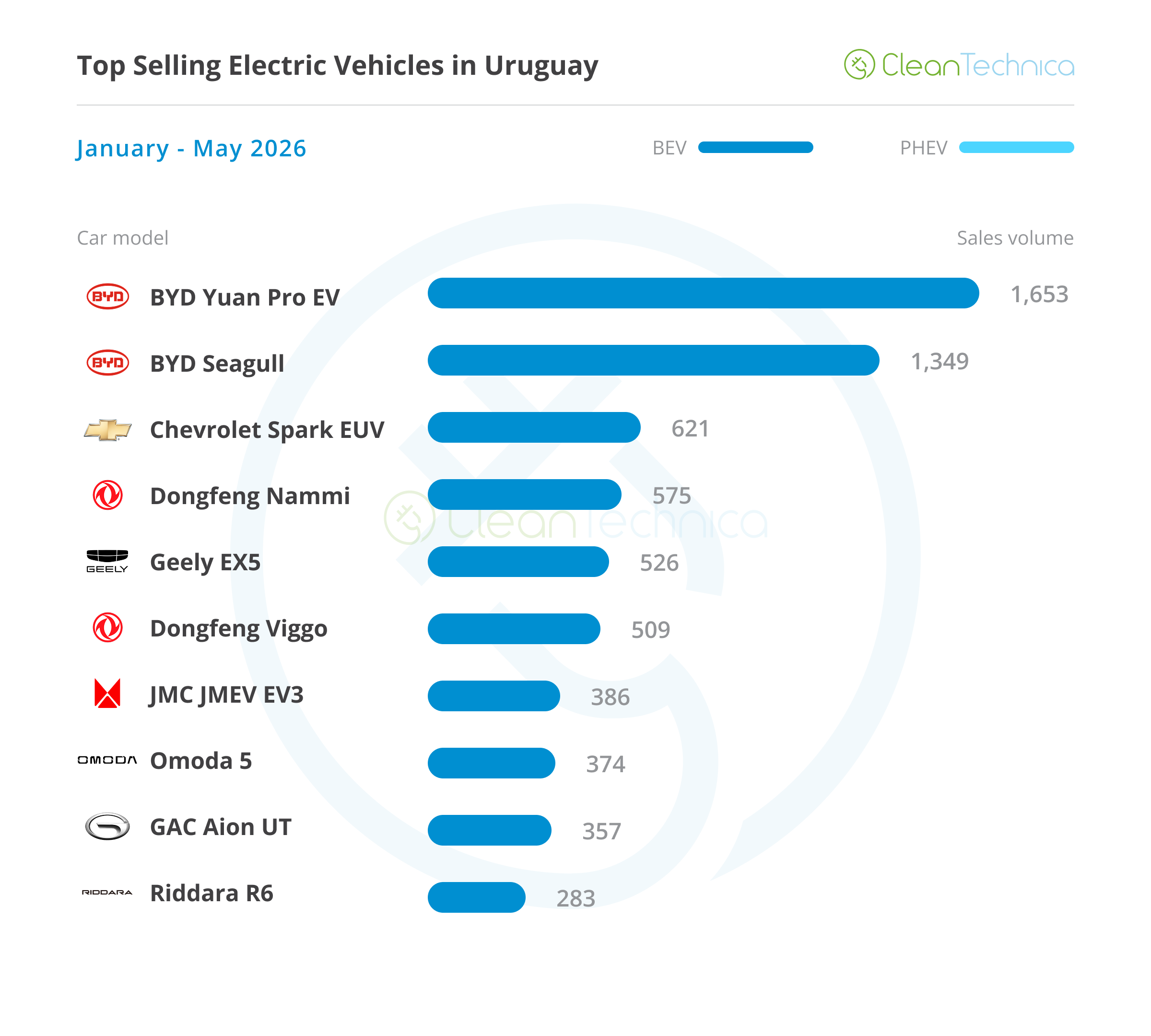
Model-wise, again, we have a pretty similar list, with the Nammi 03 and the Spark EUV switching places, and the Geely EX5 getting fifth place.
Latin America’s leading market
The numbers pretty much speak for themselves.
Uruguay has relatively expensive vehicles (making it easier for recently arrived EVs to compete) and it has the most expensive gasoline on the continent, save for a couple regions in California and British Columbia. And for the last year, its market has become incredibly competitive, providing tons of affordable options in multiple segments from a lot of brands and eroding the absolute dominion BYD had over it. Uruguay also has access to a lot of renewable energy and lacks oil reserves, meaning it must import all the fuel it consumes. And, at last, Uruguay has a decent, if a bit outdated, charging network.
All of these factors together have made it the perfect case for rapid electrification, providing incentives at the individual and national level to switch to EVs as fast as materially, and culturally, possible. What we’re seeing is meteoric growth the likes of which is rarely seen, with sales tripling from an already high base and EVs getting very, very close to the 50% mark, one that few countries have surpassed so far.
As the Iran conflict seems to be waning, and with fuel prices trending down, we could see EV demand sort of tamper down … which in this case means going to “only” around 30–35% market share, instead of 40–45%. But at this point, I feel confident in claiming that Uruguay’s transition is already a success, and that the country will slowly but surely rid itself of these pesky combustion vehicles, which every year cost it over a billion dollars in imports, replacing them with cleaner, greener sources of energy.
I also believe we will see at least one month with +50% EV share before the end of the year. Do you guys agree?
Sign up for CleanTechnica’s Weekly Substack for Zach and Scott’s in-depth analyses and high level summaries, sign up for our daily newsletter, and follow us on Google News!
Have a tip for CleanTechnica? Want to advertise? Want to suggest a guest for our CleanTech Talk podcast? Contact us here.
Sign up for our daily newsletter for 15 new cleantech stories a day. Or sign up for our weekly one on top stories of the week if daily is too frequent.


CleanTechnica uses affiliate links. See our policy here.
CleanTechnica’s Comment Policy