
India Needs 10 GWh of Battery Storage Now to Stop Coal’s Inflexibility Wasting Clean Power

Support CleanTechnica’s work through a Substack subscription or on Stripe.
Batteries are the fastest fix to make room for India’s midday solar surge as coal-based power plants are unable to ramp down far enough for the same
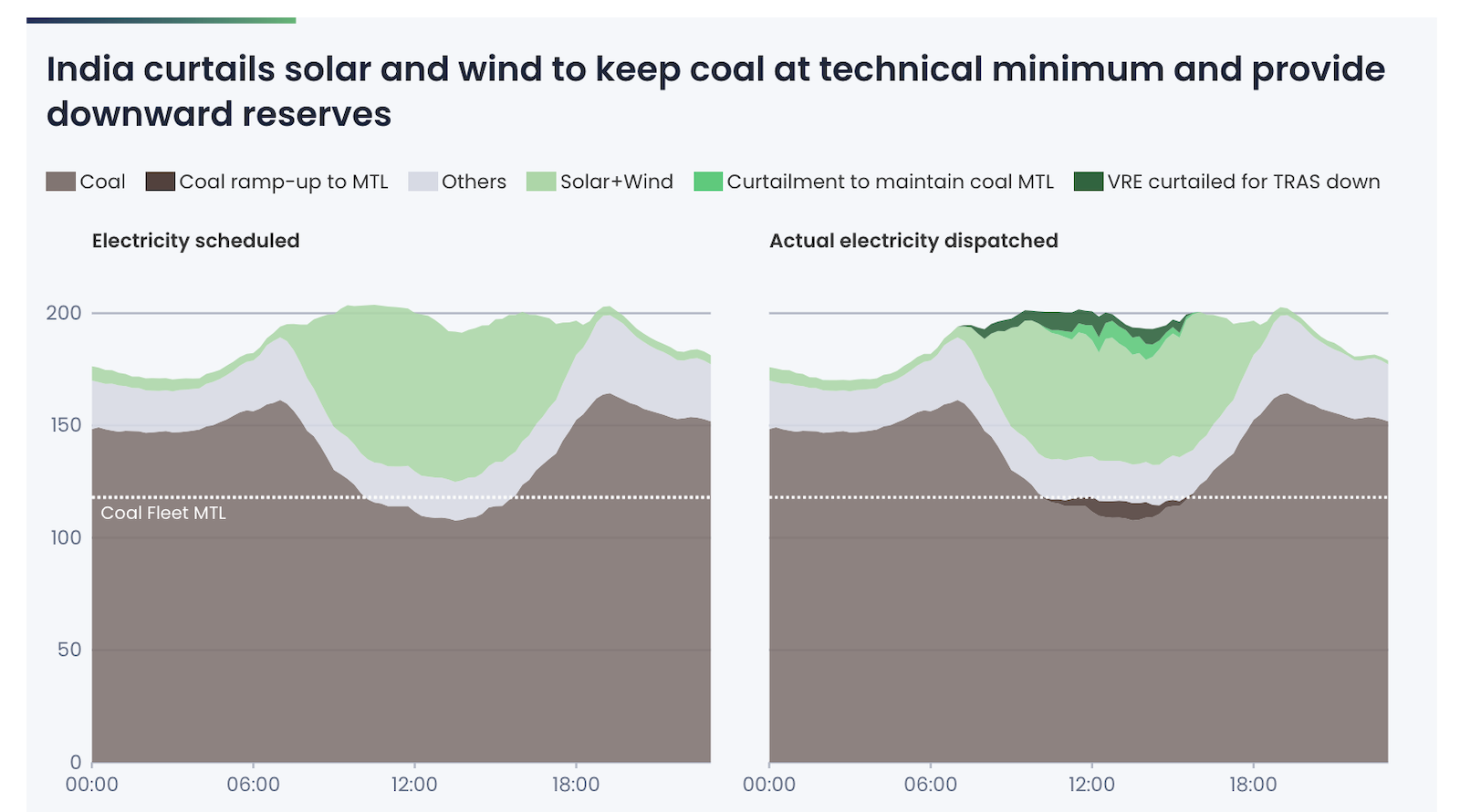
India needs around 10 gigawatt-hours (GWh) of battery storage immediately to stop renewable energy curtailment when the s coal fleet cannot ramp down below its technical minimum, according to a new analysis by energy think tank Ember. With solar power flooding the grid at midday, several coal-based power plants are required to operate at or even below their minimum technical loads (MTL), levels at which they can safely operate. As a result, grid operators are curtailing clean electricity to keep coal-based power plants online for the nighttime surge in demand and to provide necessary reserves.
Ember’s analysis found that keeping coal above its MTL forced the curtailment of around 2.1 terawatt-hours (TWh) of renewable generation in the fiscal year (FY) 2025–26, equivalent to 1.3% of total renewable generation. In 2026, around 10 GWh of storage, charging during the midday solar window, would have been enough to absorb that surplus, keep coal above its safe operating floor and avoid the curtailment altogether.
“Solar and wind curtailment is becoming a visible part of India’s real-time grid balancing, and the volumes are already noticeable and rising,” says the report’s author, Neshwin Rodrigues, Senior Energy Analyst at Ember. “Without sufficient flexibility, including storage, this could become a constraint on the next phase of renewable energy growth.”
The report highlights that the core issue is that coal still provides almost all of the grid’s flexibility, including its ancillary reserves. As solar capacity has grown, coal is being cycled from near-full output at night to its lowest point at midday every single day. For example, on 6 March 2026, solar and wind reached 41% of the generation mix at midday, pushing coal down by around 49 gigawatt (GW) in six hours before it had to climb back up by 51 GW in the evening as solar collapsed. “Coal was built for sustained high output, not this daily deep cycling,” says Rodrigues.
Once coal hits its MTL, around 55% of rated capacity, it can no longer provide downward reserves, and renewable generation would need to be curtailed to keep the fleet at this technical minimum. By April 2026, coal was breaching that floor in more than half of all midday dispatch intervals. Renewable curtailment met 37% of down-regulation that month, up from near zero a year earlier.
“This is curtailment required purely to keep coal plants at their MTL,” Rodrigues said. “Before the system even considers reserve requirements or grid constraints, renewable generation is being cut simply to make space for coal to remain operable. The constraint is structural.”
With solar capacity on the rise, the report highlights that curtailment of clean electricity is increasing in the absence of the country deploying alternatives like battery storage for grid flexibility. India added around 24 GW of solar capacity between October 2025 and April 2026, reaching approximately 154 GW. Peak-hour curtailment had returned to 4% of solar and wind generation by April 2026, comparable to the most constrained months of late 2025, despite April falling outside the worst seasonal window. Solar and wind energy curtailment owing to the emergency Tertiary Reserve Ancillary Service (TRAS) down mechanism was over 3,600 GWh by early June 2026, from zero in mid-2026. Since March 2026, the volume of such curtailment has been rising sharply, adding over 1,400 GWh in just two months. On some days, the scale of curtailment is particularly striking, exceeding 120 GWh on both 1 and 3 May 2026.
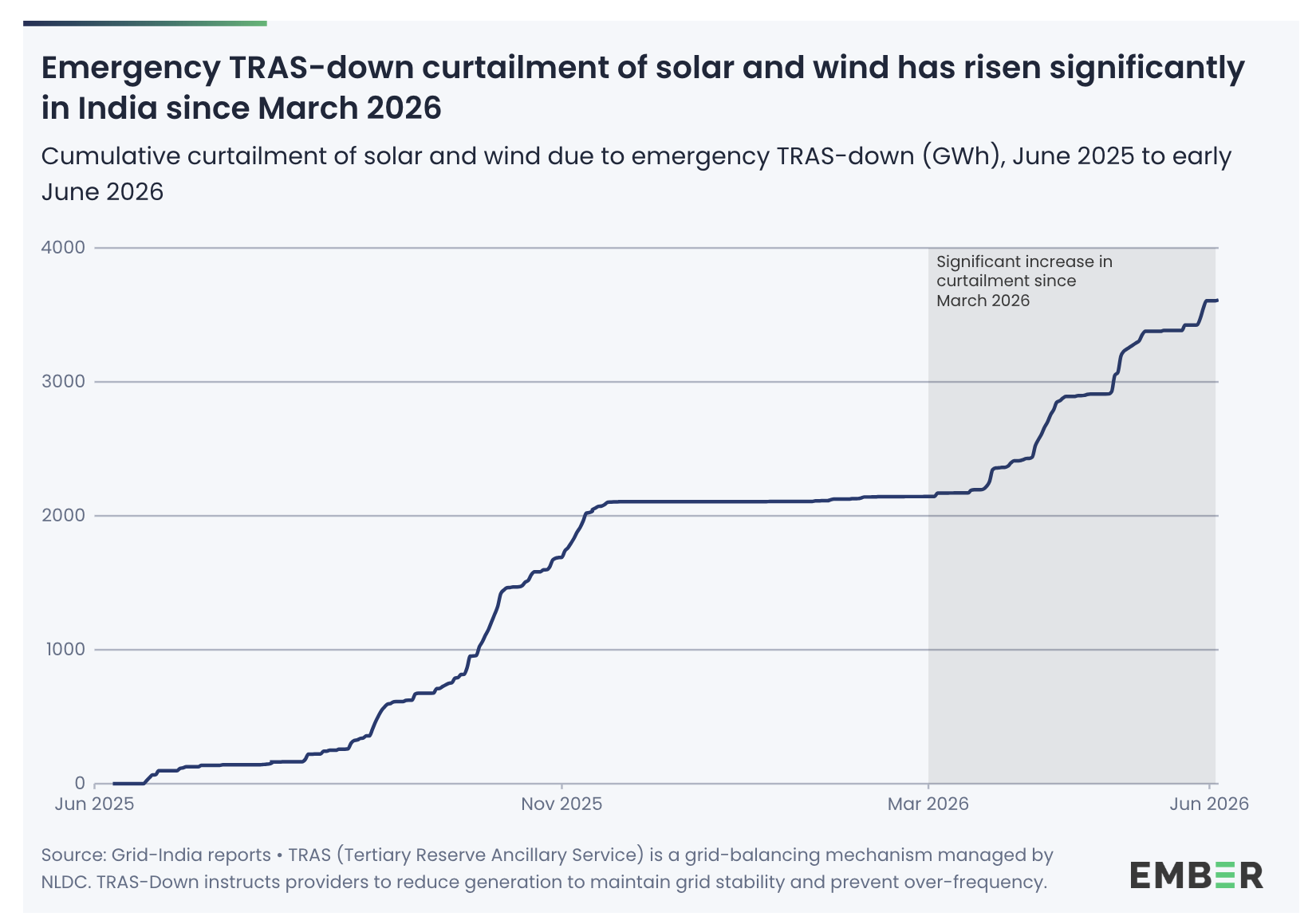
Given that last year, the sharpest rise in emergency TRAS-down curtailment was between September and November 2025, the report forecasts that, when the post-monsoon period of October-November 2026 arrives, with an even larger solar fleet, curtailment during those hours is likely to exceed 2025 levels unless storage comes online at scale.
The report highlights that battery storage is the solution, as charging during the midday surplus lets batteries absorb generation that would otherwise be curtailed and provide the downward reserves that coal no longer can. It cites the example of the 3.37 GWh Khavda project in Gujarat, the world’s largest outside China, commissioned within 10 months, to show how quickly battery storage projects can be deployed. According to the report, site-ready projects can be built in five to seven months.
However, the binding constraint, the report finds, is the connectivity framework. Current rules can require BESS projects to install commensurate renewable generation before they are permitted long-term grid charging, treating grid charging as a temporary concession rather than a normal operating mode. “The rule treats two different operations as equivalent: a battery absorbing surplus generation at noon, and a battery drawing power through a constrained connection at night,” Rodrigues said. “The first helps the grid; only the second may need limits. The current restriction is broader than the risk it is trying to manage.”
The report recommends that grid charging during solar surplus hours be permitted by default, with drawal limits applied only where non-solar-hour use creates genuine network risk. A battery free to charge from the grid can chase system-wide surplus and the cheap midday power that already falls to around INR 0.1/kilowatt-hour (kWh) on the Day Ahead Market, the route through which merchant investment can enter at the scale viability gap funding alone cannot finance. “The current framework has the default the wrong way around, restricting the very operation that would help the grid most,” says Rodrigues. “Correcting it would allow storage to charge when it reduces curtailment, lowers system stress, and improves flexibility. In doing so, it would unlock the next phase of India’s renewable energy growth.”
Article from Ember. Creative Commons Attribution license (CC-BY-4.0).
Sign up for CleanTechnica’s Weekly Substack for Zach and Scott’s in-depth analyses and high level summaries, sign up for our daily newsletter, and follow us on Google News!
Have a tip for CleanTechnica? Want to advertise? Want to suggest a guest for our CleanTech Talk podcast? Contact us here.
Sign up for our daily newsletter for 15 new cleantech stories a day. Or sign up for our weekly one on top stories of the week if daily is too frequent.


CleanTechnica uses affiliate links. See our policy here.
CleanTechnica’s Comment Policy