
Perovskite-Silicon Solar Cells Meet Matrix Shingled Interconnection Collaboration between Oxford PV & Fraunhofer ISE

Support CleanTechnica’s work through a Substack subscription or on Stripe.
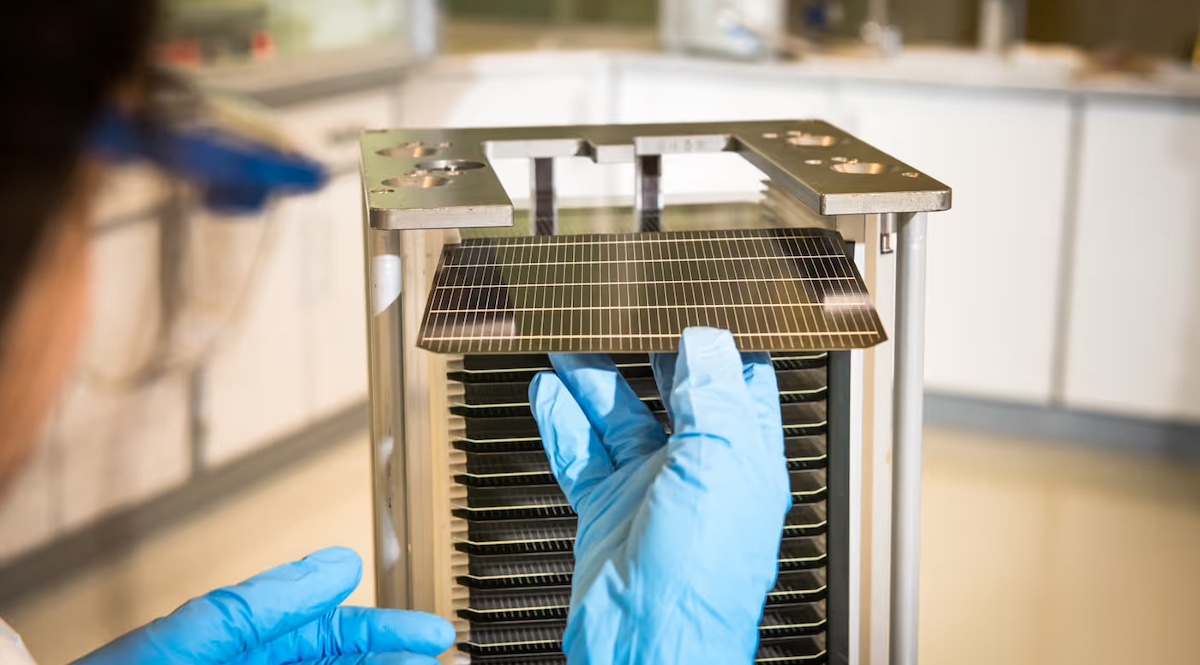
Oxford PV and the Fraunhofer Institute for Solar Energy Systems ISE have combined two high-efficiency technologies in a single photovoltaic module. To achieve this, they used perovskite-silicon solar cells from Oxford PV and connected them using the Matrix Shingle technology developed by Fraunhofer ISE. Oxford PV is a pioneer in perovskite-silicon tandem technology and was the first company to bring this next-generation solar technology into industrial production. The new module design will be on display for the first time at The Smarter E / Intersolar trade fair, taking place from 23 to 25 June 2026 in Munich. A rooftop module variant is on display at Fraunhofer ISE’s stand in hall A1.440, and a bifacial module for large-scale ground-mounted installations is shown at Oxford PV’s stand in hall A4.540.
“We are delighted to be able to combine two high-tech approaches from Europe in this PV module,” says Prof Dr Stefan Glunz, Head of Photovoltaics at Fraunhofer ISE.
“To achieve this, we have cut the solar cells from Oxford PV into shingles, arranged them in a matrix structure, electrically connected them using conductive adhesive, and then encapsulated them.” The tandem modules are glass-glass modules with edge sealing to protect the moisture-sensitive solar cells.
The 491-watt rooftop module has an area of 1.92 square metres, whilst the large-area, 546-watt bifacial module covers 2.13 square metres. Both achieved an efficiency of 25.6 percent across the entire module area.
“Our tandem technology and the shingle interconnection work well together technologically. Due to the lower current densities of the perovskite-silicon solar cells, they can be cut into wider strips, which increases productivity,” explains Dr Ed Crossland, Chief Technology Officer at Oxford PV. Tandem solar cells achieve significantly higher voltages and efficiencies than conventional cells, while the current is lower due to its distribution across two sub-cells. This lower current density is beneficial, as it helps reduce resistive losses within the PV module.
“At the same time, the adhesive interconnection of the Matrix shingle technology is a low-temperature process and requires no copper connectors,” Crossland added. Reducing usage of copper connectors can reduce operating costs and reduce stresses in the module construction.
Tandem solar cells have the potential to significantly boost efficiency in photovoltaics: by applying a perovskite cell just a few hundred nanometres thick onto a conventional silicon solar cell, the theoretical efficiency limit rises from 29.4 to 43.3 percent. Oxford PV’s perovskite-silicon solar cells and modules are manufactured in a pilot production facility in Brandenburg an der Havel, Germany. The perovskite cell is applied directly onto a silicon heterojunction cell using thin-film processes.
In Matrix-Shingle technology, the solar cell strips are bonded together using 100 percent lead-free, electrically conductive adhesives, with the strips arranged in an overlapping and staggered pattern like shingles. This enables complete, homogeneous coverage of the entire module surface. Furthermore, Matrix-Shingle technology is characterised by a high tolerance to partial shading. Thanks to the matrix arrangement, the current can flow around the shaded areas, meaning that, depending on the degree of partial shading, twice the power can be generated compared to conventional inter-connected PV modules.
The new PV modules were developed as part of the ‘HoTSun’ research project, funded by the Federal Ministry for Economic Affairs and Energy (BMWE).
© Fraunhofer ISE / photo: Jacob Forster
Sign up for CleanTechnica’s Weekly Substack for Zach and Scott’s in-depth analyses and high level summaries, sign up for our daily newsletter, and follow us on Google News!
Have a tip for CleanTechnica? Want to advertise? Want to suggest a guest for our CleanTech Talk podcast? Contact us here.
Sign up for our daily newsletter for 15 new cleantech stories a day. Or sign up for our weekly one on top stories of the week if daily is too frequent.

CleanTechnica uses affiliate links. See our policy here.
CleanTechnica’s Comment Policy