

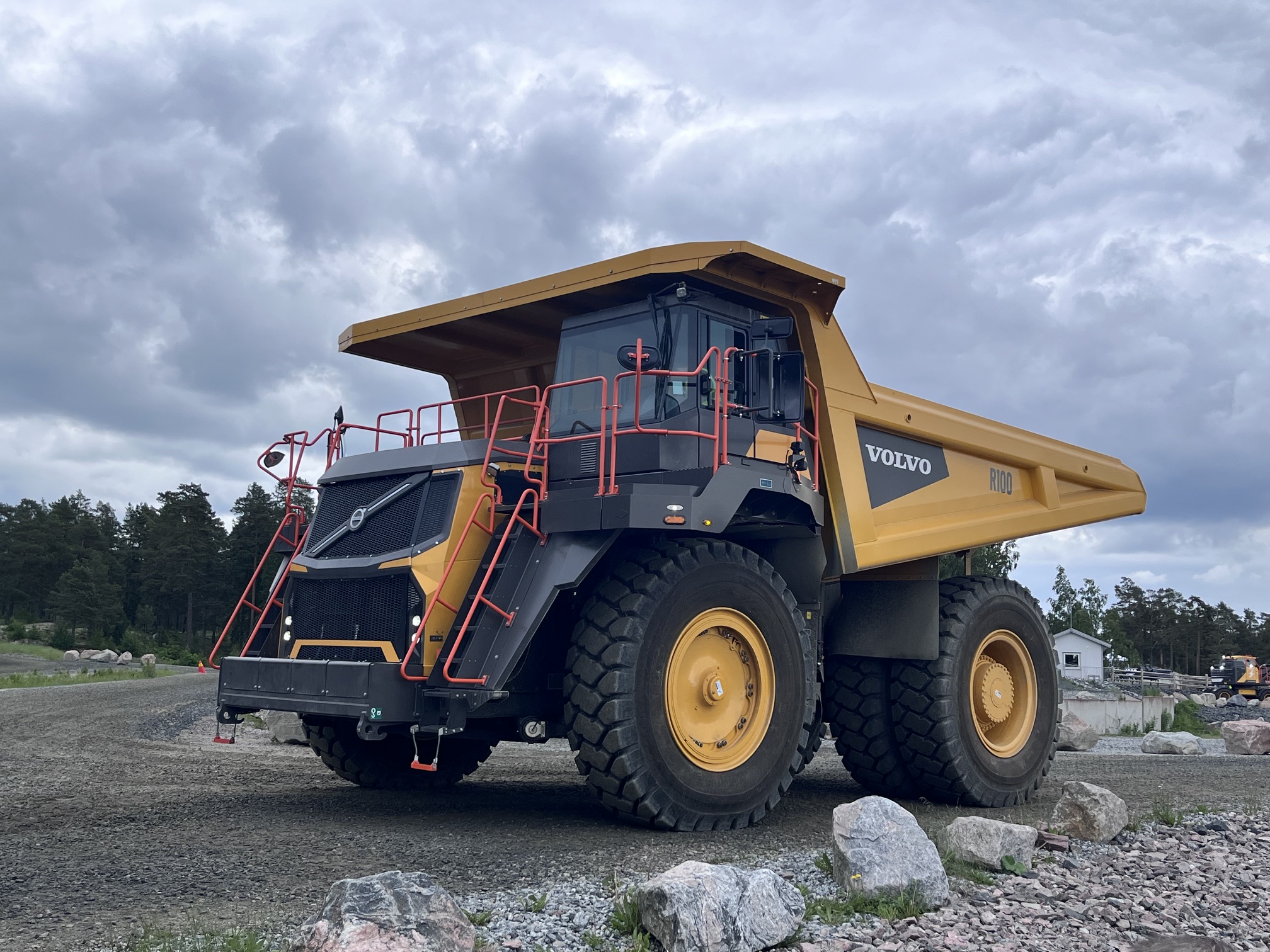
In smaller rigid mining trucks, Caterpillar and Komatsu lead in market share terms, just as they do in ultraclass, with models like the 777/775 and HD785/HD685 but there are some really good alternative options that are growing in popularity, including Volvo Construction Equipment and its rigid haulers manufactured in Motherwell, Scotland.
The Volvo CE products are also significant strategically today, as Liebherr is no longer offering its T 236 100 ton diesel-electric truck; and Hitachi does not offer the 100 ton EH1700 anymore. Chinese OEMs are making inroads with rigid models like the XCMG XDR100 (91 t) XDE130 (120 t) and SANY SRT95C (95 t) but these are primarily today still used in Chinese owned or financed mines.
Volvo’s rigid haulers are certainly very well regarded by the major operators using them – including leading mining contractors like PT Hasnur Riung Sinergi in Indonesia and Saudi Comedat in Saudi Arabia, US quarrying major Amrize, and copper miner First Quantum Minerals at its Trident operations in Zambia. The trucks are supplied and supported both by Volvo CE itself and by key Volvo dealers such as Babcock International Africa, FAMCO UAE, PT Indotruck Utama and SMT Africa.
IM Editorial Director Paul Moore has had the chance to get up close with all three main models in the Volvo Construction Equipment rigid haulers in 2026 – the 70 ton class R70 at CONEXPO-CONAGG in Las Vegas in March, plus the 60 ton class R60 and 105 ton (95 t) class R100 at Volvo Days 2026 in Eskilstuna, Sweden in early June.
In Sweden, Jim Moffat, Product Manager – Rigid Haulers at Volvo Construction Equipment talked about the fundamental upsides of the company’s rigid line-up. “Like any equipment from Volvo CE, for the rigid trucks from the outset we have been very focussed on safety, productivity and cost of ownership. Everything that we’ve done or are doing on these machines is all about one or more than one of those items.”
IM Editorial Director Paul Moore with Jim Moffat, Product Manager – Rigid Haulers at Volvo Construction Equipment at Volvo Days 2026 in Esklistuna, Sweden in front of the R60
One really stand out feature is the access up into the ROPS/FOPS certified cab via front facing and anti slip steps on both sides up to the top platform – which is at the same height as the cab floor. Eliminating a side ladder on a large machine like this was a bold move but a real safety enhancement, along with the railings that line the steps and platform throughout.
The cab itself has one of the best fields of view for the operator and it is one of the most spacious cabs in this class of trucks. Moffat: “The windscreen extends at the base to a low height to give it great direct visibility. We also gave the truck larger than usual mirrors, which are also nicely positioned, so that you can see much better when you are reversing; plus the rigids have lots of reversing lights to enhance night operation safety. The front LED lights provide a very good distance view as well.” Moffat also highlighted that the batteries for the electrical system are accessible at ground level, so that if they needing charging or replacement, it’s easy to take them out.
He added: “Looking at the body design, it gives a really big target for the excavator operator, allowing for faster loading thanks to the large surface area – it’s wide and long and with low sideboards. The double V shape of the floor centralises the first load. This ease of loading can save you a few seconds on each load, which over the course of 24 hours all ends up counting and saving a lot of cost per tonne. The trucks have a low centre of gravity to equally disperse all load impacts and structural stresses across the tyres.”
The top of the body has a 19 mm thick HARDOX plate which is there for added strength. So for example, if the bucket teeth catch it, or rocks are hitting it, it stays intact and undamaged for longer, reducing the amount of downtime for repairs.
Moffat also said that in terms of customer feedback, performance is always very high when it comes to availability in particular. Also the rigid’s ability to handle steeper haul roads – as with high drive axle multiplication, the Volvo rigid haulers deliver high levels of rimpull.
The truck also has a transmission retarder, as well as having an oil cooled disc brake retarder. The transmission retarder reduces the machine’s speed, eliminating any unnecessary use of the service brakes. As a result, the life of the primary braking system is extended, enhancing overall machine availability. It reduces wear on parts and helps keep the truck hydraulic system at a cooler temperature. The transmission retarder can also work on all four hubs, not just the rear.
Adapting to varying conditions, Volvo Dynamic Shift Control delivers productive performance through a smooth, consistent ride and low fuel consumption. This also incorporates Eco Shift Mode, which defaults to the most efficient shift schedule when working on lighter applications. The auto-idle engine shutdown and optional gear sensitive On-Board Weighing further enhance fuel savings and reduce unnecessary engine wear. Machine control is enhanced by the neutral coast inhibitor, which protects the hauler in downhill operations.
Looking at the models themselves, the R60 is available as a Tier 2 machine for less regulated markets or as a Stage V machine. The R70 only comes as a Stage V machine, and the R100, similar to the R60, has Tier 2 and Stage V variants.
Another question with the R60 is how it fares in competition with articulated haulers, including Volvo CE’s own A60? Moffat: “If you are looking at hard rock mines and quarries with steep walls, the trucks take a lot of punishment in terms of conditions and are often operating on longer shifts, so rigids are generally preferred. ADTs are often used for mines that need a lot of flexibility and have very soft ground and wet conditions. The rigids are very much aimed at shifting big volumes at high speeds – though of course that means there has to be a focus on well maintained haul roads. Rigids are also good from a long term maintenance point of view as you have less moving parts – one driven axle rather than three driven axles. So that makes it a more efficient machine, and also more economic. The rigid truck life is typically 60,000 to 65,000 hours, plus they are often rebuilt – the ADT life is quite a bit less.”
Over in the USA at CONEXPO-CONAGG, IM spoke to Rob Palermo, Product Manager Volvo Construction Equipment, about the R70 – which he said of the three models is today the biggest seller in the North American market, as opposed to globally where the R100 would have the edge. He said this is because this 70 ton class represents a sweet spot for the massive hard rock quarrying sector in the US and Canada. Palermo’s comments echoed Moffat’s in terms of operators really liking the cab visibility plus the option to use either transmission retarder or disc brake retarder; and that excavator operators like Volvo rigid trucks due to its ease of loading.
The post Volvo’s right-sized rigid mining trucks appeared first on International Mining.