

Support CleanTechnica’s work through a Substack subscription or on Stripe.
CleanTechnica was invited on a media tour through China hosted by iMpactPR. They specialize in connecting Chinese companies with the outside world, and we were excited to dive deep into all of the innovation and manufacturing happening in China with them.
Disclaimer: the author’s travel and accommodations were paid for by iMpact PR as part of a tour of companies they work with in China.
We visited robotics manufacturer and technology company Keenon in Shanghai, China, to see firsthand what they are building, how they are developing them and where they see the future of robots headed in the coming years.
Traveling around China, we saw many robots running around in public spaces. They were doing everything from delivering room service meals in hotels to providing remote camera and policing support in public spaces.
Keenon specializes in the service industry with specific focus on last-mile delivery, cleaning of public spaces, medical support, and humanoid robots. Most of their current offerings are specialized, with some designed to deliver luggage in hotels, food to a table in a restaurant, or cleaning the floor of a 7-Eleven after hours.
Why robots?
The main driver for replacing humans with robots in these tasks is saving money on the cost of labor. They can also fill in where labor markets are tight and there simply aren’t enough human workers available to fill jobs.

According to Keenon, their robots cost about a third of what humans would cost and have the advantage of being able to run almost 24/7. Keenon also stated that robots drive an increase in revenue of about 40%. Though, it wasn’t clear what specifically was causing this.
Specialized vs generalized
Robots being built today fall into two categories. Specialized robots are designed and built to do one or two specific tasks. This could be something like delivering a meal to a room or bringing drinks to a customer across town. They can identify obstacles and navigate a route within a certain geofenced area.
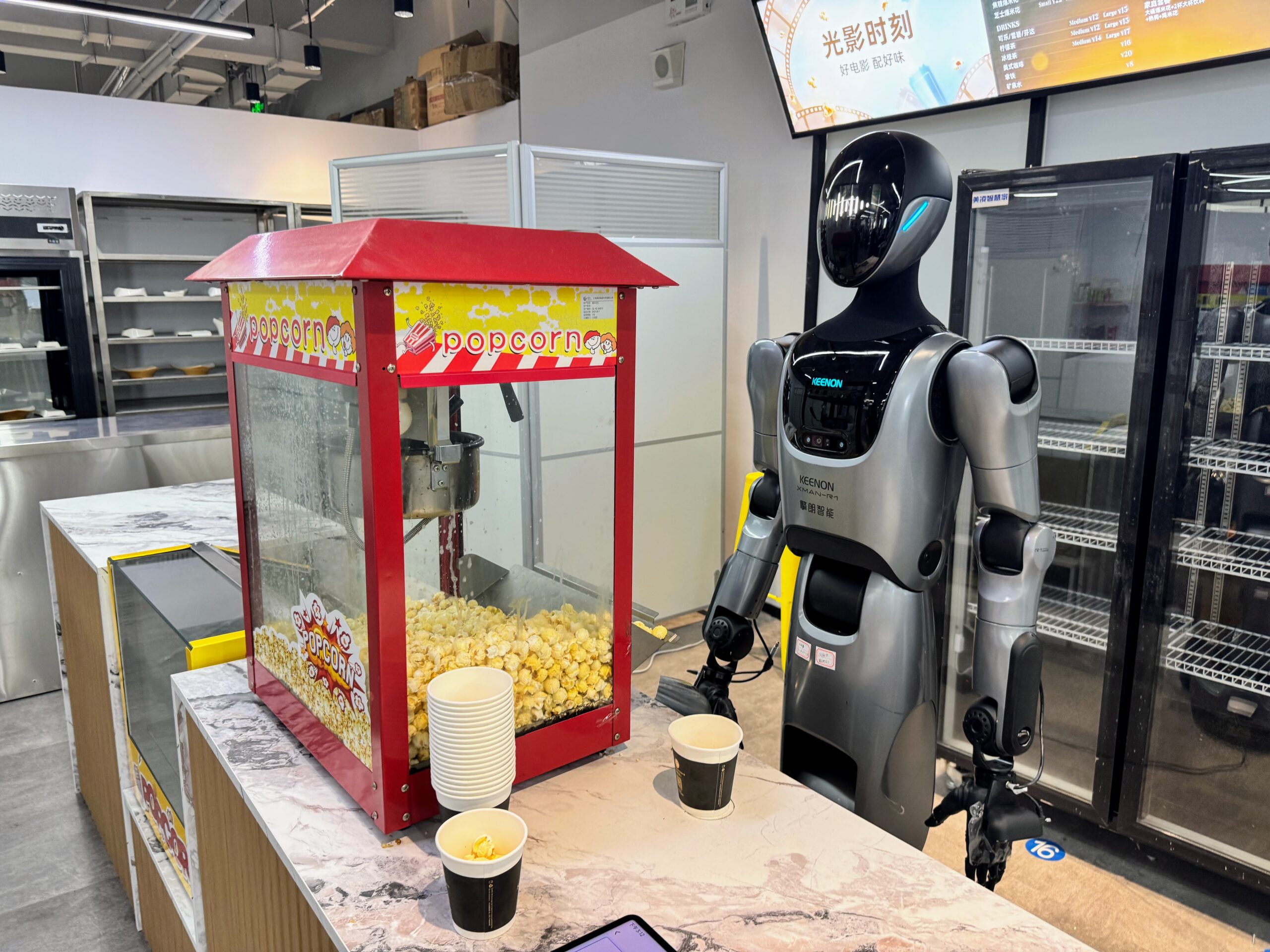
Generalized humanoid robots blow the fence right off of traditional “dumb” robots with powerful onboard compute that give them far more capability, and thus, utility. They will come in a range of form factors, but the primary differentiator is that these robots can do a wide range of tasks depending on how they are programmed and what level of artificial intelligence they possess.
I ask Keenon’s Chief Operating Officer how long he thought it would be before these generalized robots could do all of the tasks on their production lines. He snickered a little bit and said it was at least 5 years away in his estimation.

The key barrier to bringing generalized humanoid robots into the workforce in a wide range of differentiated applications is primarily intelligence. Much like the journey to fully autonomous robotaxis has been a long and arduous journey fraught with seemingly never-ending edge cases, humanoid robots face an even more complicated road ahead to navigate.
They are not confined to roads and need to be able to navigate the world in a wide range of scenarios. To be a truly generalized robot, they need to be able to perceive the world around them, understand what needs to be done, and do it with no intervention.
AGI is complicated
Keenon breaks this down into three distinct areas that need to be developed. The first is robot hardware, which while it does require different actuators with more acuity and a more complex skill set, this has effectively already been solved or is very close to being solved for the initial wave of human eye robots.
The second thing needed is what Keenon calls the embodied mind. This is the artificial intelligence neural network needed to command these robots. This is the most difficult deliverable, but as noted, the scope can be refined to allow humanoid robots to accomplish a smaller set of tasks much faster than delivering a truly generalized humanoid robot.

Finally, these robots need to have what Keenon calls embodied motion. This is the ability to perceive the world around them and navigate it seamlessly. A truly generalized robot will not be confined to buildings, sidewalks, city streets, or trails. They must be able to navigate the entire world in all of its varied formats.
On the other hand, instead of developing a fully capable generalized humanoid robot, they could be programmed to be less intelligent in order to execute a narrower range of tasks. Think about a robot acting as a barista. They don’t necessarily need to know how to drive a car, but could be trained to make every drink in the cafe in a matter of days or weeks instead of years and decades.
Training
To deploy a specialized robot, Keenon has developed a training process to streamline the implementation after purchase. Onboarding one of Keenon’s specialized robots is typically done in a single day, with most taking around 4 hours to set up. Smaller locations can do this via the integrated touchscreen, with regional distributors coming in to assist for larger jobs.
Because the capability, tasks, and scope of the job are predefined, the training can also be streamlined. Specialized robots require specialized focused training and can get on the job much faster.

Humanoid robots are another ball game altogether. They should be able to do just about anything humans can do after some training. Straightforward tasks like making coffee on a single machine can be done with simple repetition.
Developing generalized robots requires such a wide breadth of experience. “The bottleneck is the data,” the COO told us. We can look to the journey towards developing fully autonomous robotaxis to inform this as well.
According to Keenon, having an accurate stream of real world data Is critical. Much of this can be gleaned from the web by scraping video and websites and even more can be developed synthetically. Ultimately though, the richest data is from the real world where humans perform tasks over and over with sensors recording everything. This Rich data is then piped into the training ecosystem for the final flourish, but of course this is not cheap.
Overall
The shift from human to robotic labor is not going to happen overnight, but all signs are pointing to it being an inevitable transition. Early jobs like sweeping and mopping, delivering packages and food, and even luggage delivery are replacing some of the more menial jobs even today.

As robots get more sophisticated and the AI they run on gets more powerful, the number of jobs they will be able to perform will grow. As robots proliferate, we as a society will need to find ways to work with them productively and to replace the lost income and satisfaction that comes with a job.
Replacing necessary work that humans don’t want to do or get satisfaction from with robots feels like a good transition. New jobs will be created repairing robots, writing the software for robots, and building the robots themselves. As with any new technology, we will need to find a way to work with our new robot overlords, but eliminating the need to do unsafe, repetitive, and dehumanizing jobs feels like a win.
For more information about Keenon and their robots, head over to their official website.
Sign up for CleanTechnica’s Weekly Substack for Zach and Scott’s in-depth analyses and high level summaries, sign up for our daily newsletter, and follow us on Google News!
Have a tip for CleanTechnica? Want to advertise? Want to suggest a guest for our CleanTech Talk podcast? Contact us here.
Sign up for our daily newsletter for 15 new cleantech stories a day. Or sign up for our weekly one on top stories of the week if daily is too frequent.


CleanTechnica uses affiliate links. See our policy here.
CleanTechnica’s Comment Policy