

Support CleanTechnica’s work through a Substack subscription or on Stripe.
Just a few days ago, we regaled our readers with a report about how residential storage batteries are being networked together to form virtual power plants that help stabilize the electrical grid. Today, thanks to the sharp eyes of Dan Allard, we are able to expand on that story by reporting that batteries in electric buses are also being used for similar purposes.
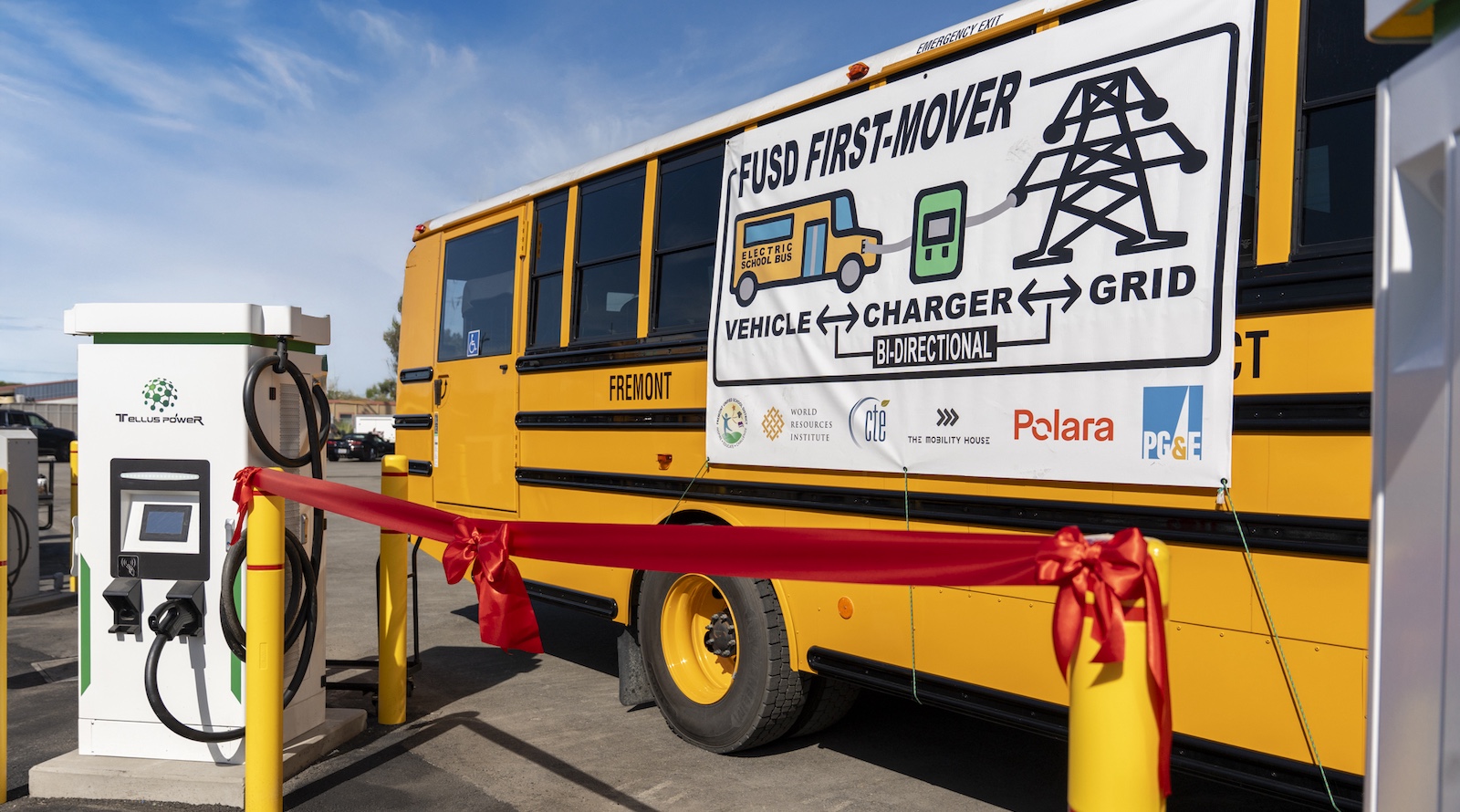
There are more than 6,700 electric school buses deployed and operating in 49 US states, Washington D.C., and tribal nations. With school out for the summer, and with temperatures this summer soaring above normal highs, the demand for electricity is higher than ever. Some of those school bus batteries are helping to meet the need thanks to bi-directional charging technologies, better known as vehicle-to-grid (V2G) capability.
Reuters reported this week that fully deployed V2G projects involving about 230 of the nation’s electric school buses now have the capacity to supply about 8 megawatt-hours of power at any given time, according to the World Resources Institute’s (WRI) Electric School Bus Initiative.
That is not enough to solve every capacity shortage. PJM, the largest regional grid in the US, will need more than 160,000 megawatts of power this week to meet peak demand for 67 million people who are sweltering under record-breaking temperatures. “It’s very early days. School buses will be a critically important backbone of V2G capacity,” Steve Letendre, senior advisor to the Vehicle Grid Integration Council trade association, told Reuters.
Electric school buses have large batteries, some exceeding 200 kilowatt-hours. They can charge when demand is low and send power back to the utility when demand is high. They often sit idle in the summer when electricity demand surges. At least 31 utilities and 21 states are involved in V2G school bus projects, WRI said. More electric school buses are being added to fleets all the time and many of them will include V2G capability.
V2G projects involve significant upfront costs and suffer from the lack of a universal V2G technology standard. Regulatory frameworks and standards are years away. Owners and operators face concerns that repeated charging and discharging of a battery could accelerate battery degradation, and that the use of V2G could void battery warranties.
California Leads In School Bus V2G
California leads the US in developing and adopting V2G school bus technology. The largest project is for the Oakland Unified School District, where Pacific Gas & Electric and transit provider Zum operate a fleet of 74 buses estimated to generate 2.1 gigawatt-hours of electricity annually. A separate Zum project with the San Francisco Unified School District is set to launch next month. It is expected to surpass the Oakland project, with a starting fleet of 104 buses returning about 3 gigawatt-hours of energy annually during peak hours. The fleet will more than double to 238 electric buses in 2027–2028.
California mandates that electric school buses funded through state programs be equipped for vehicle to grid capability. It is funding some V2G infrastructure programs and has the state’s largest utilities — PG&E and Southern California Edison — as partners.
In Connecticut, the Branford Public Schools district will have 46 V2G-capable electric buses in August. In North Carolina, Cherokee Boys Club will operate 21 electric school buses for Cherokee Central Schools. It has a V2G test program funded by Duke Energy. Danny Owle, the club service manager, is working on a project to use the buses as generators for school buildings that double as emergency shelters.
Daniel Thomas, director of administrative services at South Florida’s Glades County School District, plans to use 13 Blue Bird electric buses as cooling centers when the next hurricane strikes. “We hope it never comes, but this is Florida,” Thomas said. Make sure you don’t say the words “climate change” out loud, Daniel, or Snarlin’ Ron DeSantis will send his goon squad out to punish you.
Sign up for CleanTechnica’s Weekly Substack for Zach and Scott’s in-depth analyses and high level summaries, sign up for our daily newsletter, and follow us on Google News!
Have a tip for CleanTechnica? Want to advertise? Want to suggest a guest for our CleanTech Talk podcast? Contact us here.
Sign up for our daily newsletter for 15 new cleantech stories a day. Or sign up for our weekly one on top stories of the week if daily is too frequent.

CleanTechnica uses affiliate links. See our policy here.
CleanTechnica’s Comment Policy