

Support CleanTechnica’s work through a Substack subscription or on Stripe.
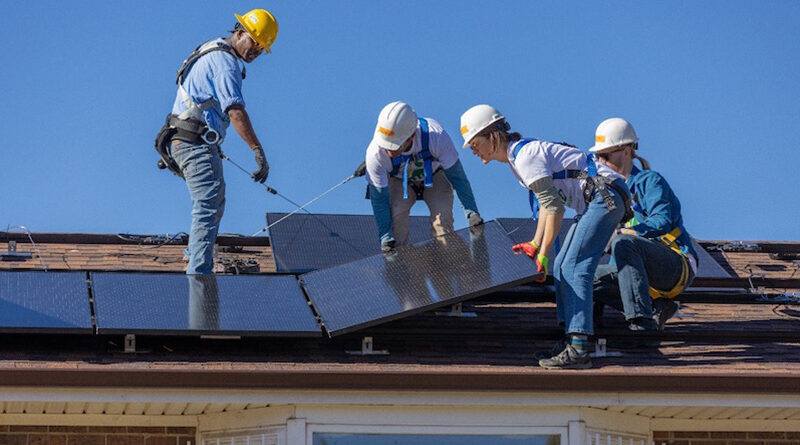
A typical rooftop solar system in the US costs two to three times more than it does in Australia. The hardware — solar panels, racking systems, inverters, and such — cost about the same. So, what makes solar so expensive in the US? Permitting and politics, primarily.
In the US, you could have ten identical homes constructed by the same builder from the same plans and if all ten homeowners wanted to put solar panels on their roofs, they would need ten separate building permit applications, which would be individually scrutinized by local building officials. Once they were approved, they would be sent to the local utility company, where more functionaries would examine them once again to ensure they met all applicable codes and bureaucratic requirements.
The review process can take six months or more to complete, and in the end, anything that does not align with every jot and tittle of local regulations can cause the whole process to get derailed, leaving the homeowner with no option other than to go back to square one and start again. All that official scrutiny creates delays that translate into higher costs.
Policy Hurdles
Several decades ago, US automakers wanted to export their products to Japan. Japanese car companies were selling their cars successfully in the US, so why shouldn’t US companies be able to do the same in Japan? But there was an important difference. Japanese automakers were able to obtain “type certification” for their products, which meant every Corolla or Civic was approved for sale in the US, once any import duties were paid. But Japan refused to extend the same treatment to US cars.
Every car brought into Japan had to be individually inspected to make certain it complied with Japanese rules and regulations. American cars all used exhaust systems made from mild steel, which was prone to rusting. That is why Midas Muffler was able to become a thriving business. Japan insisted cars imported from the US be fitted with aluminized pipes and mufflers and inspected each one individually to ensure compliance. That meant delays and higher costs for American manufacturers.
Rationalizing the permitting process leads to lower costs. Australia has been so successful at doing this that it now has a surplus of rooftop solar. In some parts of the country, ratepayers now get free electricity for three hours in the middle of each day. Do you think any Americans would be interested in free electricity? Oh, you betcha!
Permitting Reform In Massachusetts
The Massachusetts legislature is about to take a bold step forward. Following action by the House earlier this year, the state Senate last week approved S3143, which its authors refer to as “an act to save people money, repair the climate, and grow the economy.” Its purpose is to reform and streamline the residential solar permitting processes statewide.
The “Commonwealth smart solar permitting platform” will handle solar project permitting digitally, with the goal of reducing time intensive manual re-reviews and the costs involved with the process. Documents submission, permitting checklists, related fees, and project approval notices will be handled digitally. The state intends to host this solar permitting platform on a public website, according to Solar Power World.
“Massachusetts families have been waiting too long and paying too much for relief from sky-high electricity bills,” said Nicole Gentile, advocacy director at Permit Power, a solar advocacy group. “Today the Senate delivered real, meaningful relief. Smart permitting alone will save families thousands of dollars on home solar, money that goes right back into their pockets.”
The permitting platform will be made available to municipalities statewide at no cost. Cities and town will be required to adopt the platform or implement a similar means of electronic submission for solar project permitting. It is expected the new permitting program could save Massachusetts homeowners an average of $2,040 on each rooftop solar installation by 2030 and $5,540 by 2040, according to Permit Power.
S3143 includes a provision to create a solar incentive program and encourages the creation of programs for decarbonization, energy efficiency, and solar energy in public education. It also establishes a group to draft residential solar protections that “aim to facilitate affordable solar system adoption and improve system performance, customer satisfaction and consumer protection over the entire life cycle of residential solar system products and contracts.”
“As electricity demand soars, Massachusetts needs policies that make it easier to build the energy infrastructure that the economy depends on,” said Ruthie DeWit, northeast state affairs director for the Solar Energy Industries Association. “This legislation takes meaningful steps to accelerate project development, strengthen grid reliability, and keep electricity costs affordable while reinforcing the Commonwealth’s leadership on clean energy.”
Policy Considerations
Permitting is part of the problem, but policy considerations can have a powerful impact on the adoption of new technologies as well. Today, the US government is totally subservient to fossil fuel interests, which has resulted in an onslaught of new protocols that favor fossil fuels at the expense of renewables such as wind and solar. Repugnicans are famous for saying that government should not be picking winners and losers in the marketplace, yet that is precisely what they are doing each and every day this failed administration is in power.
The people caught in the middle of the fight are the workers who are building new clean energy projects, especially offshore wind. Since returning to office, the alleged president has issued an executive order aiming to halt all wind energy leases and permits, attempted to issue stop-work orders on wind projects under construction, and paid more than $2.6 billion in settlements to buy out wind energy leases. $765 million was paid to Invenergy to abandon four wind projects in California, New York, and Maine, and nearly $900 million went to Bluepoint Wind and Garden State Wind to cancel offshore wind leases in New York and California.
Hundreds of workers have been affected. Thomas Kilday, an electrician with IBEW local 99 in Providence, Rhode Island, was in the midst of a four-week-long shift onboard a vessel off the Atlantic Coast working on the Revolution Wind Project last August when the administration issued a stop-work order on the project.
“No one really knew what was going on. We didn’t know what it meant for us. We just knew that everything was up in the air,” Kilday told The Guardian. “You plan your whole life around being gone for 28 days, and to come out here and have it thrown up in the air, worrying what does this mean for me, for my pay for the next four weeks, what’s going to happen?
“There’s a lot of uncertainty. We’re proud of the work that we do out here, and we want to be able to continue to do it. We think it’s important work. When I’m at home and I drive down my street, I look up at those power lines. I helped create the power that’s running through those power lines, and I’m proud of that.”
Revolution Wind announced in March that it began delivering power to New England, citing the work of more than 1,000 local union workers, and is expected to power more than 350,000 homes and businesses. The project’s construction is over 90 percent complete.
Foolishness In High Places
“I think it’s a foolish policy that the Trump administration is engaging in trying to buy out these leases,” Pat Crowley, president of the Rhode Island AFL-CIO, told The Guardian. “These projects are not only helping to reduce our carbon emissions, they’re providing good-paying union jobs for thousands.”
Crowley said that workers would have had long-term job stability from working on these projects. He noted the administration had lost in court in its attempts to issue stop-work orders on five wind projects in the Rhode Island area. “We’re five for five taking on the administration,” he said. “What the administration is doing is just throwing money away for the sake of their ideology.”
Will Gonzalez of the Laborers’ local 385 in Fairhaven, Massachusetts, worked on the Vineyard Wind 1 project off the coast of Martha’s Vineyard, a project the administration attempted to halt in January. The project is now completed and fully operational. He criticized the Trump administration’s efforts to halt wind turbine projects, claiming the opposition from the so-called president stems from his experiences trying to stop a wind turbine project near his golf course in Scotland.
“It’s a personal vendetta,” said Gonzalez. “Good union jobs — we shouldn’t be trying to take those off the table. That just doesn’t make any kind of sense. Families obviously need good jobs … why take those jobs away?” Gonzalez said he and his co-workers were leaving training and certifications unused because of the halting of wind power projects.
“All of us that worked on that Vineyard Wind 1, obviously, we would have loved to segue right into another project,” he said. “We’re fully trained, ready to go, willing and able, so it directly affected us. But you move on. You [have] got to move on. You can’t sit and dwell on that, because that’s not going to pay the bills.”
A spokesperson for the Department of Interior denied the cancellation and stop-work orders of projects had had any impact on jobs, even on projects under construction when halted. “No jobs were eliminated because none of these leases were operational or supporting employment,” the spokesperson said.
“Rather than waiting years for the projects to materialize, the administration is prioritizing investments in existing infrastructure and functioning supply chains that can create jobs now and deliver economic benefits faster. This approach puts more people to work more quickly, using proven, affordable, and reliable energy rather than relying on projects tied to leases that were not producing jobs in the first place.”
This is the kind of Alice in Wonderland thinking in which down is up and left is right that characterizes this administration. What would Alice have to say about it all? “Curiouser and curiouser,” probably.
Sign up for CleanTechnica’s Weekly Substack for Zach and Scott’s in-depth analyses and high level summaries, sign up for our daily newsletter, and follow us on Google News!
Have a tip for CleanTechnica? Want to advertise? Want to suggest a guest for our CleanTech Talk podcast? Contact us here.
Sign up for our daily newsletter for 15 new cleantech stories a day. Or sign up for our weekly one on top stories of the week if daily is too frequent.

CleanTechnica uses affiliate links. See our policy here.
CleanTechnica’s Comment Policy