


Support CleanTechnica’s work through a Substack subscription, on Patreon, or on Stripe. Help us produce all of the high-quality, original content we publish week after week despite the challenges of content-scraping AI, antisocial media, inflation, and other hurdles.
Recent CleanTechnica stories from Michael Barnard have highlighted CATL’s joint venture to introduce electric truck swap infrastructure to Europe. That company provides turnkey solutions for swap stations and batteries.
Electric truck swap developments extend to other areas of the globe as well. Janus Electric is a company in Australia that has its own unique methods. CleanTechnica’s David Waterworth has reported on Janus developments through the years. Unlike larger companies that developed electric trucks from a factory base, Janus has developed a method of converting overhaul-ready five-year-old diesels to electric propulsion, providing a convenient and economic path to electrification for fleet owners. This method eases the transition to electrification, with a gradual replacement of the existing fleet without needing to buy brand new rigs. Janus reports that converting a diesel to electric is much cheaper than manufacturing a new electric truck, about a quarter of the cost.
In normal operation, diesel trucks become scrap when the diesel engine reaches end of life. The engine is a major part of a diesel semi’s cost. For an electric truck, motors have relatively unlimited life with proper design and use. With battery swap employing a Battery as a Service (BaaS) model, fleets reduce costs and risks. All batteries are provided by the supplier. The truck cost is reduced, and the battery pack health is monitored. As batteries age, old packs are removed from service and sold to the second use market. A known, good battery pack is always provided to the user. With swap packs in BaaS, truck life does not depend on the battery and is extended.
Details are revealed in an “Engineering with Rosie” interview with Janus Truck CEO Ben Hutt. Seeing is believing. A Janus swap takes about four minutes. Those that see and experience the trucks see the light.
In a series of articles, I highlighted the reasons and advantages for electric trucks and swap. The challenge for electric truck charging is grid demand and infrastructure upgrade costs. Slow charged swap provides a solution. Janus swap uses 300A at 240V and does not require grid upgrade. Another advantage swap has is lower battery capacity and weight. On a 500 mile route, a smaller pack designed for 250 miles can be used instead of one large 500 mile range pack. Fixed battery electric trucks need to size battery packs for the longest range trip required. They attempt to reduce charging time with fewer stops and longer range. This results in permanently heavy, costly battery packs and trucks, and less load carrying. While the amount of extra weight seems small, the effect is large, because weight regulation is per axle, not total weight.
Janus reports that diesel conversions result in lighter trucks than original, unlike fixed battery trucks that are heavier than diesel competition and require regulation exceptions. Other advantages that slow-charged swap provides are reduced grid demand, lower charging costs, extend battery life, and grid support.
Janus reports that standardization and interoperability are not factors for fleets that use their own standards within fleet. 80% of heavy truck use is low-range vehicles that return to base daily. It becomes more important for long-distance operation with multiple fleets.
“We don’t need to be the people who electrify the Hume highway from Sydney to Melbourne. There are many use cases where our technology makes sense immediately, bypassing the need to wait for national charging infrastructure.” — Janus CEO Ben Hutt
In the interview with David Waterworth, Cement Australia was given as an example. That said, any swap truck can fast charge, but not the reverse. Swap trucks can use fast charge infrastructure, reducing the need for swap interoperability during infrastructure buildout. While different swap OEMs may not be compatible, only the mechanical interface is unique. Battery electrical charging interface is standardized. Swap operations can use any chemistry. Both CATL and Janus tend to use LFP for lower cost, long life, cooler operation, and ruggedness. CATL has plans to displace LFP with sodium ion.
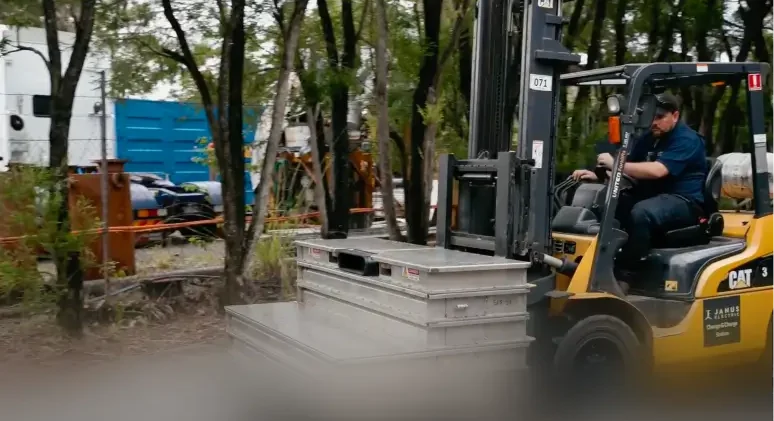
Janus presently swaps packs using forklifts operated by the drivers, and has automatic swap stations in development. All of this is already in operation with Janus Electric trucks. Rapid deployment is a feature of Janus’ approach. Janus sidesteps weight limits and charging problems. Janus is expanding rapidly, with plans for 50 kits a month from a base of 30 trucks. With recent developments putting diesel availability and cost in question, electric trucks appear increasingly more attractive. Providing an easy upgrade path to fleet owners about to overhaul diesels is a clever solution getting more interest.
Sign up for CleanTechnica’s Weekly Substack for Zach and Scott’s in-depth analyses and high level summaries, sign up for our daily newsletter, and follow us on Google News!
Have a tip for CleanTechnica? Want to advertise? Want to suggest a guest for our CleanTech Talk podcast? Contact us here.
Sign up for our daily newsletter for 15 new cleantech stories a day. Or sign up for our weekly one on top stories of the week if daily is too frequent.


CleanTechnica uses affiliate links. See our policy here.
CleanTechnica’s Comment Policy