

Support CleanTechnica’s work through a Substack subscription or on Stripe.
If you drive an EV, you probably know this feeling. You drive past a gas station sign displaying $3.41 a gallon (or a lot more these days), and then you look at your charging app showing $0.48 per kilowatt-hour. It feels like comparing apples to binary code.
It’s not just different units, it’s a totally different language. We need a common sense translation if we want to compare the cost of charging so that people shopping for EVs can make sense of what they’re seeing.
The EPA gives us MPGe and eGallons for this, but let us be honest: MPGe is for engineers. It is technically accurate but practically useless for budgeting. Most normal people do not care about “miles per gallon equivalent” energy. They care about miles per dollar. To truly compare gas and electricity, we have to look at useful work.
We need to know how much it costs to move a vehicle the same distance as a gallon of gas would.
After putting a lot of time and thought into it, I’ve come up with what I call the “Fair eGallon,” an easy to use pricing tool that lets you give a straight number to any driver, who will then know what it means regardless of whether they drive a Nissan LEAF, a Tesla Model 3, or a Hummer EV.
The Math & Science Behind This
To make this work, we have to establish a baseline for comparison. According to the EPA, one gallon of gasoline contains exactly 33.7 kWh of raw chemical energy. That is our starting point.
But here is where the efficiency reality kicks in. Internal combustion engines are basically rolling space heaters that happen to move a car as a side hustle. They are roughly 20% efficient in the real world after braking, meaning 80% of the energy in that $3.41 gallon of gas is completely wasted as heat and noise.
Electric motors, on the other hand, are incredibly efficient. For the Fair eGallon, I use an 80% efficiency rating for EVs. You might ask why we do not use 90%, which is what an EV can achieve in stop-and-go city traffic. The answer is highway driving. When you are cruising at 75 mph, especially in a truck like my Silverado EV, you are not slowing down enough to put power back into the battery through regenerative braking. We gave gas cars the post-braking penalty for efficiency, so to be fair, we need to give EVs the penalty for not using regen in all situations.
So, 80% is the fair, real-world highway benchmark that does not overpromise or give EVs any unfair advantages.
Because an EV is roughly four times as efficient (80% divided by 20%), you only need one-fourth of the raw energy to do the exact same amount of work as a gas vehicle. Again, this is a round number that won’t match every gas car or every EV, but it’s based on the physics and rounded in such a way as to be fair to both sides.
If we take that 33.7 kWh and divide it by four, we get 8.4 kWh. This is the “Fair eGallon” unit, or the amount of gasoline equivalent that you must pay for to get the same amount of work done as the gas engines do.
Multiply your electricity rate by 8.4, and you have your equivalent gas price that nearly everyone can naturally relate to.
What This Looks Like in 2026 America
Let’s look at the national averages for March 2026 to see how the Fair eGallon stacks up:
- National Average Gas: $3.41 per gallon (according to recent AAA fuel data, some places are more expensive while others are cheaper, and it’s on the rise EVERYWHERE)
- Home Charging ($0.18/kWh): $1.51 per Fair eGallon
- Average DC Fast Charging ($0.48/kWh): $4.03 per Fair eGallon
Editor’s note: Remember that many utilities offer cheap off-peak electricity. For example, it’s just $0.07/kWh for my from midnight to 6:00am. That’s much lower than the $0.18/kWh national average price of electricity, but you can find similar low-price options in many utility districts. Using Jennifer’s method, $0.07 times 8.4 is just $0.59!
At first glance, skeptics will point to that $4.03 DCFC price and say EVs are too expensive to road trip. But we have to ask why DCFC is $4.03 while gas is sitting at $3.41.
The answer is that gas is not actually cheap. It is heavily subsidized. As we have covered extensively here at CleanTechnica, the fossil fuel industry receives tens of billions of dollars annually in direct and indirect subsidies. That does not even count the massive chunk of the U.S. military budget dedicated to securing global oil supply lines. All of that acts as a taxpayer-funded coupon for the oil industry.
You might not pay for it at the pump, but your tax dollars ultimately pay for it while not paying for things like high speed rail or healthcare for all. Ultimately, you’re missing out on important things to get the cheap pump price!
Meanwhile, DC fast charging infrastructure faces active sabotage. Charging providers get hit with massive utility demand charges, regulatory hurdles, and a lack of the same government coddling that gas stations have enjoyed for a century. Government programs that Congress funded to help improve the situation were illegally halted under Trump last year (a judge recently told him that he had to stop breaking the law).
DCFC is not more expensive because electricity is inherently problematic. It is more expensive because the government has been paying for your neighbor’s gas while leaving charging stations to fend for themselves in an uphill battle.
The “Real Price” of EV Charging
Even with those cards stacked against public charging, the Fair eGallon proves EVs still win for most drivers. Almost nobody fuels their EV at a DC fast charger every single day. Industry data consistently shows that around 90% of charging happens right in the driveway for most residential owners.
When you weight the cost based on reality (90% home charging at $1.51, and 10% public charging at $4.03), you find the Real Price of an EV Fair eGallon across the board:
( $1.51 x 0.90 ) + ( $4.03 x 0.10 ) = $1.76
Even when you factor in the “expensive” premium of public fast chargers for road trips, the typical EV driver is effectively paying $1.76 per gallon to move their vehicle. That is nearly half the price of heavily subsidized gasoline today, and the gap will only widen as the Iran conflict rages on to distract us from Trump’s Epstein problem.
Stability vs. Volatility
Finally, the Fair eGallon highlights the biggest hidden advantage of driving an EV: predictability. The conversion itself doesn’t reveal this, but if you’re explaining equivalent gas prices, you have to add this important context so people don’t miss out on one of the biggest advantages.
Gasoline is highly volatile. Your monthly budget is constantly at the mercy of geopolitics. Right now, the conflict in Iran has caused a massive spike in oil prices, pushing the national average up to $3.41 and beyond. You can wake up on a Tuesday and find that your daily commute just got significantly more expensive because of a headline halfway across the world.
You are up against a moving target. If gas hits $4.10 this summer, even the most expensive DC fast chargers will become cheaper than the normal way to fuel a gas truck.
Electricity is entirely different. It is a regulated local utility. According to the EIA, the national average residential rate is around $0.18 per kWh right now, but that price is generally locked in for long periods. If your home rate gives you a Fair eGallon of $1.51 today, it will likely be $1.51 next month and next Christmas because utilities have to go through lengthy approval processes to hike prices. They can’t just change a digital sign like gas stations can.
Being Fair & Understandable
I didn’t set out to lecture everyone on geopolitical issues or fossil fuel subsidies when I started, so let’s head back to the main point again before closing.
In short, the easy way to convert electricity prices to gas prices is to multiply the electric price by about 8.4. This converts the cost of electrons to the cost of doing real-world work, and puts it in a way that people living in the fossil fuel paradigm can naturally understand whether they drive a Prius or an F350 with a 7.3L Godzilla V8.
The only thing this doesn’t really do is give a fair diesel price equivalent. Because diesel efficiency is a lot higher than gasoline, we’d have to come up with another unit for that. But, I’ll save that for another time.
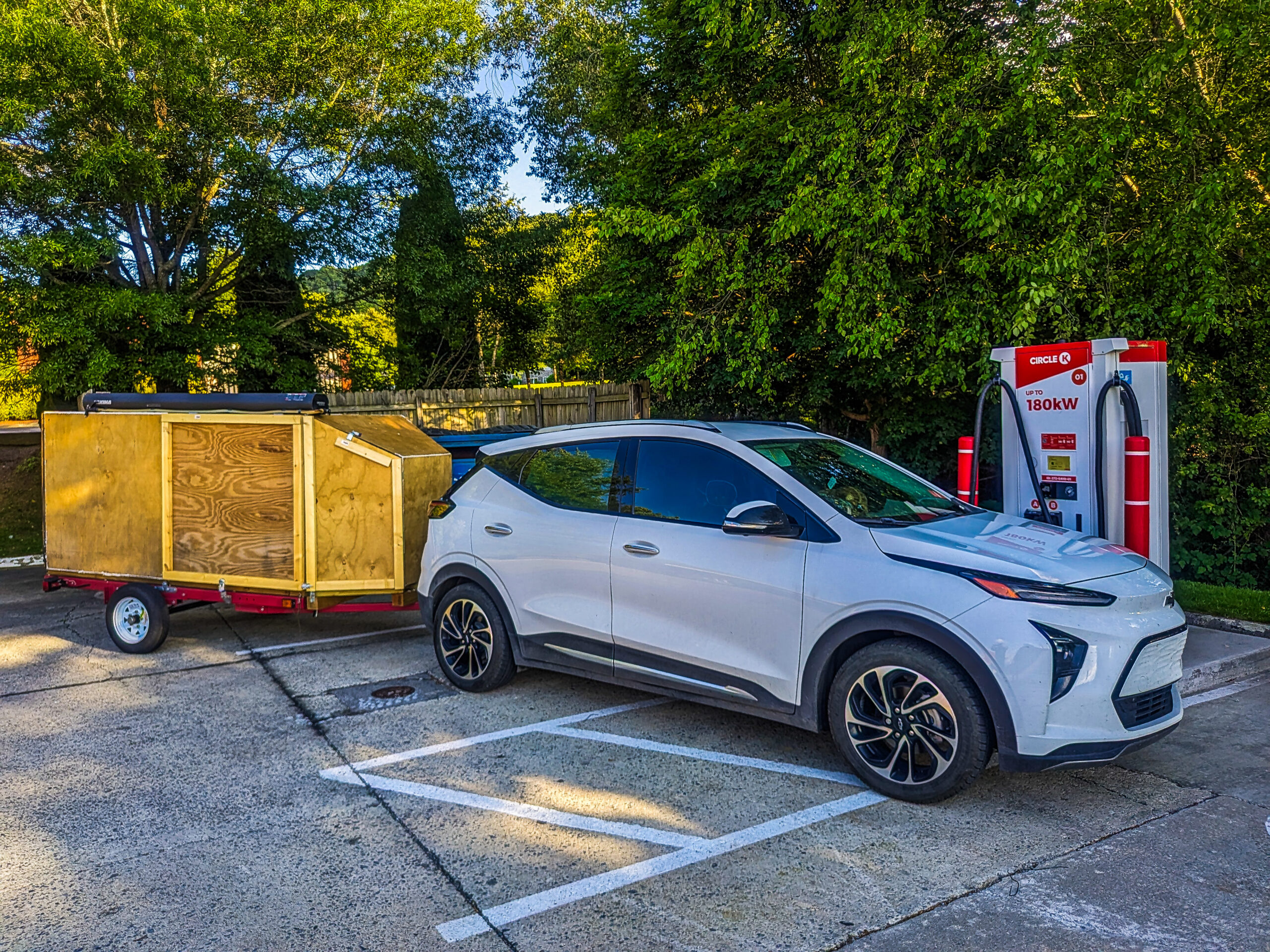
Featured image: the Bolt EUV I used to own charging at a Circle K station in Boone, North Carolina along the Blue Ridge Parkway. Image by Jennifer Sensiba.
Sign up for CleanTechnica’s Weekly Substack for Zach and Scott’s in-depth analyses and high level summaries, sign up for our daily newsletter, and follow us on Google News!
Have a tip for CleanTechnica? Want to advertise? Want to suggest a guest for our CleanTech Talk podcast? Contact us here.
Sign up for our daily newsletter for 15 new cleantech stories a day. Or sign up for our weekly one on top stories of the week if daily is too frequent.
CleanTechnica uses affiliate links. See our policy here.
CleanTechnica’s Comment Policy