
Africa’s Copper Exports Highly Concentrated as 10 Countries Command 98% of Trade Value

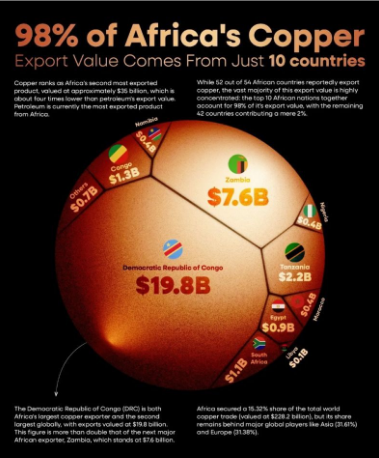
Africa’s copper export landscape reveals a striking concentration, with just 10 countries accounting for nearly 98% of the continent’s total copper export value, despite copper shipments originating from as many as 52 African nations. The trend highlights both Africa’s growing importance in the global copper market and the structural imbalances shaping the sector.
At the forefront is Democratic Republic of Congo, which dominates Africa’s copper exports with shipments valued at approximately $19.8 billion. The country’s vast mineral reserves and expanding industrial mining capacity have positioned it as a critical supplier to global markets, particularly as demand accelerates from clean energy and electric vehicle industries.
Zambia follows as the second-largest exporter, contributing around $7.6 billion in copper export value. Long regarded as one of Africa’s traditional copper producers, Zambia continues to benefit from established mining infrastructure and cross-border trade routes linked to regional ports.
In third place, Tanzania has emerged as a significant exporter, with copper exports valued at roughly $2.2 billion. Its growing role reflects increased investment in mining projects and logistics corridors connecting mineral-rich regions to global supply chains.
Overall, Africa accounts for about 15.32% of global copper trade, underlining the continent’s strategic importance in meeting rising international demand. However, the fact that more than 90% of Africa’s copper export value is concentrated within a handful of countries exposes vulnerabilities. Supply disruptions caused by political instability, regulatory uncertainty, infrastructure gaps, or security challenges in these key producers could have outsized effects on global copper markets.
The imbalance is further underscored by the remaining 42 copper-exporting African countries, which collectively contribute only around 2% of the continent’s total export value. This disparity highlights the uneven development of mining capacity, processing facilities, and transport infrastructure across the region.
As copper remains a cornerstone of the global energy transition—essential for electric vehicles, renewable energy systems, and modern infrastructure—Africa’s role is expected to grow steadily. Industry experts note that broader regional development, investment in mineral logistics, and expansion of refining and value-addition capacity could help diversify production, reduce risk, and ensure that more African economies benefit from the copper boom.