

Support CleanTechnica’s work through a Substack subscription or on Stripe.
Or support our Kickstarter campaign!
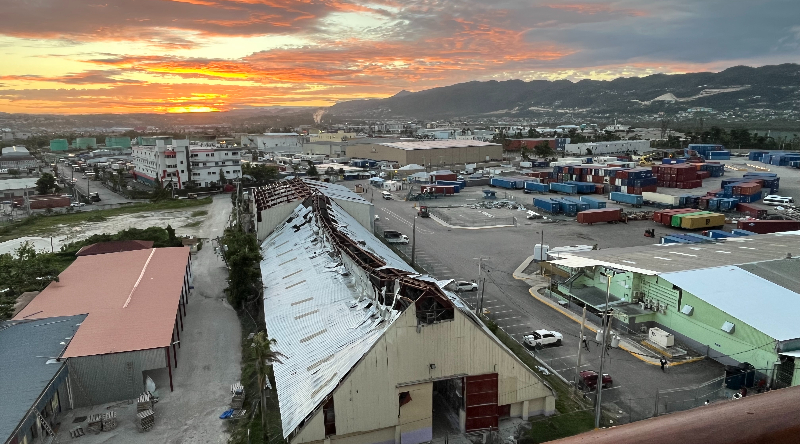
“The road is pocked from the hurricane,” the driver says, “so don’t blame me for the bumps.” Claeon laughs with us, then continues. “I don’t know why they don’t fix it.” As we leave the port, I see a warehouse next to the dock with a collapsed roof. It’s filled with pallets of construction material, wrapped in plastic. When it rains, the water must pool on the supplies destined for Jamaica’s interior. It’s a tenuous situation.
Jamaica is a land with abundant sunshine. What it doesn’t seems to have is enough robust infrastructure to support the solar equipment, nor does it currently possess federal power to supply its people with the financial means to move from diesel, coal, and natural gas to renewables. Hurricane Melissa certainly contributed to those facts of life. But so, too, has a colonialist past that continues to haunt and cloud today’s citizens, even with their determination and fiery independent natures.
After many days of unseasonably cold weather, wind, and sea swells, the day is calm and humid. We drive on the northern coast of this 4411-square-mile island, with its 14 parishes and individual capitals. It is the third largest of the Caribbean islands. Soon the shoreline is dotted with one story buildings at the water’s edge. the shore is strewn with colorful small plastics. Fences are broken. A few boats have been tossed up on land. Garbage bags filled with debris punctuate all the roadsides.
Little Evidence of Clean Energy
Some simple heat pumps are visible on the sides of commercial or multi-family dwellings. But, as the van moves beyond the Montego Bay central area, heat pumps — or any kind of air conditioning or heating — become scarce.
I see a roof with solar panels. A rare new housing complex offers one solar panel per structure. Thousands of homes that I’ll pass today, however, are unable to take advantage of the sun’s nearly constant rays here. Solar hot water cisterns sit on the tops of many roofs. A tiny building with awnings intact and a debris-free yard has one small solar panel purchased on top of a sawed-off tree.
On the island there are 150 limestone quarries; the limestone is used to make casts for broken bones, toothpaste, and water filtration, among other purposes.
A “Coal for Sale” sign is posted outside an enclave of dilapidated structures.
Claeon advises us again. “Some of the roads are going to be, let’s say, winding, bumpy, twisting, and very small.” He pauses. “Ya, mon.” I never see an electric vehicle or any EV charging infrastructure while on the excursion.
A Colonialist Legacy that Lingers Today
“They’re driving on the wrong side of the road,” a tourist mutters. “No, they’re driving on the right side of the road,” our tour guide, Charlene, with a big smile. “Ya, mon. The road direction has a legacy of its British past.”
The island’s original human inhabitants, the Taino people, were exterminated by the Spanish, who named the island Yamayca — land of food and water.
In this city, as we meander away from the industrial port, international corporations are prominent: Wendy’s, Payless, Scotia Bank, Tutti Fruiti, Pizza Hut, KFC, Kia, Honda. “We pay a 75% duty tax for import vehicles,” Charlene states matter-of-factly.
As we drive along, we pass lots of turquoise and burnt orange two-story buildings that have their doors opened and are sales spaces. Entrepreneurs sell oranges and papaya. Meats and groceries. Restaurants and bars. Caps and caftans in Jamaica’s colors of red, yellow, and black. Red Stripe beer. “Cold Beer Joint.” Sugarcane, chopped with a machete. Bags of popcorn. Chicken and chicken necks and chicken backs. Beef. Goat. A man sells concrete columns salvaged from destroyed homes and their porches. “Juicy Kitchen.”
Charlene gives us a primer in local language nuances — Jamaicans speak in a patois, so that the English “er” is pronounced “a.” They have adopted the Spanish “mi” in place of the English “my.”
Lucia, a small community in a rainy region, was named after Christopher Columbus. Sugarcane was exported in the 18th century; today, it’s wine. The island boasts 115 varieties of bananas and 15 varieties of mangoes. Coconut water is popular. Local crops include cabbage, a type of collard greens, and pumpkins. Because they are cold water crops, apples and salmon are imported and expensive — salmon runs about $50 a pound.
A roadside stop offers two buildings and tourist purchases of Jamaican rum. Blue Mountain coffee. Water shoes and towels. Cuban cigars. Local crafts and jewelry. Zion collections and footwear.
Did you know that 90% of Jamaica’s famous Blue Mountain coffee, which is grown in the mountains at high altitude, is purchased by Japanese consumers?
Descriptions Of Buildings That Are Damaged
In the early part of the trip, most roofs seem intact. All too quickly, though, several rooftops are curled and open to the elements. Lots of construction is in progress.
“Unfinished homes are common on the island,” Charlene states. “We don’t have a set time that houses are completed. Two years, five years, ten years: and when we regain cash, we continue building. 13.5% interest rate. Ya, mon.” She paused. “We pay property taxes one time a year. Some people live in their unfinished homes.” Those with money and/or credit frame out structures with lumber. For the rest, repurposing sections of broken fencing, torn sheets of corrugated metal, pallet strips, and other salvaged materials are the material sources for rebuilding.
As tourists, we’re unable to differentiate between planned progressive construction and Hurricane Melissa damage.
Newly whitewashed buildings are located next to crumbling structures. Twisted metal corrugated panels are everywhere: torn and bent, the panels peel off fences, are heaped in mounds, and lean off roofs. Restaurants open to the public have piles of rubble off to the side. For every pristine building complex, there are a hundred dwellings where their inhabitants live with the most basic services. Charlene mentions that, “on top of the resorts, there are patches on the roofs. We have road damage, flooding, and outages of electricity.”
A pristine golf course — one of 28 on the island — seems out of place among the twisted vegetation and debris.
We drive further northwest to Negril, an oceanfront location on the island that didn’t receive the heads-on force of the hurricane as did the more southern-facing regions. The Sandals resort presents itself as untouched from the hurricane. Vegetation is neatly trimmed, entrance landscapes are lush and inviting, and trim work is in place. Jimmy Buffet Margaritaville, Negril Beach offers a planned rustic atmosphere and a compound of Tiki bars, shed-like restrooms, open-air restaurant, and sheltered seating is fully functional. Mature palms flank the sand driveway and show no evident damage from the hurricane — they’ve obviously been pruned. Rick’s Cafe (“since 1974”) is known for its cliff diving, and it’s western all-the-way. There’s no sign of hurricane damage — but a promotional mural of five Red Stripe bottles and five shots was in-your-face behind the bar.
It doesn’t take much of a turn away from this tourist destination, though, to see electrical wires wrapped around each other haphazardly, draped and flapping into the incoming surf. Inland damage seems quite extensive. Entire ocean-facing walls of 500 square foot structures were torn off, with their turquoise facades standing erect and silent. Small businesses facing the road seem uninhabitable, yet, in all likelihood, the vendors are living behind their wares.
A roofless building posts a sign out front: “Yes, we are open.” My traveling companion mutters, “Yeah. They are really open.”
We see several graveyards of abandoned boats, many of which have “Glass Bottom” stenciled on their sides.
A few signs have been pummeled to the ground and lie stiffly on their sides. Telephone wires run haphazardly, dipping and nearly touching home and fences. Many wires are temporarily clipped to each other for short term stability.
A cluster of pre-teens of both genders helps parents to move buckets of yellow small stones as part of their rebuilding project. “Nearly all kids going to school here wear uniforms,” Charlene explains. The playground of a nursery school has one swing set, flanked by mounds and mounds of construction debris.
By the end of the trip, I realize that only about one in fifty structures is fully constructed, painted, and landscaped. The rest are in a variety of stages of building/ rebuilding and yard cleanup.
Descriptions Of Natural Features That Are Damaged
A low wetland that flanks the 2-lane by 2-lane road is strewn with trees broken in half and bowed.
As our drive continues, more trees are snapped in two, while others lean awkwardly. Vines climb and engulf leafless tall trees. Huge trees are on the sides, with massive root balls exposed. In nearly every neighborhood there are broken limbs and withering leaves. Tangles of branches. Dead palm fronds. Many of the trees that are leaning over have deep green vibrant leaves — they are resilient, fighting for life. Two men use small machetes to hand-chop weeds on the side of the road. A clutch of white egrets gathers beside a brook. Hundreds gather later in a sheltered cove. A few brown pelicans float on the breezes. Otherwise, the landscape seems quiet of birds.
Lots of people — both male and female — work side-by-side outside their homes, moving debris. Their enormous rebuilding tasks are still at the beginning stage.
Some pairs of trees are strapped together in symbiosis to strengthen their root structures. It seems a metaphor for the necessary collaboration and unity it will take for Jamaica to overcome the damage from Hurricane Melissa and continue the slow plod away from its colonialist past.
Support CleanTechnica via Kickstarter

Sign up for CleanTechnica’s Weekly Substack for Zach and Scott’s in-depth analyses and high level summaries, sign up for our daily newsletter, and follow us on Google News!
Have a tip for CleanTechnica? Want to advertise? Want to suggest a guest for our CleanTech Talk podcast? Contact us here.
Sign up for our daily newsletter for 15 new cleantech stories a day. Or sign up for our weekly one on top stories of the week if daily is too frequent.
CleanTechnica uses affiliate links. See our policy here.
CleanTechnica’s Comment Policy