
Bridging the Value Gap: Mining’s Essential Role in a Tech-Driven Future

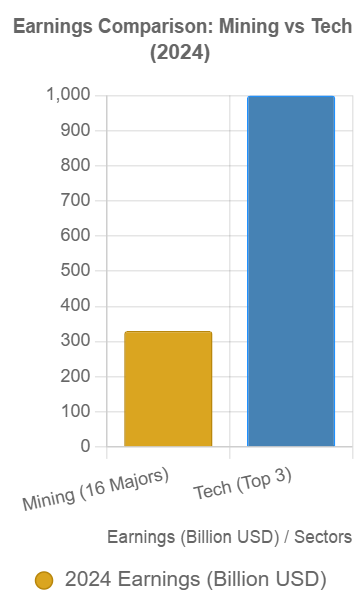
striking disparity has come into focus: the combined earnings of the world’s 16 largest mining companies amount to just one-third of the revenue generated by the top three tech giants—Apple, Microsoft, and Nvidia. This stark contrast underscores a profound undervaluation of the mining sector, despite its indispensable role in powering modern life, from smartphones to solar panels. While technology garners headlines and market dominance, mining quietly fuels the materials that enable this digital revolution. Yet, amid resource scarcity and global challenges like decarbonisation, electrification, and infrastructure renewal, the mining industry is thriving. This article explores why mining remains essential, the reasons behind its undervaluation, and the urgent need to close the value gap to meet ambitious climate, innovation, and development goals.
The Earnings Disparity: A Tale of Two Sectors
The financial chasm between mining and tech is evident in the latest data. In 2024, the top three tech giants collectively reported revenues exceeding $1 trillion, with Apple leading at $394 billion, Microsoft at $245 billion, and Nvidia at $96 billion, according to Statista. In contrast, the combined earnings of the 16 largest mining companies—spanning giants like BHP, Rio Tinto, and Vale—totaled approximately $330 billion, as per Mining Technology’s 2024 rankings. This figure represents just 33% of the tech trio’s haul, highlighting a market perception that prioritizes software and hardware over the raw materials that underpin them.
This disparity reflects investor preferences and market dynamics. Tech companies benefit from high-profit margins, scalable digital products, and a narrative of innovation, driving their market capitalizations into the trillions. Mining, however, is capital-intensive, subject to commodity price volatility, and often associated with environmental and regulatory challenges, which dampen its valuation. Yet, the sector’s output—copper for electric vehicles (EVs), lithium for batteries, rare earths for electronics, and gold for financial stability—forms the backbone of the tech ecosystem, revealing a disconnect between perceived and actual value.
Mining’s Thriving Role in a Transforming World
Despite its undervaluation, mining is experiencing a resurgence in 2025, driven by the world’s greatest challenges. Decarbonisation efforts, aimed at reducing greenhouse gas emissions, rely heavily on copper and aluminum for renewable energy infrastructure, with the International Energy Agency (IEA) projecting a 40% increase in copper demand by 2030. Electrification, a cornerstone of the green transition, hinges on lithium and cobalt for EV batteries, with global lithium demand expected to triple by 2025, according to Benchmark Mineral Intelligence. Infrastructure renewal, from smart grids to high-speed rail, further amplifies the need for steel, cement, and rare earths, essential for magnets in wind turbines and electric motors.
Gold, too, retains its relevance, with central banks purchasing 1,081 tons in 2024, per the World Gold Council, as a hedge against inflation and geopolitical instability. This demand surge has pushed gold prices to $2,450 per ounce in 2024, with forecasts of further gains in 2025. The mining sector’s ability to meet these needs—producing 3,000 metric tons of gold, 21 million tons of copper, and 130,000 tons of lithium annually, as reported by the U.S. Geological Survey—demonstrates its critical role in enabling a greener, more connected future.
The Undervaluation Paradox
The undervaluation of mining stems from several factors. First, the sector’s cyclical nature exposes it to commodity price swings, with copper dropping from $10,800 per ton in 2022 to $9,000 in mid-2025, per London Metal Exchange data. Second, environmental concerns, including deforestation and water usage, have tarnished its image, despite advancements in sustainable practices. Third, the long lead times for new mines—averaging 10–15 years from exploration to production—contrast with tech’s rapid innovation cycles, making mining less attractive to short-term investors.
Yet, this perception overlooks mining’s strategic importance. The IEA estimates that achieving net-zero emissions by 2050 will require a sixfold increase in mineral production, including a 20% rise in copper supply and a 40% jump in lithium by 2030. Without mining, the tech-driven solutions to climate change—EVs, solar panels, and wind turbines—cannot scale. Posts on X in July 2025 reflect this sentiment, with users noting, “Mining is the unsung hero of the green revolution,” and calling for a reevaluation of its economic worth.
Closing the Value Gap: A Necessity for Global Goals
The value gap between tech and mining must narrow if the world is to meet its ambitious climate, innovation, and development targets. The Paris Agreement’s goal of limiting global warming to 1.5°C necessitates a massive ramp-up in clean energy infrastructure, requiring an estimated $4.5 trillion annually by 2030, according to the United Nations. A significant portion of this investment must flow into mining to secure critical minerals, yet current funding lags behind tech’s $1.2 trillion annual venture capital influx.
Bridging this gap requires a multifaceted approach. Governments must offer incentives, such as tax breaks and streamlined permitting, to accelerate mine development, as seen in Australia’s Critical Minerals Strategy. Investors need to recognize mining’s long-term value, with ESG (Environmental, Social, Governance) funds increasingly allocating capital to sustainable miners like Newmont and BHP, which reported 20% ESG investment growth in 2024. Tech companies, too, must collaborate with miners to ensure a stable supply chain, potentially through joint ventures or off-take agreements, as Tesla has done with lithium producers.
Mining’s Evolving Role in the Future
Mining’s deep historical roots—dating back to the Bronze Age—belie its modern relevance. In 2025, the sector is transforming with automation, AI-driven exploration, and circular economy initiatives like recycling rare earths from e-waste. Companies like Rio Tinto are piloting autonomous haul trucks, reducing emissions by 10–15%, while Vale is investing in carbon capture at its Brazilian mines. These innovations position mining as a forward-looking industry, not just a legacy sector.
The global transformation—marked by resource scarcity, with copper reserves declining 2% annually and lithium deposits concentrated in just three countries (Australia, Chile, and Argentina)—amplifies mining’s importance. The U.S. Department of Energy warns that supply shortages could delay EV production by 2030 unless new mines are developed. Mining’s role in shaping a sustainable future is undeniable, from powering tech innovations to enabling infrastructure that supports 8 billion people.
Challenges and Opportunities
Despite its potential, mining faces hurdles. Regulatory delays, community opposition, and water scarcity in arid mining regions like Chile’s Atacama Desert pose risks. The sector’s carbon footprint, contributing 4–7% of global emissions, requires urgent mitigation. However, opportunities abound: the IEA predicts a $600 billion market for critical minerals by 2030, and sustainable mining practices could attract $150 billion in ESG funding by 2025, per McKinsey.
Emerging markets like the Democratic Republic of Congo (cobalt) and Indonesia (nickel) offer growth potential, while advanced economies invest in domestic production to reduce reliance on China, which controls 60% of rare earth processing. This shift could elevate mining’s valuation, aligning it more closely with tech’s economic stature.
The stark earnings disparity between the world’s 16 largest mining companies and the top three tech giants reveals a profound undervaluation of a sector that powers the technologies defining modern life. Yet, mining’s thriving status in 2025—driven by decarbonisation, electrification, and infrastructure renewal—highlights its essential role. From copper and lithium to rare earths and gold, the industry fuels the green and digital revolutions, making the closure of the value gap imperative. As resource scarcity intensifies and global goals loom, mining’s deep roots must be recognized as the foundation for a sustainable, connected future. The time is now to invest in and revalue this indispensable industry.