

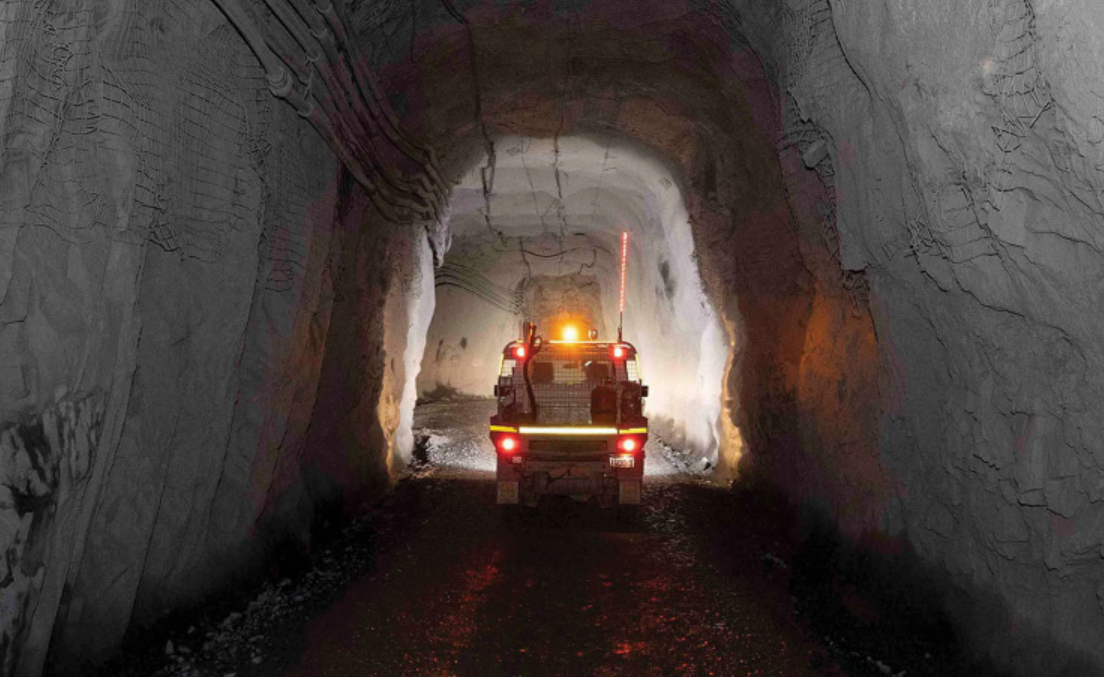
With the 2026 edition of the Future Minerals Forum coming up in Riyadh, Saudi Arabia, all eyes are on the potential for new greenfield mines in the Kingdom as intensive exploration continues. Metals mining in Saudi from a production point of view is today dominated by mining contractors – and they will continue to play an important role going forward.
IM Editorial Director Paul Moore recently caught up with Steve Coughlan, Byrnecut Group Executive Chairman, to talk about its operational background and history there at the Jabal Sayid copper mine, located 350 km north-east of Jeddah, where the current contract runs to 2028.
Steve Coughlan, Byrnecut Group Executive Chairman and Paul Moore, IM Editorial Director
The Jabal Sayid Joint Venture is held 50% by Barrick and 50% by Ma’aden but Byrnecut’s involvement started back in 2010 when Citadel Resource Group, a small Australian company, was operating the mine. Byrnecut had discussions with them in Western Australia and negotiated an initial contract which covered dewatering, rehabilitation of old abandoned workings, and early mining operations from 2010 to 2014. During this period, Citadel was acquired by Equinox Minerals in 2011 before Equinox was then acquired by Barrick the same year – Barrick then formed the current Jabal Sayid Joint Venture with Ma’aden in 2014.
Byrnecut’s full mine operation contract commenced in early 2015, which includes decline, vertical and lateral development, paste-fill, production drilling, blasting, and haulage. Using large-scale longhole open stoping methods, with a combination of cemented rock fill and paste fill, the project extracts approximately 3 Mt of ore per year. The fleet is composed of Sandvik machines – trucks nine TH663i and three TH663; LHDs seven LH621i and one LH621; four Sandvik DL421 production drills and three Sandvik DD421 development rigs plus a Rhino 100HM boxhole borer.
The first shipment of copper concentrate occurred in December 2015, and the mine commenced commercial production in July 2016. Fast forward to today and it remains a major copper producer – for the first nine months of 2025 the mine produced 48,000 t of copper, down slightly from 49,000 t for the same period in 2024. For the full year 2024, the mine produced 65,000 t and for 2025 the forecast upper end is 70,000 t.
There is also scope for expansion, which is already happening. The Jabal Sayid Lode 1 orebody is located less than a kilometre from the existing lode at Jabal Sayid. The development project for the extension was completed in 2024 with Byrnecut carrying out extensive underground capital development. The wider project also involved ventilation, paste plant and underground mining infrastructure upgrades. Stoping commenced during Q3 2023 with development for 2024 completed on schedule. A ventilation raise bore shaft was fully equipped and the reaming of the fresh air ventilation shaft was completed. The reagent plant and direct flow reactor were also completed. All construction activities at the paste plant were completed and commissioning commenced during Q2 2024.
Lode 1 has seen Byrnecut construct and set up a underground workshop for minor repairs and daily services which has seen a significant reduction in unproductive tramming time for loaders and drills as they were previously required to tram to the surface workshop for maintenance. It also completed a rebuild facility where major components such as drifters, pumps and other rotables are refurbished on site, reducing the costs on repairs, freight and reducing turn-around times.
The project also has a Transcale system which comprises a truck load scanner, weigh bridge and truck analysis system. The system was integrated into Byrnecut’s innovative LiveMine platform for accurate data recording, reporting and real time feedback to the operators to help improve truck load factors and productivities. Jabal Sayid was one of Byrnecut’s first offshore sites to implement the LiveMine system, which utilises tablets to record the operators achieved physicals per shift and uploads the data to the production database. The long-term plan is to ensure all the activities completed underground are reported through LiveMine to streamline the recording process and remove the need for paper-based data capture.
Exploration programs on Joint Venture projects around the Jabal Sayid mine have also made significant progress in delineating key prospective corridors within the Jabal Sayid and Umm Ad Damar projects. Barrick says that results to date suggest a low probability of a near-surface discovery along these corridors, but untested potential at depth remains promising and has been a central focus for work in 2025.
Back to Byrnecut’s role and Coughlan told IM: “What we do at Jabal Sayid is no different to our approach at any other underground, highly mechanised operation with the same practices we use in Australia or anywhere else in the world – focused on safety, reliability and professionalism. It is the largest underground mine in Saudi Arabia and the only one operating at this scale in the Kingdom. In 2025, physicals include 4,300 metres of large scale mine development, 3.1 million tonnes of ore hauled and 270,000 metres of production drilling. Globally in 2025, Byrnecut completed 175 kilometres of large scale development, 3.9 million production drilled metres and hauled a total of 41 million tonnes of ore and waste.” He added: “Obviously, we would hope that as the Saudi mining economy develops and grows that we will be able to take advantage of future opportunities as well. We also have a good relationship with Ma’aden and hope we will be able to continue that should they opt to develop more underground mining operations. It is still early days in Saudi but there is a lot of early stage exploration happening and in time some of that will translate into new mines, but it will take time.”
Byrnecut also has the advantage of having the equipment fleet in Saudi and a large team of trained people. Byrnecut is the largest owner of underground mining equipment in the world with sophisticated monitoring, maintenance, safety and training systems to support this fleet and our personnel globally, tailored to meet the varying cultural and employment requirements of this project.
Coughlan: “Like any of our international operations, we started with a highly experienced ex-pat team and then where possible have replaced them in senior roles with local people. In the case of Jabal Sayid we were able to bring in a number of our experienced staff from Africa and Indonesia along with Australians as well. Today the Saudi workforce is over 20% but we are working hard to increase that; plus we are also looking to hire more female employees as well – hopefully in underground roles as well. The cultural transition in that respect in Saudi has been quite significant, so that is a really good thing for industry in the country. The opening up of the business economy in recent years to encourage investment arguably places Saudi Arabia as the best country in the Middle East to do business.”
IM also talked to Coughlan about Byrnecut’s work with the key OEMs on future lower emissions powertrains, including diesel-electric and full battery solutions, as this technology may one day also be deployed in Saudi Arabia as well.
“We collaborate very closely with our two major underground suppliers, Sandvik and Epiroc. We collect a lot of data regarding performance of their equipment units and any issues they might have; and of course we feed that information back to them, so they can put those learnings into their development programs. In relation to electrification, we are also working together with the OEMs but ultimately the decisions to move forward with it are made not by us but by our clients. If the client wants a battery electric operation, we will buy machines – but as things stand at the moment, it might be a more sustainable option but it is a more expensive option. In areas like understanding their productivity and performance from a longer term point of view, including cycle times, charging and lifecycle maintenance – I would say understanding is advancing well but there is still work to be done.”
The contractor is also keeping its options open with diesel-electric machines. In 2024, Byrnecut began collaborating with Sandvik to develop new diesel-electric mining equipment; it will be the first to trial Sandvik’s yet to be named diesel electric truck, which left the Turku factory in Finland bound for WA in late November 2025.
In 2023, Byrnecut also signed an agreement with Epiroc to partner on the development of its next generation of electric drive underground loaders, that will also be automation ready and are expected to be launched in 2026. These will have more optimised hydraulics, and a modular design to accommodate for different energy sources with the ability ultimately to be converted to battery operation.
Byrnecut has also purchased two Caterpillar R2900 XE loaders – these are in use at Ore Banda Mining’s Sand King mine in WA.
Coughlan: “So we are moving in this new powertrain space as fast as we can but at the end of the day as I said its about the client – if they want to go totally green then great – but today it will still come at a higher cost that we have to pass on. Some clients are pushing for it more than others, and at the end of the day it is a learning curve for all three parties – ourselves, the client and the OEM.”
As far as Saudi is concerned, the potential for efficient operation of green mining equipment is certainly there; the Kingdom is aiming for 50% renewable electricity by 2030 as part of its Vision 2030 strategy. To date, Saudi Arabia has connected 12.3 GW of renewable energy capacity to its national grid and also brought 8 GWh of battery storage online. Jabal Sayid formerly replied on a large bank of 32 1 MW diesel generators but has now switched to grid power after extensive works completed in 2025 by specialist contractor Delonix Solutions.
The post Byrnecut building on 15 years of success at Jabal Sayid appeared first on International Mining.