

Support CleanTechnica’s work through a Substack subscription or on Stripe.
Another offshore wind win is tipping the score sheet in favor of renewables.
At first glance, you may find it hard to believe that offshore wind is up-and-running and providing clean energy to communities. The Trump administration would like you to think that offshore wind is a losing proposition, and, certainly, the Trump administration has done everything in its power to stymie its progress.
However, Vineyard Wind is another success story in the long and difficult disinformation battle against Trump and his fossil fuel allies.
Disinformation Playbooks, Well-Thumbed but Dust in the Wind
Trump tried to manipulate world leaders at the United Nations in September to reject climate change and green energy; his rhetoric consisted of a series of misleading claims and disconnected ramblings. His administration issued a stop-work order on Vineyard Wind and four other offshore wind projects in late 2025 and used their federal might to freeze new permits for offshore wind in January 2025.
He’s trying to shut down leasing for wind projects on federal lands and waters — Trump has declared that the US will see “no new windmills,” the type of comment that many in the media chalk up to another whimsical feature of his quirky personality. That, however, “obscures and deflects from the real agenda behind Trump’s assault on the wind-energy industry,” argues Michael E. Mann, director of the Penn Center for Science, Sustainability, and the Media. Mann outlines hows Project 2025 was a fossil fuel industry-friendly plan that advocated for ending taxpayer support for wind and solar energy.
Project 2025 pushed the myth that renewables were “unreliable” and overly dependent on subsidies. Of course, fossil fuel companies receive far more subsidies than renewables ever have, notes Mann.
“Trump’s assault on wind — in both word and deed — is best seen, in this context, as a quid pro quo to the fossil fuel interests, plutocrats, and petrostate actors who helped return him and enabling congressional Republicans to power.”
The US East Coast is experiencing the effects of “a well-worn disinformation playbook, one the fossil fuel industry has refined over decades, being redeployed to slow the clean energy transition at precisely the moment it threatens entrenched power,” says L. Delta Merner, lead scientist at the Science Hub for Climate Litigation with the Union of Concerned Scientists.
A façade of local resistance obscures a coordinated, well-resourced campaign to preserve fossil fuel dependence, she argues. Voices claiming to speak for local residents, fishermen, or wildlife advocates are, in actuality, “embedded in a dense national network of fossil fuel aligned think tanks, dark money donors, and political advocacy organizations.” A 2023 Brown University report, Against the Wind, documents these disinformation groups.
Tally Another Offshore Wind Win on the Books ⇑
Bundle all these obfuscations together, and Trump administration roadblocks mean the pace of decarbonization will slow dramatically as a result of his policy changes.
Yet, based on low, medium, and high emissions scenarios, the US will still reduce GHG emissions 26%–41% in 2040 compared with 2005 levels, according to Rhodium Group’s” Taking Stock 2025″ report. All the bluster can’t hide the fact that wind is one of the least expensive (even without subsidies) and fastest ways to add new power to the grid.
Kate Sinding Daly, senior vice president for law and policy at the Conservation Law Foundation, wants you to know that, yes, the offshore wind is winning in what seems a bit mythical, like a Phoenix rising from the ashes. “We passed two major milestones with this critical source of clean energy right here off our New England Coast,” she says, adding, “Did you know that Vineyard Wind has already been delivering electricity across New England?”
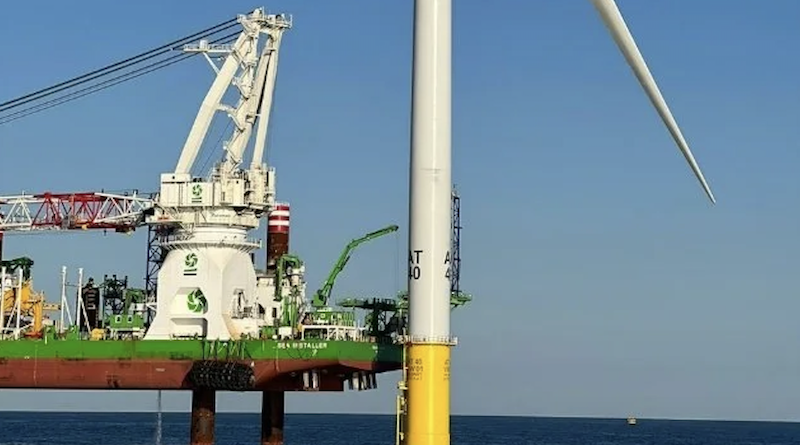
Even though the Interior Department suspended the project on December 22, citing national security concerns, the project sued the federal government and was granted a preliminary stay on January 27. That stay allowed construction to resume. Vineyard Wind finished project installation on March 13 when it put into place the last three blades on the 62nd turbine. Though the wind farm is physically installed, an unknown number of turbines still have to undergo commissioning and testing before they can be brought online.”
Talkin’ Bout a Revolution
Next up is Revolution Wind, which will power 350,000 homes in Connecticut and Rhode Island. Ørsted announced on March 13 that the project has started delivering power to New England’s electric grid, strengthening the region’s power supply and helping reduce costs for consumers.
Amanda Dasch, chief development officer at Ørsted, described the offshore wind win.
“Built by local, highly skilled union workers, Revolution Wind is a testament to states tapping their energy resources to strengthen regional energy security. We’re grateful to the leadership of Rhode Island and Connecticut, our labor partners, utility customers, and the many other stakeholders whose collaboration has made this milestone possible.”
Offshore wind lowers and stabilizes energy bills. “That’s why these wins are so pivotal,” Sindling Day continues. “Because wind slashes electricity prices and toxic, planet-warming pollution. It costs a fraction of what gas and oil did, especially during the blizzards, snowstorms, and bitterly cold weather. She adds, “This is the future that all New Englanders are asking for: cheaper, cleaner ways to power our lives. This is the future we deserve, and one that wind can provide.”
Massachusetts has a strategic goal to halve its greenhouse gas (GHG) emissions by 2030 and achieve net-zero emissions by 2050. Incorporating offshore wind into the equation is crucial. Senator Ed Markey (MA-D) explains in a recent press release that, even with Trump’s attempt to halt the project, Vineyard Wind was resilient and, ultimately, victorious.
“Donald Trump tried to kill this project last year,” Markey challenges. “The courts stopped him, unionized workers finished the job, and now this offshore energy will bring costs down for Massachusetts families – even as Trump’s chaos in global energy markets hits home and drives prices up.”
Offshore Wind Wins: Let’s Hear More Geopolitical Voices Celebrating Renewables
Rana Adib, executive director of REN21, a global network of governments, industry, and experts driving the transition to a renewable-based economy, offers a framework to consider how the latest Middle East tensions expose the systemic volatility of fossil energy markets and how a more renewable-based energy system that includes wind would even the playing field for geopolitical risk.
“What is clear from this crisis is that simply switching suppliers does not eliminate the vulnerability of fossil fuel-based systems. As long as economies remain dependent on imported oil and gas, the risk of disruption is always present. Shifting suppliers may change the geography of dependence, but it does not address the underlying structural weakness of the system.”
This moment serves as a critical opportunity to embrace renewable energy, Adib argues. Combined with electrification, energy storage, and contemporary grid infrastructure, renewables-based economies can provide greater autonomy, stability, and security for all. The move towards a renewables-based economy offers multiple benefits:
- Reduced exposure to geopolitical shocks: Energy systems that rely on domestic, widely available resources are far less susceptible to supply disruptions caused by conflict or political instability;
- Stabilized long-term energy costs: Unlike fossil fuels, whose prices are volatile and often dictated by international conflicts, renewable energy sources offer more predictable costs over time;
- Strengthened domestic value creation and job growth: Investing in renewable energy systems creates local jobs, boosts economies, and helps reduce reliance on imported fuels, thereby enhancing sovereignty; and,
- Enhanced resilience: Energy systems that are grounded in renewable resources are better positioned to withstand external shocks, making them more resilient to future crises.
Resources
- “Against the wind: A map of the anti-offshore wind network in the Eastern United States.” Climate Development Lab, Brown University. December 12, 2023.
- “How disinformation is being used to block and distort offshore wind.” L. Delta Merner. Union of Concerned Scientists. February 4, 2026.
- “Our offshore wind tracker: What’s new with wind projects off Massachusetts and beyond? Anastasia E. Lennon. The New Bedford Light. March 13, 2026.
- “Revolution Wind begins delivering power to New England.” Ørsted. March 13, 2026.
- “Taking Stock 2025: US energy and emissions outlook.” Rhodium Group. September 10, 2025.
- “The case for renewables: Lessons from global dependence on Middle East fossil fuels.” RENI21. March 11, 2026.
- “The darker agenda behind Trump’s obsession with wind turbines.” Michael E. Mann. Boston Globe. September 10, 2025.
Sign up for CleanTechnica’s Weekly Substack for Zach and Scott’s in-depth analyses and high level summaries, sign up for our daily newsletter, and follow us on Google News!
Have a tip for CleanTechnica? Want to advertise? Want to suggest a guest for our CleanTech Talk podcast? Contact us here.
Sign up for our daily newsletter for 15 new cleantech stories a day. Or sign up for our weekly one on top stories of the week if daily is too frequent.
CleanTechnica uses affiliate links. See our policy here.
CleanTechnica’s Comment Policy