
CENTRE UNLOCKS MINERAL WEALTH: INCENTIVES FOR ‘FIRST-MOVERs’
India’s Fast-Track Mining Policy to Ignite Industrial Growth & Resource Independence

By Editorial Desk
In a decisive push to supercharge domestic mineral production and accelerate industrial expansion, the Central Government has rolled out a bold incentive package to reward ‘first-mover’ mine owners — those who can swiftly convert auctioned blocks into producing assets.
The new framework squarely links speed with reward by promoting operational efficiency as a competitive advantage to boost the mineral sector and incentivise early commercialisation. In this process, Govt is giving a signal that “Time is essence and delay is curse”.
The mandate: Cut time, Boost output:
India’s mining ecosystem has long suffered from regulatory inertia, multi-layered approvals, and extended gestation periods up to mine-production. The policy now seeks to convert mineral potential into industrial reality.
Now policy targets are broadly on the following lines:
- Enhance resource security: Rapidly unlock strategic mineral deposits like coal, iron ore, manganese, bauxite, copper etc. to reduce import dependency.
- Expand domestic output of critical minerals/ REEs, keeping in mind their growing demand.
- Economic booster: Mineralise economy with greater emphasis on the renewables.
- Attract Global Capital: Incentivize investments including Viability Gap Funding.
Key incentives/measures announced:
The Dart of incentives points at providing support against measurable performance indicators by linking timelines for execution with tangible outcomes and development measures to create platform to explore, trade and deal with different minerals:
- Revenue-Sharing Bonus: Early starters who achieve commercial production ahead of schedule will qualify for a higher revenue share from mineral output for an initial period. e.g. Ministry of Coal offers a rebate on the final revenue share to incentivize the early production of coal.
- Incentives for Coal gasification/ liquification in the form of rebate on final offer price.
- Promote environment friendly UG mining by providing incentives in the form of reducing the floor percentage of the revenue share, waive upfront payment, permitting captive mine owners to sale a part production in the open market etc
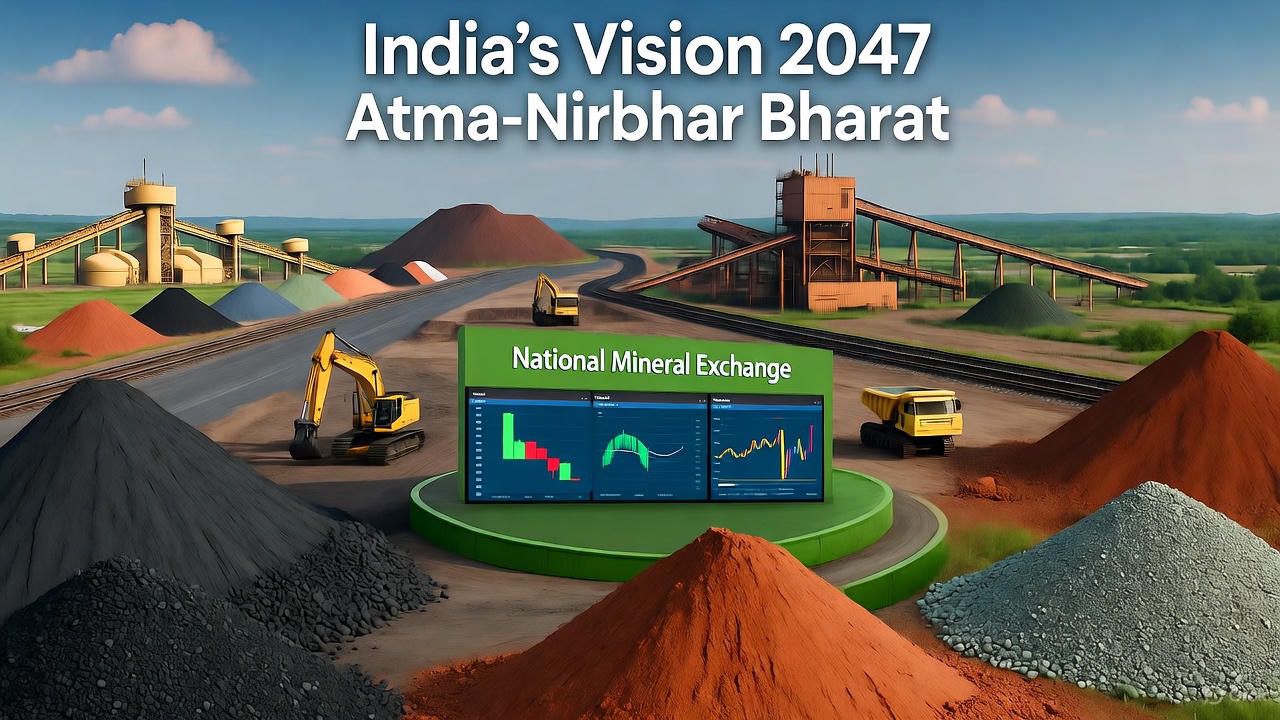
- Creation of National Mineral Exchange to transact/ trade minerals in an on-line platform.
- Greater emphasis on mineral exploration by increasing contribution and facilitating development activities.
- Expeditious Statutory Clearance and review: A single-window fast-track mechanism will clear environmental, forest, and operational clearances for projects based on progressive readiness and established project monitoring mechanism.
- Infrastructure Support: Financial stimulation will be extended to improve logistics covering haul roads, rail sidings, power and water linkages — bridging the gap between the needs and deliveries.
- Entry of critical minerals in the schedule under MMDR Act and setting up National Critical Mineral Mission (NCMM).
- Auction of critical mineral blocks and development of ‘urban mining’ i.e. recycling of secondary sources especially e-waste and Li-ion batteries through R3/R4 recyclers.
- Capex/Opex subsidy based on investment in the critical minerals.
Policy shift: Compliance Review vs Performance Milestone:
Unlike earlier framework that relied on post-delay pull-up, present policy is forward looking to compliment the achievement through a calibrated carrot-and-stick approach focusing on accountability at every stage. Macro differences may be outlined as follows:
Hitherto:
- Broad, flexible timelines and generic monitoring parameters.
- Liberal penalty for delayed progress.
- Systemic loopholes supporting a speculative “block squatting.”
Henceforth:
- Successive auction of mine blocks under different categories and transparent declaration of preferred bidder after conclusion of auction.
- Time-Bound Milestones for the activities to develop mines after issuing LoI.
- Financial push: Early movers enjoy auction-premium, rebates and operational concessions.
- Delays trigger monetary penalty and loss of preferential treatment.
The much-awaited pro- active structural reform is likely to ignite India’s mining landscape and drive domestic output to meet rising demand, thereby saving forex due to lesser reliance on imports.
Expert insight:
Mr. A. P. Panda, Ex-CMD of Eastern Coalfields Ltd. (ECL) and South Eastern Coalfields Ltd. (SECL), and currently Whole-Time Board Member & Senior Advisor with MMPI (Metals & Minerals Publication of India, New Delhi), believes that such a policy marks “a progressive shift from Allocation to Stimulation.” It has been a general perception that India’s mining potential is yet to be leveraged fully to meet the requirements of a rapid growing economy due to systemic, structural and statutory issues deeply impacting the economy in large and mining sector in particular. In this scenario, new measures/ incentives may provide a fillip to the languishing sector. He adds that introduction of mineral exchange, development and beneficiation of minerals, thrust on critical minerals and ‘first-mover’ advantage etc, are likely to benefit the players / mine owners with integrated capabilities — those who can handle mine development, beneficiation, logistics, and environmental compliance etc. It is also likely to pull large scale investments into the mining sector by attracting FDI/FIIs not only to make country self-reliant or ‘Atma-Nirbhar’ on the mineral inputs, but also to ensure sustainable mineral extraction on ‘Dharohar’ philosophy.
Global race to rein over strategic minerals:
Present policy intervention may not be purely accidental, as the developed nations and growing economies tighten their grip over the liberal movement of critical minerals. India is moving forward in right direction by asserting itself as a resource-rich and drive-delivery destination.
India’s vision 2047 not only coincides with celebrations over 100 years of independence, but also enables the eco-system that meets the aspirations of one and half billion Indians.
Watch India:
As a fastest growing economy poised to overtake Germany to achieve 3rd rank in the world, India is being watched from the policy perspectives:
- India’s Execution Curve: Will policy translate into actual output and delivery beyond domestic consumption in near term?
- Investor Confidence: Global funds and large players track India’s regulatory consistency.
- Sustainable Operations: How does India balance economic acceleration with environmental obligations?
- Infrastructure adequacy: Whether growing logistics, energy security and delivery eco- system align with the expanding operations?
- Reciprocal effect: Can it provide any input mineral-rich nation to improve international trade?
Conclusion: Mining an economic booster
The Centre’s series of reforms signal a move towards a new era to make mining sector a growth multiplier for the economy instead of a legacy backed inertia. Indian economy is growing at a faster pace as compared to other developing economies necessitating greater contribution from the mineral sector. Change in demand dynamics, emphasis on renewable energies and global restrictions on trading with critical minerals etc may prove costly to the economy, unless players in the mineral sector rise to the occasion to contribute to nation building in the form of providing cost competitive inputs to promote domestic manufacturing in a big way.