

Support CleanTechnica’s work through a Substack subscription or on Stripe.
More and more heavy-duty electric trucks are hitting the roads in Australia. CleanTechnica has written about that here and here. Before we go any further, we need to note that most trucks in Australia run on defined short routes. Electrifying those routes, either with battery swapping (as does Janus) or high-speed charging is not difficult, with the right support.
So, let’s address the charging issue. There are many possible solutions.
eLumina and HubZero are adapting innovative solutions from EV charging and mine sites, where ARENA (the Australian Renewable Energy Agency) is funding a more traditional model.
Recognizing that heavy freight is one of Australia’s hardest transport sectors to decarbonise, with trucks accounting for a disproportionate share of transport emissions, ARENA is providing federal funding for the sector. ARENA is cofunding the establishment of three shared use electric truck charging depots in Melbourne, Victoria. It is providing AU$25.3 million of the total project cost of AU$61.82 million. The first site in Melbourne’s west side is expected to be open by the end of this year and will comprise 12 bays offering 400 kW charging. Two more sites (southeast and north) are expected to be operating by the middle of next year. You can see the map here. The sites will be powered by 100% renewable energy and cover Melbourne’s key freight corridors.
ARENA and Newvolt plan to overcome two of the barriers hindering the transition to electric freight:
- Small and medium-sized businesses freight operators “lack the depot space, grid capacity, and capital to install private charging infrastructure at scale. The upfront complexity of procuring and commissioning high-power charging equipment is a significant deterrent.”
- “There is no reliable, publicly accessible fast-charging network designed for heavy vehicles operating along Australia’s major freight corridors. Without that infrastructure, operators cannot commit to electric trucks for duty cycles.”
Newvolt plans to overcome these barriers with the three, networked shared use charging hubs listed above. Learnings from the project are expected to lead to replication of the concept across state borders using the Hume, Pacific, and Newell Highways. This should increase confidence for fleet transition from diesel and per operator cost.
Knowledge gained and shared publicly about “hub operations, grid integration, demand management, charging behaviour, and operator economics” is expected to “lower barriers for future infrastructure developers and fleet operators nationally.” Newvolt projects that its hubs will encourage at least an extra 54 heavy- and medium-duty BEV trucks into the fleet, with the accompanying reductions in emissions, noise, and air pollution. Perhaps cost reductions also.
Learning from their work with battery augmented chargers for EVs, eLumina is establishing a New Energy Transport hub near Sydney to provide high-speed charging for up to 20 trucks at a time — “assuming a 200 kW average split or smart staggering per truck.” One to two hectares of gravel hardstand have been paid to allow for parking and heavy turning circles, served by 10 × 400 kW skid-mounted eLumina DS400 chargers.
Power is provided from the NEM grid via a connection to the local Maldon substation (1.3 MVA). The eLumina DS 400 satellite chargers use integrated battery systems to enable trickle charging over time and avoid spikes on the grid when domestic demand may be high. Trickle in, store, ultra-fast charging out. This avoids overloading the substation.
Deployment of skid-mounted chargers can be rapid. Use of integrated batteries avoids costly and time-consuming high-voltage grid upgrades. Use of gravel hardstand and skid-mounted chargers means that sites can be flexible — reconfigured as needed and relocated if necessary.
As with the early days of EVs, charging solutions will evolve as the electric semis prove them themselves able to handle the freight and the route.
Hub Zero is another company setting up battery integrated chargers for heavy trucking. Their website opens with answers to objections: “Our routes are too long for an Electric Truck.” But … the average Australian articulated vehicle does 250 km a day. “Charging will kill our turnaround.” But … a 350kW charger can add 250 km of range in 45 minutes, and that’s the cumulative rest a long-haul shift requires. Charge in the breaks you’re already paying for. On depot-to-depot routes, the truck can charge overnight at the depot. Hub zero estimates that an electric prime mover will save the trucking company between AU$50 and AU$200 a day. I expect those numbers will be higher now, due to the war-driven spike in diesel costs.
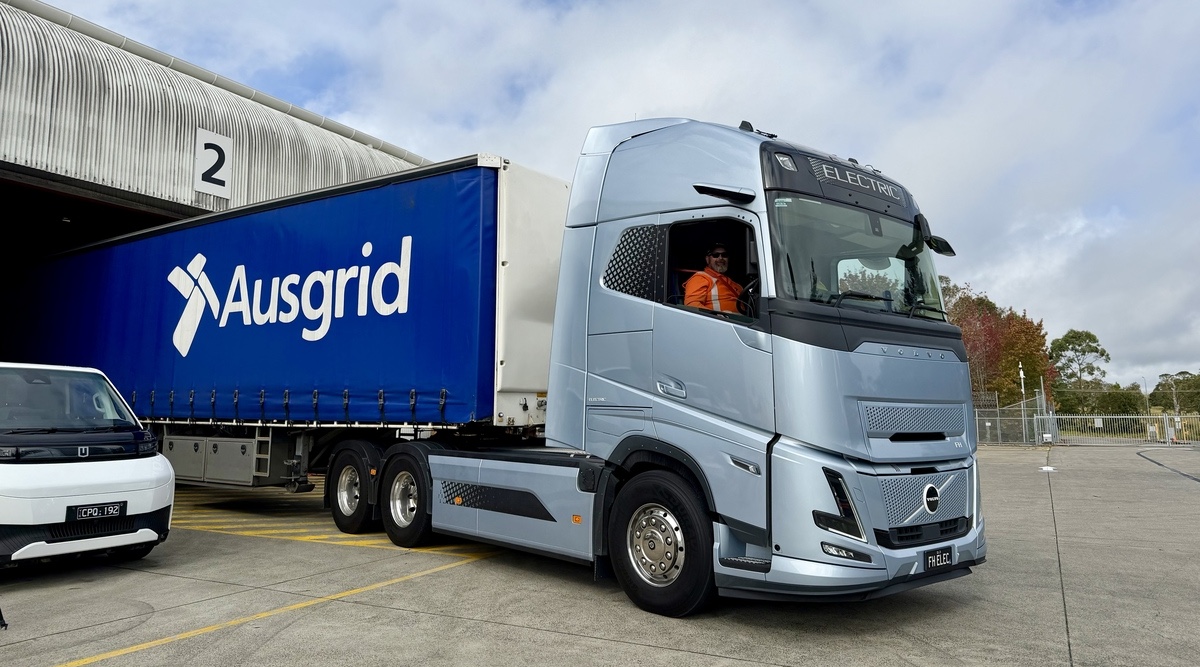
HubZero has a convenient tool to find grants for the building of charging infrastructure. The site lists 28 programs at state and federal level with a total funding pool of AU$21.4 billion. That’s quite a commitment. HubZero has recently supplied a Grid Rig battery charger to Ausgrid to support the trial of a Volvo FH Aero Electric prime mover. The Volvo will haul loads of more than 30 tonnes from the Upper Hunter to Southern Sydney.
See the video of midsized trucks charging at the depot here.

The Grid Rig combines a standard grid connection with integrated battery storage. “Power where the grid can’t go” is their motto. But, obviously, they can do more than that. It is great to see an innovative solution designed for off-grid mine sites being applied to the urban trucking and logistics industry.
“Our solutions are engineered for real-world conditions — high duty cycles, extreme temperatures and mission-critical uptime. With battery capacities ranging from 100kWh to 2MWh, support for CCS1 and CCS2 fast charging, industrial-grade power outputs and intelligent liquid-cooled thermal systems, Grid Rig products are built to perform consistently in the field. Backed by regulatory compliance and hands-on service capability, we partner with operators to keep projects moving, vehicles charged and operations running — wherever the work takes place.” It was exciting for me to see Fortescue-branded vehicles in their media releases.
Ausgrid has already electrified more than 150 of its fleet passenger vehicles and is now shifting its focus to trucks, vans, and utilities. CEO and cofounder of Hub Zero Mahan Perera said the [Grid Rig] setup is designed to avoid more complex upgrades and was installed in a matter of hours, helping get the trial up and running quickly.
“Some of the challenges with heavy vehicle electrification include the time and cost it can take to install charging infrastructure,” Mr Perera said. “This trial is demonstrating a different approach.”
“Using rapid deployment, battery-assisted fast charging to avoid the need for grid upgrades and digging up the ground — simplifying the process and getting infrastructure in place more quickly and cost-effectively.”
Sign up for CleanTechnica’s Weekly Substack for Zach and Scott’s in-depth analyses and high level summaries, sign up for our daily newsletter, and follow us on Google News!
Have a tip for CleanTechnica? Want to advertise? Want to suggest a guest for our CleanTech Talk podcast? Contact us here.
Sign up for our daily newsletter for 15 new cleantech stories a day. Or sign up for our weekly one on top stories of the week if daily is too frequent.


CleanTechnica uses affiliate links. See our policy here.
CleanTechnica’s Comment Policy