


Support CleanTechnica’s work through a Substack subscription or on Stripe.
The second-generation Chevy Bolt is arriving in dealer showrooms as you read this. Based on the prior Bolt EUV, it takes a discerning eye to notice the new headlight and taillight treatments. To the casual observer, the car appears to be “refreshed” rather than “all new.” And yet, under the skin, there is very little left of the original car.
All New Powertrain
The new Bolt comes with a 65 kWh LFP battery in place of the previous NMC battery. This means a greatly reduced risk of fires and the ability to charge to 100 percent on a regular basis. Chevy strongly recommended charging only to 80 percent with the old battery.
As a practical matter, travelers will probably elect to stop charging at 80 percent on trips, as the charging curve tapers sharply past that point. Many EV owners have found it is faster to make two stops to charge to around 70 percent or so than it is to make one stop to charge to 100 percent. That sounds counterintuitive, but in practice it works well.
The motor that drives the front wheels comes directly from the Equinox EV and is rated at 210 hp and 169 lb-ft of torque. That’s actually less torque than the old motor, but Chevy has fiddled with the gear ratio in the one-speed transmission to boost low-speed performance and the difference in acceleration is less than an eye blink or two. The new motor is also said to be more efficient, which allows the new car to garner a 262-mile range estimate from the EPA, even though LFP batteries tend to be less energy dense than NMC batteries.
Chevy says the new Bolt can accept up to 150 kW of DC charging power — triple that of the first-generation car. It claims 10 to 80 charging can occur in about 25 minutes, which is pretty darn good if not outstanding in the world of EVs today. The car comes with a NACS charging port built in, and “plug & charge” convenience is available now on some charging networks and coming to more (including Tesla) soon.
The new navigation system that is part of the Android Auto software platform will also precondition the battery prior to a designated charging stop. LFP batteries suffer from reduced performance in cold weather. Getting the battery temperature correct before charging begins helps offset that weakness.
The Price Includes Important Safely Features

The new Bolt is the least expensive electric car available in the US. It starts at $28,995, including the destination fee. But at that price, the car is no strippo. Here are the safety features baked in at the factory — most of which were extra cost add-ons in the first generation Bolt:
- Rear Cross Traffic Braking: When you’re in reverse, Rear Cross Traffic Braking alerts you and automatically provides hard emergency braking to help prevent a collision with detected vehicles crossing behind you.
- Front Pedestrian and Bicyclist Braking: At speeds between 5 and 50 mph, Front Pedestrian and Bicyclist Braking can help you avoid or reduce the severity of a collision with a pedestrian or bicyclist it detects directly in front of you. It provides alerts and can automatically provide hard emergency braking or enhance the driver’s hard braking. It has limited nighttime and low visibility performance.
- Enhanced Automatic Emergency Braking: At speeds above 2 mph, Enhanced Automatic Emergency Braking can help you avoid or reduce the severity of a collision with a detected vehicle you’re following. Radar and camera technology are used to automatically provide hard emergency braking or enhance the driver’s hard braking.
- Lane Keep Assist with Lane Departure Warning: Lane Keep Assist with Lane Departure Warning uses a brief steering wheel turn to prevent a potential lane departure when it detects you are unintentionally drifting out of your lane lines. If needed, you may receive additional Lane Departure Warning alerts. System alerts do not occur if you’re using your turn signal, or it detects you may be intentionally leaving your lane.
- Blind Zone Steering Assist: Blind Zone Steering Assist can alert you and provide a brief, firm turn of the steering wheel when a potential crash is detected with a moving vehicle in the lane you’re entering.
- Forward Collision Alert: Forward Collision Alert can warn you if it detects a potential collision with a detected vehicle you’re following so you can take action. It can also provide a tailgating alert if you’re following a vehicle much too closely.
- Side Bicyclist Alert: Side Bicyclist Alert alerts you to a detected bicyclist that is approaching a side blind zone. Also, during a brief time after parking, the feature can alert you when a detected bicyclist is approaching so you don’t open your door.
- Rear Seat Reminder: Tells you to look in your rear seat before exiting your vehicle under certain conditions. It’s activated by the opening and closing of a second-row rear door just before or during vehicle use.
- Intersection Automatic Emergency Braking: Can help you avoid or reduce the severity of an intersection collision with a detected cross-traffic vehicle. It provides alerts and can even automatically provide hard emergency braking or enhance the driver’s hard braking.
- Buckle to Drive: Reminds the driver to buckle their seat belt before driving by preventing the vehicle from being shifted out of PARK temporarily when the driver’s seat belt is not buckled. On some vehicles, the feature also reminds the front passenger to buckle up.
- Teen Driver Technology: When a Teen Driver designated key fob is used, Teen Driver helps encourage better driving habits for teens by providing an in-vehicle report card. It also activates certain safety systems when a Teen Driver-designated key fob is used and mutes the radio until the front-seat occupants fasten their seat belts.
- HD Rear Vision Camera: Shows a high resolution digital image of the area directly behind your vehicle when in reverse to help you park and avoid vehicles and objects. You can also display an overlay of where your vehicle is heading.
- Reverse Automatic Braking: Alerts you and/or automatically provides hard emergency braking to help avoid collisions with detected vehicles and objects directly behind you when you’re in reverse.
- Safety Alert Seat: Uses left, right, or both side driver seat vibration pulses to help you detect and identify the direction of potential crashes. You can also switch to beeping crash avoidance alerts.
Super Cruise
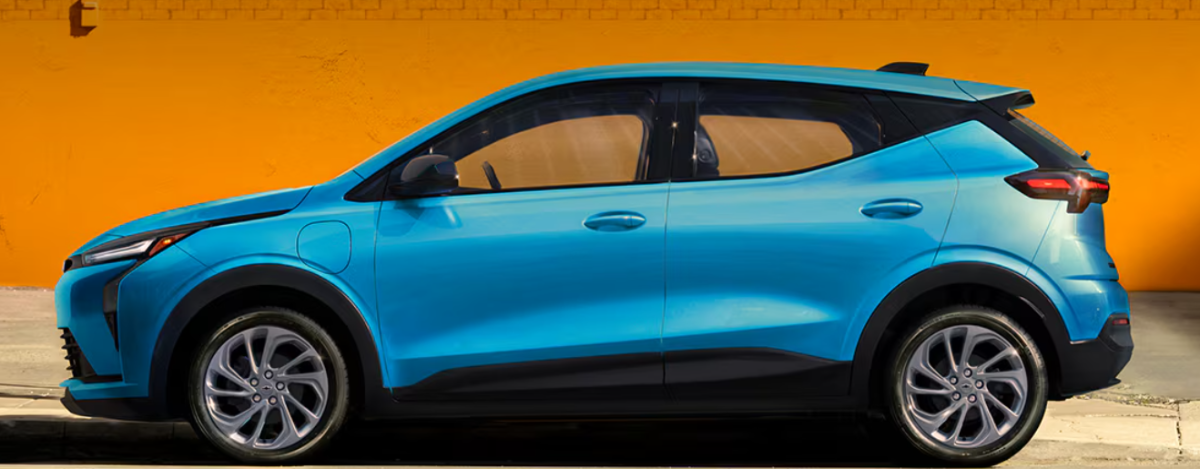
The new Bolt is also the lowest priced car in the United States to offer an advanced driver assistance package. The Super Cruise option is the same package offered on GM’s more expensive models, including those from Cadillac. It only operates on certain limited access highways and secondary roads, but where permitted, it performs automatic lane changes and freeway to freeway navigation with admirable precision. BMW now requires drivers to shift their gaze briefly to confirm an intended lane change, but Super Cruise simple alerts the driver with a vibration in the seat — on the left side for a merge left and on the right side for a merge right.
Super Cruise is not inexpensive, it is a $6,600 upgrade over the base price of the car. But that still keeps the total price well below the cost of any other car with similar features. The new Bolt is a modern interpretation of the traditional Chevrolet mantra — maximum value for the minimum price.
A Limited Time Offer
The new Bolt will be assembled at the GM factory in Kansas City, but the current anti-EV, pro-internal combustion gale force winds blowing across the land from the headwaters of the Potomac have induced GM execs to decide that factory could be put to better use building gas hogs internal combustion powered vehicles currently made in Mexico and China there instead. Production of the Bolt is already scheduled to end sometime next year. At the present time, there are no plans to build the car elsewhere. That’s a shame, because this is the electric car America needs as gas prices rocket upward.
What Reviewers Say
Chevy invited a bunch of journalists to sample the new Bolt in Southern California last week. (Our invitation must have gotten lost in the mail.) The consensus is that it is a pretty darn good car but has a few weaknesses. Several people commented on the seats being uncomfortable. In addition, there is no room for those sitting in back to tuck their feet under the front seats.
Motor Trend contributor Aaron Gold wrote, “The Bolt’s annoyances are big ones. Front seat comfort (or lack thereof) is one thing that can really irk long term, and the back seat arrangement makes the Bolt better suited to groceries than families. And if you live in a place where frost wreaks havoc with pavement, the bouncy, crashy ride will get very old very quickly.”
So, is the new Bolt a home run? Maybe not, but it offers far more features for about the same price as the old car, which is quite a statement considering how the cost of everything else has shot up in the past two years. Perhaps Chevy has only hit a triple with the new Bolt, but as Lee Iacocca used to say, “If you can find a better car at this price, buy it!
Sign up for CleanTechnica’s Weekly Substack for Zach and Scott’s in-depth analyses and high level summaries, sign up for our daily newsletter, and follow us on Google News!
Have a tip for CleanTechnica? Want to advertise? Want to suggest a guest for our CleanTech Talk podcast? Contact us here.
Sign up for our daily newsletter for 15 new cleantech stories a day. Or sign up for our weekly one on top stories of the week if daily is too frequent.
CleanTechnica uses affiliate links. See our policy here.
CleanTechnica’s Comment Policy