

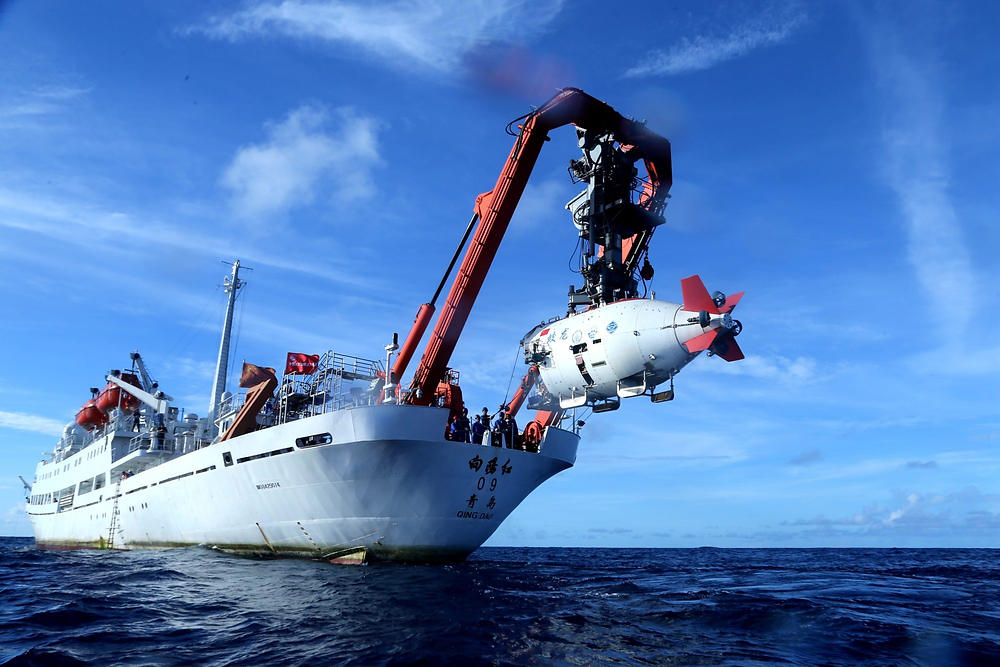
As global competition intensifies for access to critical minerals, China is meticulously building a deep-sea mining strategy, signaling its ambition to dominate the next frontier of resource extraction. With growing demand for cobalt, nickel, copper, and rare earth elements—essential for green technologies—China is now turning its focus to the mineral-rich seabeds of the world’s oceans.
The move is part of a broader geopolitical and economic strategy to secure long-term access to strategic resources, reduce reliance on imports, and gain influence in future mineral supply chains.
What is Deep-Sea Mining?
Deep-sea mining involves retrieving mineral deposits from the ocean floor, particularly from:
-
Polymetallic nodules (found in abyssal plains like the Clarion-Clipperton Zone in the Pacific).
-
Polymetallic sulphides (around hydrothermal vents).
-
Cobalt-rich crusts (on seamounts).
These resources are crucial for lithium-ion batteries, EV motors, wind turbines, and defense equipment—all central to modern technology and the global energy transition.
China’s Deep-Sea Mining Blueprint
China’s deep-sea mining efforts are being developed in phases, with a strong emphasis on:
-
Survey and Exploration:
-
China has secured multiple exploration contracts from the International Seabed Authority (ISA), including in the Clarion-Clipperton Zone (CCZ).
-
Its state-backed company, China Ocean Mineral Resources Research and Development Association (COMRA), is conducting oceanic surveys.
-
-
Technology Development:
-
Investing in underwater robotics, dredging systems, remotely operated vehicles (ROVs), and autonomous seabed extractors.
-
Working on eco-monitoring systems to assess environmental impacts and ensure regulatory compliance.
-
-
Legal and Institutional Strategy:
-
Active involvement in ISA negotiations to shape future rules for commercial deep-sea mining.
-
Building partnerships with Pacific Island nations to gain exclusive mining access to Exclusive Economic Zones (EEZs).
-
-
Commercial Readiness:
-
Targeting 2030 for full-scale commercial operations, supported by state-owned enterprises like China Minmetals and CNOOC.
-
Why Deep-Sea Mining Matters to China
-
Strategic Autonomy: Reduce reliance on imports of cobalt from politically unstable regions (e.g., Congo).
-
Industrial Security: Secure steady raw material supplies for battery, electronics, and defense sectors.
-
Geopolitical Leverage: Gain influence over emerging mineral supply chains, potentially mirroring its control over terrestrial rare earth elements.
-
Technological Edge: Dominate emerging technologies and create new standards in oceanic mining operations.
Environmental & Legal Concerns
While China moves ahead, the world is grappling with ecological concerns about seabed mining, including:
-
Destruction of fragile marine ecosystems.
-
Loss of unknown deep-sea species.
-
Disruption of oceanic carbon storage processes.
Environmental groups and several nations are urging a moratorium on deep-sea mining until a robust regulatory framework is finalized. China, however, appears poised to balance economic interest with minimal compliance, aiming to be first-mover once approvals are granted.
Global Implications
China’s deep-sea mining strategy poses challenges for other major powers:
-
U.S., Japan, India, and European nations are now intensifying their own deep-sea mining plans.
-
Could trigger a new “Ocean Minerals Race”, similar to the space race or Arctic energy exploration.
-
Calls for multilateral agreements and sustainable development standards are growing louder.
India’s Opportunity
India, which holds ISA contracts via National Institute of Ocean Technology (NIOT), can:
-
Collaborate with Quad nations on technology and ocean governance.
-
Invest in deep-sea infrastructure under the Deep Ocean Mission.
-
Leverage its marine biodiversity laws to champion eco-conscious extraction while exploring economic potential.