


Support CleanTechnica’s work through a Substack subscription or on Stripe.
In Geretsried, Germany — an area south of Munich — a Canadian company known as Eavor has started producing electricity from its first closed loop geothermal installation. CleanTechnica has reported recently on open loop systems pioneered by Fervo Energy and Sage Geosystems.
The key to open loop systems is to find an area of super hot rocks beneath the surface of the Earth. Drill a bore hole, pump water down it (or use water already located underground) and use it to make steam to spin generators on the surface. The technology has been proven to work, but it relies on finding places where those hot rocks are close enough to the surface to be accessible by drilling.
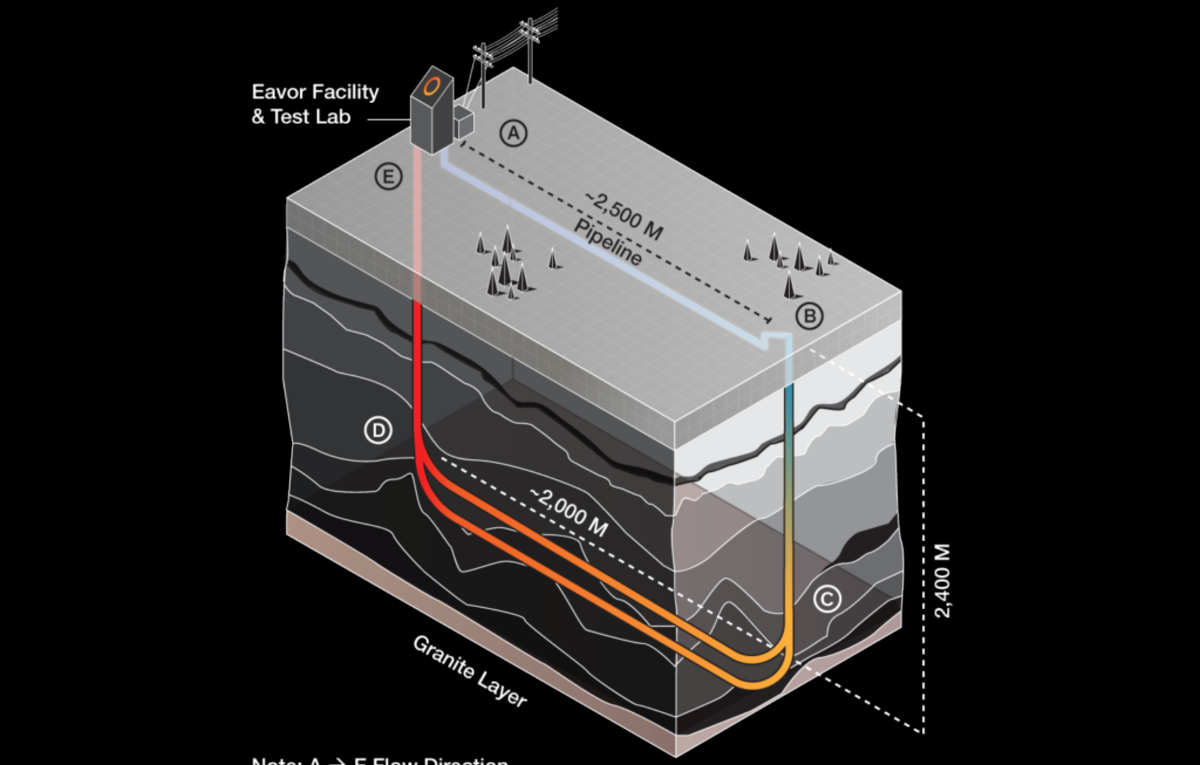
The Eavor system works on the same principle — a transfer of heat from beneath the surface or the Earth to a liquid and then using the heated liquid to do work back on the surface. The difference is the closed loop system creates what looks like a giant underground radiator that soaks up thermal energy from below the Earth. The piping underground is all connected so the fluid remains contained within the system.
The systems are similar, but the closed loop system can be employed in far more locations than an open loop system, according to Eavor. Different strokes for different folks. What both systems have in common is that they share drilling technologies developed by the oil and gas industries. There is a certain satisfaction in knowing techniques invented to harvest fossil fuels from deep underground are now being used to provide zero-carbon energy to the electrical grid.
When fully operational, the closed loop system in Germany is expected to add 8.2 megawatts of electricity to the regional grid and 64 MW of heat for local district heating systems. The location of the pilot program in Geretsried was no accident. There are several nearby communities with district heating systems that will be only too happy to make use of any excess heat.
According to the New York Times, the Geretsried facility will pump fluids through loops that are nearly three miles underground. Those loops branch out into many long prongs that resemble giant rakes. But all the fluids stay contained within the boreholes and pipes underground, which makes it a closed loop system. The fluid will pick up the heat through contact with the rocks surrounding the boreholes and pipes and then bring it to the surface.
Analysts say this closed-loop process is promising because building what resembles an enormous radiator underground can be done successfully in many more locations than would work for an open loop system. “If this technology is proven and commercially viable, it’s a complete game changer everywhere in the world,” said Heymi Bahar, a senior analyst at the International Energy Agency in Paris.
Eavor In Depth
Recently, Jeanine Vany and Mark Fitzgerald of Eavor were interviewed by David Roberts for his Volts podcast after the first portion of their closed loop system began operations. Roberts began by explaining the Eavor system this way:
Let me describe it. There is an injection well. It goes down 2.8 miles, very far, unusually far. Goes down 2.8 miles, takes a 90 degree turn and then starts going laterally, splits into four tubes. Those four tubes go out laterally 1.8 miles and then loop back on themselves, return back to the origin point, re-merge, and then come back up as an output well next to the injection well.
The disadvantage, one of the things traditional conventional geothermal does, is it squirts the water down into the ground and then the water fans out. It leaks out into the rock, meaning it creates a wide surface area in which it can absorb heat. Your water or your fluid…..is contained, sealed in these pipes, which means it has much less surface area to contact hot rock.
This is the basic disadvantage. All of the engineering choices that are made are to compensate for that. One thing is you go a lot deeper, you find rock that’s a lot hotter, and then you move your water a lot longer of a distance through that rock than conventional geothermal…..That seems like a substantial disadvantage. You must think there are compensatory advantages. Why do this? Why deny yourself all that surface area? What are you getting out of keeping the water in a tube?
Those are questions many highly sophisticated CleanTechnica readers are probably asking themselves. Jennifer Vany told Roberts:
For hydrothermal, you are sourcing water from an aquifer. There are rocks that have pores or spaces in them that hold water that you ultimately pump to the surface. You inject water down just to have some flow in the reservoir, and then you have to pump it out.
Remember the pumping piece, because pumping is very important. The mode of extracting energy in either EGS or in the hydrothermal systems is a convection-based model, which [means] you can produce more megawatts with fewer wells.
On our side, we have a conductive heat transfer method, which means in order to contact enough surface area, we build out these loops…..to compensate for the convective heat flow by drilling this large set of lateral wells.
We think there are many upsides to doing that. One of them is the siting flexibility that we have. We are not restricted to looking for hot rock close to the surface. Even in the fracking methodology, you still need to find hot rock to flow the fluid through. Our whole value proposition and premise is to make this technology available anywhere in average geothermal gradients.
Water usage is an important question for places that are experiencing a decline in access to water because of changes in rainfall. In the beginning of the gasoline engine era, some people used overflow cooling. An open tank was fed hot water from the engine and allowed to evaporate. It worked fine for early hit and miss engines that ran sawmills and threshing machines, but the water had to be constantly replenished. Later, closed loop systems were invented that cooled more efficiently and did not need extra water added at regular intervals.
Vany explained that “most of that infrastructure is built underground. Because we’re not producing large volumes of water from the underground, we have nothing to treat. We have no scaling or corrosion issues. We have no future operating expenses, which is not something that people talk about enough.
“We have high capital expenses upfront where we have to drill and build this radiator. We’ve been very forthcoming that 80 percent of our capital costs are just the drilling. You dial that in, you’ve built an asset that just operates for 100 years. No re-drilling, no water.”
Black Start Capability
Vany then offered a detailed explanation of how the system works.
We drill vertically down — two wells side by side on the same surface pad or same surface area. Once we get to the temperature we want, we turn right and drill out. We drill 12 wells on each pad for each horizontal. Then we connect them toe to toe with magnetic ranging, and that closes the loop. Once we close the loop, we seal the loop, and then we fill the loop up with water.
We have a small pump on the surface. We truck the water in, fill it up. It’s about the size of an Olympic swimming pool. Once we start it up, we turn that pump off and it operates as a thermosyphon using the density driven differences between the cold water and the warm water coming out.
We do have a small pump on the surface that we start it with because it needs something to push it down. But as I mentioned, the water heats up and then it wants to rise. What we just demonstrated in Germany is that we only need one degree of temperature differential and this thing just goes on its own.
We are completely black start capable. If the lights turn off or there is a tornado or hurricane, if there is a military issue, it is a very bunkered, reliable, secure energy resource that stays producing. Even if you cannot power a pump, it stays producing, and I think that is a huge advantage.
Magnetic Ranging
There are many CleanTechnica readers who are far more technically savvy that I am (I know this because they tell me all the time in their comments what a dolt I am), but Vany’s explanation of “magnetic ranging” nearly took my breath away. She told Roberts:
I am a geologist. I spent 15 years working oil and gas before starting this company. There is this thing called an ellipse of uncertainty, which means when you’re drilling you know where you are, but the bit can drift a little bit in this azimuthal or east–west direction.
A lot of people said “You’ll never connect these wells.” I had never connected wells before either….but I started researching this thing called magnetic ranging. It’s an anti-collision technology that oil and gas producers use so they don’t collide wells.
We just turned it on its head and took an anti-collision technology to collide wells. We did it the first try in Alberta at a mile underground. Now we’ve done it in Germany at three miles underground and we’re connecting six and a half inch wellbores that deep.
It is an amazing level of precision. How we do that is there is a spinning magnet [that] emits a rare earth element. Then there is a magnet on the other side picking it up. You drill a few meters and then you do what is called a check shot. You look at the math and there will be an ellipse of a bunch of different points. Then your directional guys will reorient you and then you will march another 10 meters until you connect.
That technology is what’s called wireline conveyed. It does take time for the data to come back up the wireline and things like that. But you can communicate to the surface….via a wire.
If you do not find that extraordinary, you are far more blasé than I. Drilling such long and complex wells and joining them together underground was “challenging,” drilling expert Michael Klingbeil told the New York Times. He added that the work was more complicated than what drillers usually encounter, especially in Europe.
Two Years In The Making
Completing the first of four planned loops at the site required two years. The company reduced the scope of its first loop so it could begin selling power to the grid sooner, which was critical for attracting investors. He added the company hoped to begin drilling again in the second half of 2026, but moving ahead would be “dependent on our fund-raising.” The completed project will cost up to €300 million. The first phase has been funded by a €92 million grant from the EU’s Innovation Fund.
Technophiles are gaga about space-based electricity, but tend to ignore solutions that exist literally beneath our feet. Governments pour money into green hydrogen, carbon capture, and fusion energy when the tools to decarbonize our economies already exist. We just need to expand them.
Fervo and Quaise are having success with open loop geothermal. Perhaps Eavor will add one more technology to the clean energy toolkit. We have a long way to go and a short time to get there. We also face determined and well funded opposition from the fossil fuel industry. If we are to keep the Earth habitable for all living things, we need to put the fossil fuel genie back in the bottle as soon as possible. Closed loop geothermal may help us do exactly that.
Sign up for CleanTechnica’s Weekly Substack for Zach and Scott’s in-depth analyses and high level summaries, sign up for our daily newsletter, and follow us on Google News!
Have a tip for CleanTechnica? Want to advertise? Want to suggest a guest for our CleanTech Talk podcast? Contact us here.
Sign up for our daily newsletter for 15 new cleantech stories a day. Or sign up for our weekly one on top stories of the week if daily is too frequent.
CleanTechnica uses affiliate links. See our policy here.
CleanTechnica’s Comment Policy