

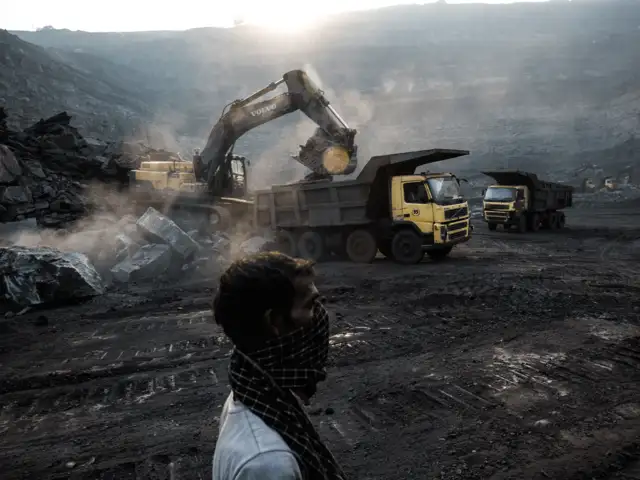
Coal India Limited (CIL), the world’s largest coal-producing company and a Maharatna PSU under India’s Ministry of Coal, has set an ambitious target to supply 900.24 million tonnes (MT) of coal in the fiscal year 2025–26 (FY26), marking an 18% growth from the 762.98 MT achieved in FY25. To support this goal and align with India’s energy security and diversification objectives, CIL has allocated a ₹16,000 crore capital expenditure (capex) for FY26, focusing on coal production, infrastructure, renewable energy, and critical minerals. This article explores CIL’s strategy, its alignment with national goals, the challenges posed by controversial projects like Hasdeo Arand, and parallels with global and domestic industrial efforts, including lessons from the El Teniente tragedy and Mangampeta’s baryte operations.
FY26 Supply Target: 900.24 Million Tonnes
CIL’s FY26 supply target of 900.24 MT reflects a strategic push to meet India’s rising power demand, which grew by 5% to 1,826 billion units (BU) in FY25, with coal-based generation accounting for 1,299 BU. The power sector is projected to consume 668.1 MT (74%) of CIL’s FY26 supply, underscoring its critical role in ensuring 24×7 power for households, as mandated by the government. The remaining supply will cater to non-regulated sectors (e.g., steel, cement) and reduce coal imports, which dropped by 5.35% between April and November 2024, saving ₹30,007.26 crore ($3.91 billion).
-
Production Goal: CIL aims to produce 875 MT in FY26, a 12.02% increase from 781 MT in FY25, supported by new mines and enhanced logistics. This is a stepping stone to CIL’s long-term target of 1 billion tonnes (BT) by FY29.
-
Sectoral Breakdown: The power sector demands 906 MT for FY26, per the Ministry of Coal, with CIL tasked to supply 668.1 MT, supplemented by captive and commercial mines and Singareni Collieries Company Limited (SCCL). Coking coal for the steel sector is pegged at 76 MT.
-
Import Reduction: By prioritizing domestic supply, CIL aims to substitute imported coal, particularly for thermal power plants, aligning with Coal Minister G. Kishan Reddy’s goal of zero thermal coal imports by FY26.
CIL’s FY25 performance provides context: it supplied 616.17 MT to the power sector (93% of the 661 MT demand) and 145.3 MT to non-regulated sectors (up 8.1%). E-auction bookings rose to 89.38 MT, though premiums fell to 48% from 72% due to sufficient domestic supply and lower international prices.
₹16,000 Crore Capex Plan: Strategic Investments
CIL’s ₹16,000 crore capex for FY26, a reduction from ₹20,000 crore in FY25, is strategically allocated to sustain volume growth, enhance infrastructure, and diversify into cleaner energy and critical minerals. Key investment areas include:
-
Coal Transportation and Evacuation (35%, ₹5,622 crore): Investments in rail sidings, corridors, coal handling plants, silos, and roads to ensure seamless supply, especially during monsoons. Weekly inter-ministerial meetings with the Ministry of Power, Central Electricity Authority (CEA), and Railways monitor coal stock levels, with 160 MT available at pitheads and power plants as of May 2025.
-
Land Acquisition (₹2,382 crore): Securing land for new mines and expansion, critical for projects like the Hasdeo Arand coal blocks, though fraught with environmental and social challenges.
-
Heavy Equipment and Washeries (₹1,952 crore): Procurement of heavy earth-moving machinery and upgrades to coal washeries, exemplified by the 2 MTPA Dugda Coal Washery in Jharkhand, monetized for ₹504 crore under the build-own-operate model, marking India’s first coal washery monetization.
-
Diversification Projects: Investments in solar power (3,000 MW by FY28), coal gasification, coalbed methane (CBM) extraction, thermal power, and critical minerals exploration. Notable projects include:
-
Coal Gasification: Joint ventures with BHEL (Bharat Coal Gasification & Chemicals Ltd, Odisha, 6.6 lakh tonnes ammonium nitrate), GAIL (Coal Gas India Ltd, West Bengal, 633.6 million cubic meters synthetic natural gas), and BPCL (Chandrapur, Maharashtra), each backed by ₹1,350 crore from the Ministry of Coal.
-
Thermal Power: A 2×800 MW ultra-super-critical plant by Mahanadi Basin Power Ltd (MBPL) in Odisha (₹16,000 crore) and a 2×800 MW JV with Damodar Valley Corporation in Jharkhand (₹16,500 crore).
-
Solar Power: CIL’s JV with NLC India Ltd (Coal Lignite Urja Vikas Pvt Ltd, 1,000 MW) and MoUs with NTPC and Solar Energy Corporation of India for 1,000 MW each, supporting CIL’s net-zero mandate.
-
Critical Minerals: Exploration and processing to reduce import dependency, aligning with the National Critical Mineral Mission (NCMM).
-
CIL’s Q1 FY26 capex performance, alongside NLCIL and SCCL, achieved 114% of the target, reflecting operational efficiency. The Dugda Washery monetization aligns with the National Monetisation Pipeline, unlocking new revenue streams.
Challenges in Hasdeo Arand and Environmental Concerns
CIL’s ambitions intersect with the controversial Hasdeo Arand coal mining approvals in Chhattisgarh, where 1,742.6 hectares of forest land were approved for the Kente Extension coal block on June 26, 2025, operated by Rajasthan Collieries Ltd (Adani Enterprises). This follows clearances for the Parsa East and Kanta Basan (PEKB) and Parsa blocks, threatening 450,000–850,000 trees, 9 Schedule I species, and the Hasdeo River’s catchment area. Key challenges include:
-
Environmental Impact: Deforestation risks biodiversity loss and human-elephant conflicts near the Lemru Elephant Reserve, undermining India’s 33% forest cover and net-zero by 2070 goals.
-
Tribal Rights: Allegations of forged gram sabha consents violate the Forest Rights Act (FRA) 2006 and Panchayats (Extension to Scheduled Areas) Act (PESA) 1996, displacing 700–2,000 Adivasis and threatening cultural practices.
-
Political Backlash: Opposition from Congress, Chhattisgarh Bachao Andolan, and activists like Alok Shukla accuses the BJP-led government of prioritizing corporate interests, echoing sentiments around Adani’s involvement.
CIL’s focus on selective mining, coal beneficiation, and underground mining aims to reduce environmental impact, but Hasdeo’s approvals highlight the tension between energy security and ecological preservation. The NGT or Supreme Court may intervene, as seen in the 2014 coal scam ruling.
Parallels with Global and Domestic Contexts
CIL’s FY26 strategy reflects broader industrial and social dynamics:
-
Global Mining Safety: The El Teniente mine collapse in Chile (August 2025), which killed six workers due to a seismic event, underscores the need for robust safety protocols. CIL must adopt similar international audits for Hasdeo and other mines to prevent tragedies, especially given Chhattisgarh’s stable but complex geology.
-
Domestic Mineral Wealth: The Mangampeta baryte deposit in Andhra Pradesh, supplying 95% of India’s baryte, showcases sustainable mining potential. CIL could emulate APMDC’s zero-liquid-discharge systems and afforestation to mitigate Hasdeo’s environmental impact.
-
Industrial Precision: The precision in gold smelting flux ratios (borax, sodium carbonate, silica, sodium nitrate) parallels CIL’s need for meticulous planning in coal extraction and gasification to balance output and sustainability.
-
Entrepreneurial Resilience: India’s teen tycoons, like Kaivalya Vohra of Zepto, navigate systemic gaps with innovation, a model for CIL to address Hasdeo’s governance issues, such as forged consents and weak EIAs.
-
Civic Governance: The Gurugram garbage crisis highlights systemic failures in waste management, similar to Hasdeo’s regulatory lapses. CIL’s investments in rail and road infrastructure could model efficient logistics for urban systems.
Challenges and Opportunities
Challenges
-
Environmental Resistance: Hasdeo’s approvals risk legal challenges and protests, potentially delaying FY26 targets. The CGSTC’s report on forged consents could escalate to judicial scrutiny.
-
Logistical Constraints: Monsoon disruptions and land acquisition delays, as seen in Hasdeo, could hinder coal evacuation, despite ₹5,622 crore for infrastructure.
-
Market Dynamics: E-auction premiums fell to 48% in FY25 due to sufficient domestic supply and lower global prices, potentially impacting revenue.
-
Energy Transition: Balancing coal reliance with net-zero goals requires rapid scaling of renewables and gasification, which face technical and financial hurdles.
Opportunities
-
Sustainable Technologies: Coal gasification and CBM extraction offer cleaner alternatives, with ₹1,350 crore per project supporting innovation. The NCMM’s Centres of Excellence (e.g., IIT Kharagpur) could enhance these efforts.
-
Renewable Energy: CIL’s 3,000 MW solar push by FY28 aligns with India’s 500 GW renewable target by 2030, diversifying revenue and reducing fossil fuel dependency.
-
Critical Minerals: Exploration under NCMM could position CIL as a leader in minerals like lithium, complementing Mangampeta’s baryte success.
-
Community Engagement: Transparent gram sabha processes and tribal rehabilitation, as mandated by FRA, could mitigate Hasdeo’s backlash, fostering inclusive growth.
Future Outlook
CIL’s FY26 target of 900.24 MT is a critical step toward 1 BT by FY29, aligning with India’s coal production goal of 1.5 BT by 2030. The ₹16,000 crore capex will drive 20 new mines with 80 MT capacity in FY26, per the Ministry of Coal’s action plan, alongside captive and commercial mines. However, Hasdeo’s ecological and social costs demand urgent reforms:
-
Sustainable Mining: Adopting real-time environmental monitoring and afforestation, as in Mangampeta, could reduce Hasdeo’s impact.
-
Global Lessons: Codelco’s El Teniente audit offers a blueprint for transparent safety reviews, critical for Hasdeo’s seismic stability.
-
Tribal Inclusion: Genuine FRA compliance and community-led projects, like eco-tourism, could mirror the social impact of Generic Aadhaar.
-
Energy Diversification: Scaling solar, gasification, and CBM will align CIL with India’s net-zero goals, reducing coal dependency by 2030.
By FY30, India’s coal demand is projected at 1.4–1.58 BT, per NITI Aayog and the Coal Ministry, with CIL contributing the lion’s share. Strategic partnerships, like those with BHEL, GAIL, and NTPC, will bolster diversification, while addressing Hasdeo’s concerns could set a global standard for responsible mining.
Coal India’s FY26 plan to supply 900.24 MT of coal with a ₹16,000 crore capex underscores its pivotal role in India’s energy security, targeting 668.1 MT for the power sector and reducing imports. Investments in rail infrastructure, solar power, coal gasification, and critical minerals reflect a dual focus on growth and sustainability. However, the Hasdeo Arand approvals highlight ecological and tribal challenges, risking 450,000–850,000 trees and Adivasi displacement. Lessons from Mangampeta’s sustainable baryte mining, El Teniente’s safety audits, and India’s teen tycoons emphasize precision, transparency, and resilience. As CIL navigates these complexities, balancing energy demands with environmental and social accountability will define its legacy in India’s industrial landscape.