

Support CleanTechnica’s work through a Substack subscription or on Stripe.
Or support our Kickstarter campaign!
Scottish economist Adam Smith is responsible for the concept of the “invisible hand” in economic theory, although the way that notion is understood today is very different than it was when Smith used it in his 1776 treatise The Wealth Of Nations. In the 20th century, Paul Samuelson and many of his contemporaries popularized the use of the term to refer to a more general and abstract conclusion that truly free markets are self-regulating systems that always tend to create economically optimal outcomes without government intervention.
For those of us who are not economists and have never played one on TV, we tend to think of Adam Smith as the leading exponent of modern capitalist theory. People are self interested. Left to their own devices, they will maximize their personal financial opportunities, and society as a whole will benefit, thanks to the effect of the “invisible hand.”
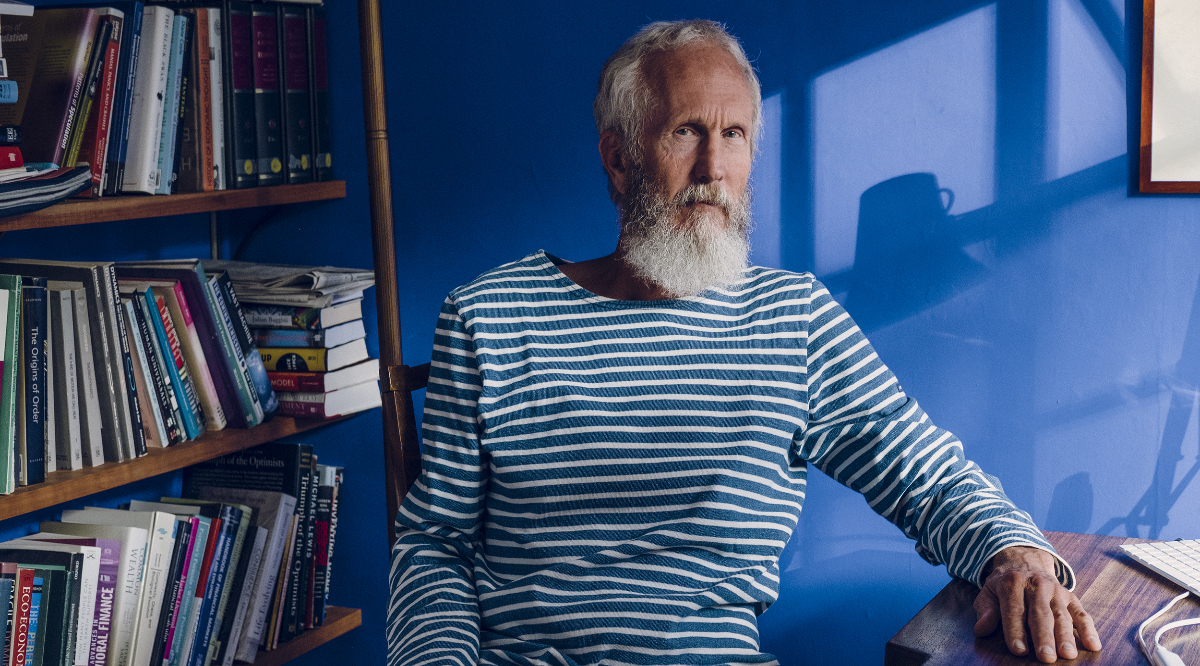
Professor Doyne Farmer of Oxford University wants to take current economic theory and improve it by using the enormous computing power at our disposal today. For an investment of just $100 million, he says we could assemble data from every business on Earth and use it to make realistic decisions that change as the economy changes.
Clarity From Chaos
From this astonishing complex input would emerge forecasts of unprecedented clarity. There would be no more flying blind into global financial crashes — and more importantly, no more climate policies that fail to produce actual changes.
Your first reaction may be that Farmer is some kind of a nut. Would it change your opinion to know that he and his associates learned how to beat casinos at roulette in the 1970s using the first wearable digital computer? Twenty years later, they created an automated trading computer company that specialized in rapid stock trading. It was later purchased by UBS. So Farmer is the real deal with the track record to prove it.
He told The Guardian recently, “We want to do for economic planning what Google maps did for traffic planning — so we can give anybody who has an economic question an intelligent and useful answer.” He argued that traditional economic models are either too simple to give useful forecasts or too complex for even today’s computers to handle.
Where Adam Smith was thinking in terms of maybe a half dozen inputs, the computer system Farmer is proposing would marshal inputs from tens of thousands of companies, each with hundreds or even thousands of variables, into a giant database that would reveal real, actionable insights for businesses and global leaders.
Here’s how Farmer explains it. “The global financial crash in 2008 cost the world about $10 trillion. If in 2006 the US central bank had the model we could build now, they would have said: ‘Wow, this is really going to be a disaster — we’ve got to act now and save the world a lot of pain’.” If his $100 million system had reduced those losses by just 1 percent, it would have paid for itself 1000 times over.
Farmer has now set his sights on the climate crisis. “In my old age, I want to do good things for the world and I think this is the biggest problem we’re facing, maybe along with political polarization, which unfortunately is itself making [the climate crisis] even harder to deal with. The world is going to experience a lot of pain due to not coping with climate change.”
A Failure Of Economic Models
“Secondly, it’s an area where the failure of economic models is seen most dramatically. I think the models we have are completely inadequate and even misleading. For example, the track record for these models in saying what renewable energy was going to do is genuinely terrible. They consistently predicted that it would be very slow to roll out and the cost would come down very slowly.” In reality, costs have plunged and the roll out has been rapid.
Farmer and his team are starting by creating a model of the entire global energy sector — all 30,000 companies and their 160,000 oil rigs, power stations, and other assets using a 25-year-long dataset of how they have actually operated during that time.
“We’re literally modelling the decision making of all the energy companies in the world,” he says, each represented by a separate digital agent in the model. “We can simulate the whole energy system of the world to see how much energy each company delivers and at what price.”
The model is still in development, but should be much better at laying out the best path to a green energy future than today’s economic models, which could be transformative. A study in 2022 by Farmer and his colleagues using similar data found that a rapid transition to clean energy could save the world trillions of dollars.
The First Fundamental Problem
Farmer claims there are two fundamental problems with mainstream economic models. First, they assume economic actors make perfect, rational decisions. But for each actor to make perfect decisions, it has to know everything about the system and everything about what every other actor is doing.
If there are only a few actors involved, it might be possible to keep track of everything. But if there are a few dozen actors — let alone thousands or even millions — it becomes an impossible computing task even for the most powerful machines in the world today. “So the models are necessarily kept simple, which means that you can’t model the real world very well, as the economy is a pretty complicated beast,” says Farmer.
His new models are different. They allow the economic actors to make decisions based on simple rules. For example, they can imitate the best or rely on trial and error. Ironically, trial and error is a better reflection of the real world because people don’t make perfect decisions, as behavioral economics has proven many times. This simplification dramatically reduces the computing power required. “Whereas the normal way of doing things is limited to five or at most 10 different agents, and that would be a lot, we can do millions of them,” says Farmer.
Creating simple rules for financial actors from the analysis of large amounts of real world data makes the models even more realistic and useful. But that leads to another problem, known as the Lucas critique. It says that people may change the way they make decisions as the world changes. Farmer’s complexity science has a solution to that — use machine learning to enable the economic actors to evolve their strategies.
“There are already some studies showing this in really simple settings,” says Farmer. “We’re going to be able to do that in more complicated settings. That’s a frontier problem we’re working on right now.”
The Second Fundamental Problem
The second fundamental problem with mainstream economic models is that they are assumed to be in equilibrium. That means supply and demand are balanced, or that every agent is acting perfectly. But that’s not how things happen in the real world, which is why there are economic meltdowns every now and again. To explain those anomalies, mainstream economists resort to introducing external shocks into their models, a practice they call “kicking the rocking horse.”
The way Farmer’s complexity models are set up means economic cycles emerge without any introduced shocks. “You get fads, booms and busts, all that stuff, happening internally, driven by the fact that the agents are changing their strategies over time. They’re learning in a dynamic world, where they are chasing each other’s tails and things don’t settle down.”
How did economic theory get so far from reality? Farmer says there are several reasons. “We got stuck in a very deep academic rut back in the 1960s, when the big debate about how to do economics was won by the people who said agents were perfect rational actors. “So we’ve been doing it that way ever since. The academic establishment has let itself become too close minded and has been very resistant to different ways of doing things.”
A lack of computing power was another factor. “Back then, computers were a billionth as powerful as they are now, and the [economic] data wasn’t there, so it was much harder to do things the way we’re doing it now,” he says.
Colonized By Mathematicians
“Economics was colonized by mathematicians, not by physicists. Physicists have a much more practical viewpoint. Mathematician economists like to prove theorems and have high-falutin models. Physicists go, ‘Oh, this isn’t right, let’s just roll up our sleeves and simulate the world.’”
You have to admire someone as plain spoken as Doyne Farmer, although it is a bit distressing to think of all the lost opportunities for progress toward viable climate solutions that have resulted from trying to fit the messy details of an economic ecosystem into the inflexible strictures of mathematical formulas. So a waste of time, money, and energy.
Farmer has made addressing climate issues a priority. “I really want to realize this goal within 10 years. Hopefully we can even get there in five years. I’m old enough that I feel a certain urgency. I’d like to see it happen before I die or I go senile.” He is 72 today.
He believes his new computer tool would enabling politicians and business leaders to forecast the impact of their decisions with far more confidence — allowing them to seize opportunities and avoid pitfalls. In the case of the climate crisis, that could point the world toward a path for ending emissions that is far more affordable than current initiatives.
“It’s a very exciting endeavor. Stay tuned,” he says. Those who wish to contribute toward the $100 million cost of his creation are urged to contact him directly. Are you listening, Bill Gates? How about you, Jeff Bezos or Sergei Brin? $100 million is pocket change for the likes of you.
Oddly Appealing
There is something oddly appealing about Farmer and his quest to sidestep the road blocks to progress presented by current economic policies and theories. The one caveat we can think of is that Farmer assumes all those tens of thousands of economic actors will provide accurate data to plug into his complexity models, but he has probably considered that quibble and has a solution, one that is rooted in the best analysis physicists can offer.
It’s all terribly exciting to think there might be away to update the world of economics to bring a thoroughly modern interpretation of the “invisible hand” to bear on the most urgent and intractable problem humanity has ever faced.
Farmer’s latest book is called Making Sense Of Chaos — A Better Economics For A Better World and is available from Penguin Books.
Support CleanTechnica via Kickstarter

Sign up for CleanTechnica’s Weekly Substack for Zach and Scott’s in-depth analyses and high level summaries, sign up for our daily newsletter, and follow us on Google News!
Have a tip for CleanTechnica? Want to advertise? Want to suggest a guest for our CleanTech Talk podcast? Contact us here.
Sign up for our daily newsletter for 15 new cleantech stories a day. Or sign up for our weekly one on top stories of the week if daily is too frequent.
CleanTechnica uses affiliate links. See our policy here.
CleanTechnica’s Comment Policy