

Support CleanTechnica’s work through a Substack subscription or on Stripe.
The most recent US labor force analysis shows a four-year low — the unemployment rate is at 4.6%. Not since the end of the Covid-era pandemic has the job rate been so abysmal. But there’s a bright point in the employment equation: energy efficiency jobs continue to assist a flaccid US economy.
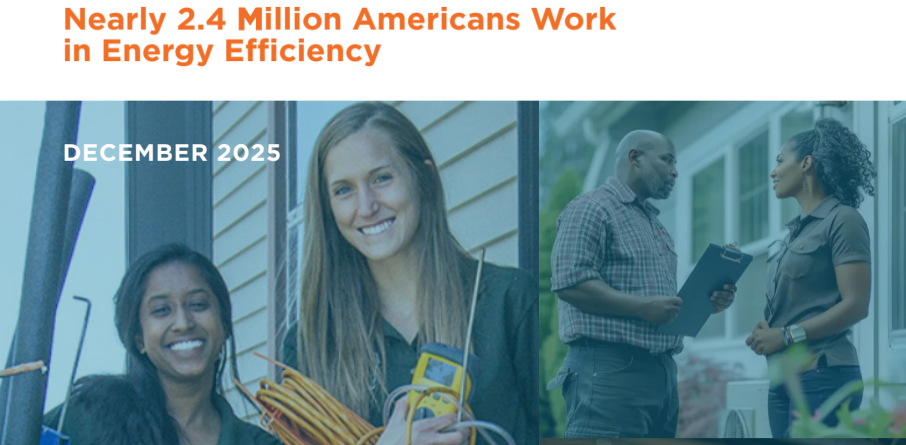
On Thursday, December 11, 2025, the Building Performance Association released “Energy Efficiency Jobs in America” (EEJA), an annual report tracking the latest state and national energy efficiency employment data, as well as across multiple sectors such as construction and manufacturing.
The rate of growth for the energy efficiency (EE) sector continues to increase, from around 3.4% for 2022-2023 to 4% for 2023-2024. EE has proven to be one of America’s most resilient sectors, sustaining steady job growth while other sectors continue to struggle to recover post-COVID.
Energy efficiency jobs continue to provide the backbone of other clean energy investments, and EE remains the largest energy sector in most US states. Additionally, EE jobs can be found in 99% of US counties, indicating the degree to which EE is deeply embedded in urban and rural communities nationwide.
And, if you know someone who is looking for a fast-growing career, the median wage for EE employment is 20% higher than the US median wage. These occupations are far-reaching: energy auditors, insulation installers, technicians, HVAC professionals, architects, electrical engineers, and more.
If you’ve ever shopped for a new refrigerator, dishwasher, air-conditioning unit, or other large-ish household appliance, you’ve probably seen the canary yellow “EnergyGuide” tag listing information about the appliance’s energy consumption. Projects span homes, schools, small businesses, buildings, and corporate businesses. Even enormous data centers are researching energy efficiency.
Sample findings from the EEJA report:
- Energy efficiency is creating more jobs than any other energy sector.
- Energy efficiency jobs have nearly doubled since 2021.
- Energy efficiency is the largest energy sector in almost every state.
- New states—including major fossil fuel producers—are experiencing some of the fastest energy efficiency job growth in the country.
- Energy efficiency workers represent a significant percentage of the construction workforce.
- Energy efficiency job wages are significantly higher than the US median wage.
- Energy efficiency employs a higher percentage of U.S. veterans compared to the national average.
What is energy efficiency, anyway? Simply put, efficiency means using less of a resource to achieve the same result. Energy efficiency simply means using less energy to perform the same task – that is, eliminating energy waste. Energy efficiency brings a variety of benefits: reducing greenhouse gas emissions, reducing demand for energy imports, and lowering our costs on a household and economy-wide level.
Why should we care about energy efficiency and the workforce that installs the equipment in our homes and businesses? Energy efficiency saves US residents money on energy bills, which is always important for consumers. It improves air quality and supports US energy independence. When our homes are made more comfortable through energy efficiency, we are not only reducing energy waste — we improve grid resilience.
What’s an example of a familiar energy efficiency program? Energy Star was launched in 1992 during the Bush administration as a voluntary certification program. Administered jointly by the US Environmental Protection Agency and the Department Energy, it is tasked with providing clear, reliable EE information to consumers. The program certifies dozens of products, including appliances, lighting, electronics, and entire buildings and homes. It is updated regularly to accommodate new products and new technologies like EV charging stations.
Energy Star also has thousands of partner organizations including almost 40% of Fortune 500 companies. When a proposal to eliminate Energy Star surfaced back in 2017, the reaction was swift and furious. Hundreds of US manufacturers and other firms joined with environmental groups to lobby successfully against cutting the program.
Federal programs that support energy efficiency: Energy efficiency has historically enjoyed broad bipartisan support—a continued consensus demonstrated in the current Congress via proposed annual appropriations and authorization legislation for key programs like the Weatherization Assistance Program (WAP). However, despite this support, energy efficiency sits at a crossroads as federal investment in this public good has been challenged.
The July 2025 passage of the One Big Beautiful Bill Act (OBBBA, H.R. 1) set several key energy efficiency incentives—all originally bipartisan and expanded as a part of IRA investment—on a path for termination, including:
- The 25C Energy Efficient Home Improvement Tax Credit (slated to sunset at the end of 2025), which allows homeowners to claim a 30% credit on home upgrades like insulation and efficient HVAC and water heating systems.
- The 45L New Energy Efficient Home Credit (slated to sunset in July 2026).
- The 179D Energy Efficient Commercial Buildings Deduction (slated to sunset in July 2026).
- Rescission of any unobligated funding for the Training for Residential Energy Contractors (TREC) state grants.
Benefits created by these incentives are not confined to taxpayers: Such programs support jobs across the energy efficiency supply chain, including manufacturers, distributors, contractors, and training centers. The 25C Energy Efficient Home Improvement tax credit has been a particularly important tool for home retrofit businesses; contractors routinely advertise 25C to boost sales, helping small businesses to grow while saving families an average of $882 per tax return across all 50 states and lowering family energy bills by an average of $130 in the first year.
Workers are benefiting from the EE surge: EE is an integral part of construction, employing nearly 1.3 million workers within the industry. Between 2022 and 2024, EE remained a consistent and substantial component of the US construction workforce, accounting for roughly 16% of all construction jobs. Importantly, the EE sector employs nearly 2.4 million workers — more than a quarter of the total energy workforce. From 2023 to 2024, EE grew the fastest and added more jobs than any other energy sector, creating nearly 100,000 new jobs and increasing its growth rate year over year—nearly doubling since 2021.
Which states are embracing energy efficiency and its industry employment? The top five states with the fastest growing EE sectors this year are Idaho, Oklahoma, New Mexico, Nevada, and Colorado. In states like Michigan, Kentucky, Wisconsin, Alabama, and Mississippi, manufacturing represents a quarter of all EE employment. In Michigan, it’s more than half.
Gaps in the EE labor force: Despite the sector’s growth, energy efficiency business owners still find hiring to be a challenge. Subsectors focused on construction, manufacturing and trade, and professional services all continued to report very high levels of hiring difficulty, with 84% to 88% of companies in all three categories describing hiring as at least “somewhat difficult.”
Though fewer EE construction businesses reported finding hiring to be “very difficult,” dropping from 62% in 2022 to 48% in 2024, the overall picture remains clear: nearly nine in ten surveyed companies still face hiring challenges. These data suggest that, while the most acute hiring challenges may be easing, recruiting challenges remain top of mind for EE businesses.
What’s needed to recruit and train more EE workers? Between 2019 and 2024, the share of energy efficiency workers aged 55 and over increased from 12% to 15.5% nationally. While younger workers continue to enter the field, these additions are not yet sufficient to offset retirements in the existing workforce. Creating workforce programs to provide resources to train and on-board new contractors, through state incentives or federal resources, such as the Training for Residential Energy Contractors (TREC) grants for states, helps organizations and small businesses hire and train new EE employees. These programs are crucial to the future of the industry.
What are the demographics of the current EE workforce? The industry is still primarily male-dominated, representing 73% of the workforce, while just 26% of EE workers are female. These numbers differ significantly than the national workforce percentages, which are 53% and 47%, respectively.
The Building Performance Association Investment report indicates that more wrap-around services are needed to support a more diverse workforce. They say that “a representative workforce is proven to boost innovation, productivity, employee satisfaction, and retention, as well as profits. Investing resources to ensure EE workforce trainings are deployed in underserved communities will allow for broader participation and better results.”
Resources
Sign up for CleanTechnica’s Weekly Substack for Zach and Scott’s in-depth analyses and high level summaries, sign up for our daily newsletter, and follow us on Google News!
Have a tip for CleanTechnica? Want to advertise? Want to suggest a guest for our CleanTech Talk podcast? Contact us here.
Sign up for our daily newsletter for 15 new cleantech stories a day. Or sign up for our weekly one on top stories of the week if daily is too frequent.
CleanTechnica uses affiliate links. See our policy here.
CleanTechnica’s Comment Policy