

Support CleanTechnica’s work through a Substack subscription or on Stripe.
As much as various high ranking officials in the Trump administration would like to pretend that energy storage is not a thing existing in time and space, it does. Batteries are already replacing fossil fuels in vehicles and power stations. Now they are beginning to pull duty in the sticky world of hard-to-decarbonize commercial and industrial applications. In an interesting twist, the latest development in the C&I space involves a concentrating solar power system capable of delivering the clean kilowatts on a ’round-the-clock basis, with the help of thermal energy storage.
Energy Storage & Concentrating Solar Power
The concentrating solar power angle may come as a surprise, considering that the technology got a bad rap here in the US after a series of high profile flops in the early 2000s. However, CSP has caught on elsewhere around the world.
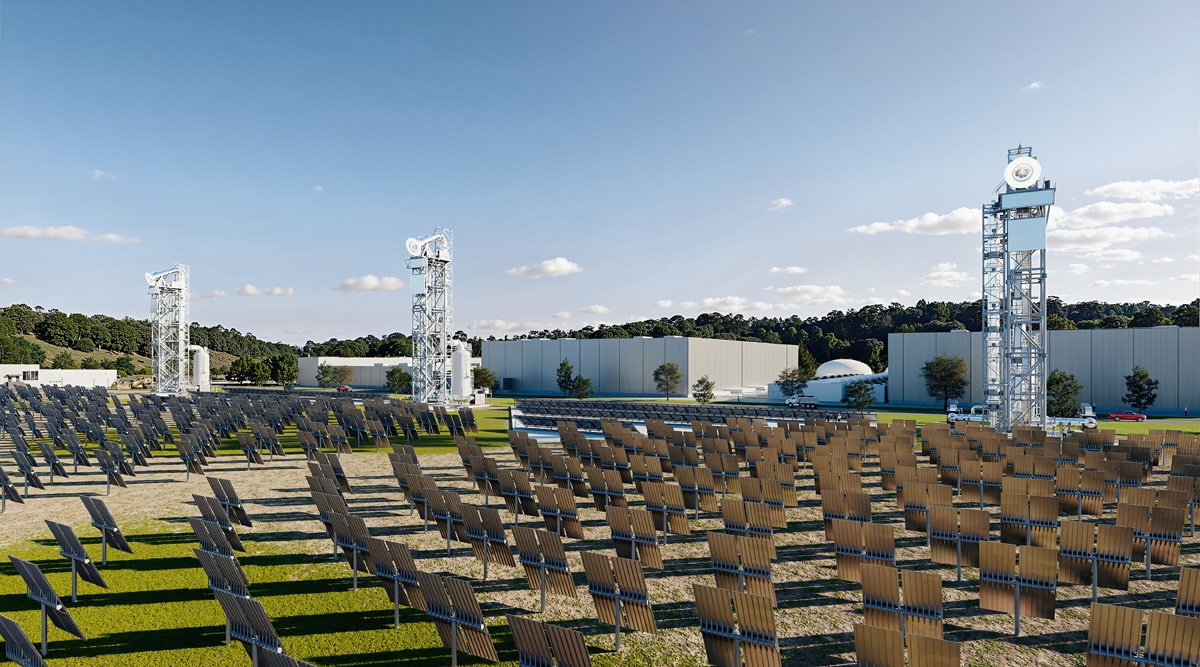
For those of you new to the topic, CSP systems are just what the name says. Instead of converting sunlight directly to electricity in a photovoltaic cell, CSP systems typically deploy large fields of specialized mirrors called heliostats. They collectively bounce sunlight onto a central point, where a reciever heats a liquid transfer medium typically composed of molten salt. CSP systems can also come in the form of long, parabolic troughs, and they can heat particles of sand or other matter instead of heating a liquid.
Either way, the transfer medium acts as a sort of two-way energy storage system. It can be called up when needed for commercial and industrial processes that require heat, even after the sun goes down. Or, the transfer medium can be shunted to a generating station, where it produces steam to run a turbine that spits out electricity (see lots more CSP background here).
If that sounds complicated and expensive compared to simply parking a solar panel out in the sun, it is. During the Obama administration, the US Department of Energy tried to help the domestic CSP industry launch itself into being, but nothing of consequence stuck. Still, the Energy Department continued to fund innovation in the CSP field all during the first Trump administration from 2017 to 2021. The Biden administration also picked up the CSP R&D torch and ran with it, all the way until January 20 of this year, when the task fell to Trump again.
As of March, the Energy Department’s National Renewable Energy Laboratory indicated that third-generation CSP research programs were continuing during Trump’s second time in the Oval Office. However, last week Energy Secretary Chris Wright changed NREL’s name to “National Laboratory of the Rockies,” so who knows what goes on there.
247Solar Has Fossil Fuel’s Number
The US startup 247Solar is among the CSP innovators not waiting around for further support from the Energy Department. The company’s flagship “247Solar Plant” heat-plus-power system combines CSP with a heat-storing battery, enabling it to last longer than earlier CSP-based energy storage systems. As a backup, the battery is also designed to be source-agnostic, running on alternate fuels in case of a shortfall in solar availability. The battery is also compatible with wind power and grid-sourced electricity, too.
The company is new to the CleanTechnica radar, so now is a good time for catch-up. It launched in 2015, co-founded by the late MIT Professor Emeritus David Gordon Wilson and longtime solar engineering and architecture professional David Anderson, who serves as CEO.
MIT News profiled the company last year, noting that Professor Wilson’s high-temperature heat exchanger provides the technology platform for the system. As described by Anderson, the heat exchanger is integrated with a conventional turbine. Similar to those used in jet engines, the turbine circulates hot air without requiring combustion or producing emissions.
MIT News reporter Zach Winn provides some further details about the system. The central tower in the CSP part of the operation supports a proprietary solar receiver capable of reaching 1,000 degrees Celsius. Some of the hot air can go directly to drive the turbines to produce electricity while the sun is shining. The rest is routed to a long duration solid-state thermal energy storage system, which takes over when the sun goes down.
“We offer round-the-clock electricity, but we also offer a combined heat and power option, with the ability to take heat up to 970 Celsius for use in industrial processes,” Anderson told MIT News. “It’s a very flexible system.”
Who’s Gonna Pay For All This?
247Solar has already cultivated a $250 million pipeline of projects around the world for its heat-plus-power CSP system, reportedly including a major utility in India. Accordingly, earlier this week 247Solar announced the launch of a new Series B capital raise aimed at hitting the $25 million mark, enabling it to scale up operations.
In a press statement, 247Solar indicated that its that its existing investors have already put up $3.5 million towards a successful raise, and that forthcoming commitments are in the pipeline pending due diligence.
The demand is certainly there. Although US President Donald Trump has done his best to throttle down the domestic wind and solar industries, the global race for reliable, economical clean power is continuing apace. 247Solar notes that its project pipeline includes Africa, Europe, Australia, and South America, as well as India, with a focus on mining and desalination operations, among other industrial applications.
“Industrial companies worldwide face the urgent need to decarbonize their energy use — without sacrificing reliability, cost, or performance,” 247Solar emphasized in a press statement dated December 1. “And 60% of industrial energy use across sectors is to produce heat, not power, typically by burning fossil fuels.”
Energy Storage Is Coming For Your Fossil Fuels
Typical CSP systems are sprawling, one-of-a-kind facilities tailored to their location, adding risk as well as expense. In contrast, 247Solar has developed a cost-cutting, modular system that can be fabricated in a factory setting and hauled out to the site.
With the combination of heat and power in hand, 247Solar notes that cutting carbon emissions down to the bone is just part of the picture. In addition to reducing the carbon footprint of an operation’s energy systems by up to 95%, 247Solar estimates that energy costs can be cut by 25% or more.
Adding to the attraction is 247Solar’s EaaS (Energy-as-a-Service) business model. EaaS contracts typically provide business with the ability to upgrade their energy systems without paying up front for new equipment. “In addition, 247Solar solutions typically increase reliability and improve performance,” 247Solar also says of itself.
That remains to be seen. However, considering the extent of 247Solar’s global project pipeline, apparently some leading energy consumers have seen enough. If all goes according to plan, 247Solar will deploy the Series B funding to establish a cost-cutting, mass production system for a new 3.5-megawatt module. That’s a big leap up from the company’s current size of 400 kilowatts, but the timeline calls for full development to be completed within the next six months or so, leading to deployment in 2027.
Don’t be surprised to see 247Solar cropping up here in the US, too. 247Solar includes North American on its to-do list, along with its overseas pipeline. For all the hot air about “American Energy Dominance” blowing out of the White House, solar power is the fastest, most abundant, and most economical way to add more kilowatts to the nation’s power profile. Follow the money…
Photo (cropped): With an assist from energy storage, concentrating solar power gets a reboot for commercial and industrial applications (courtesy of 247Solar via Global Newswire).
Sign up for CleanTechnica’s Weekly Substack for Zach and Scott’s in-depth analyses and high level summaries, sign up for our daily newsletter, and follow us on Google News!
Have a tip for CleanTechnica? Want to advertise? Want to suggest a guest for our CleanTech Talk podcast? Contact us here.
Sign up for our daily newsletter for 15 new cleantech stories a day. Or sign up for our weekly one on top stories of the week if daily is too frequent.
CleanTechnica uses affiliate links. See our policy here.
CleanTechnica’s Comment Policy