
From Guns & Steel to Grids & Batteries: A History-Informed View of Climate Action

Support CleanTechnica’s work through a Substack subscription or on Stripe.
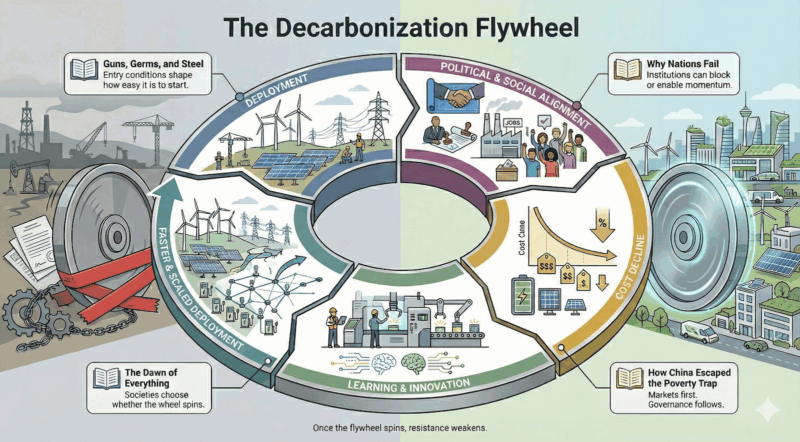
The past year of thinking about climate action has increasingly felt like thinking about markets. Not markets in the narrow sense of price signals alone, but markets as arenas where learning happens, capacity is built, costs fall, and political coalitions shift. Reading and in some cases rereading Guns, Germs, and Steel by Jared Diamond, Why Nations Fail by Daron Acemoglu and James Robinson, How China Escaped the Poverty Trap by Yuen Yuen Ang, and The Dawn of Everything by David Graeber and David Wengrow over recent months has clarified that decarbonization is best understood as a market creation problem first, an institutional reform problem second, and a cultural or moral problem last. This ordering matters, because getting it wrong leads directly to delay.
Diamond’s work is often read as a story about inevitability, but at its strongest, it is a story about early market conditions. The domestication of plants and animals created surpluses. Surpluses supported specialization. Specialization enabled trade, innovation, and eventually technological dominance. Steel and ships did not emerge in isolation. They emerged from dense networks of exchange, competition, and cumulative learning. In climate terms, this reminds us that technologies do not mature in the lab or in policy papers. They mature when they are produced, sold, installed, and improved at scale. Diamond’s mistake is not emphasizing material conditions. It is stopping the analysis before markets and institutions take over as the main drivers.
One of Diamond’s most memorable stories involves the rapid collapse of Indigenous societies in the Americas following European contact, driven largely by disease rather than conquest alone. What is often missed is the market dimension of the aftermath. European goods flooded into surviving societies. Horses transformed mobility and warfare on the Great Plains. Metal tools displaced stone within a generation. These changes were not mandated by institutions. They were adopted through exchange because they worked better. The tragic context does not erase the lesson. Markets and diffusion can reshape societies faster than formal governance ever could.
Why Nations Fail picks up where Diamond leaves off and focuses on what happens once markets exist at scale. Acemoglu and Robinson argue that inclusive institutions allow markets to expand and compound, while extractive institutions choke them off. Their examples are familiar. North and South Korea shared geography, culture, and starting conditions. Divergent political economies produced radically different outcomes. The same story appears in colonial Latin America, where extractive institutions suppressed broad based market development, locking in inequality for centuries.
In climate action, this explains why some countries struggle to build clean energy markets even when technology is available. Fossil incumbents distort markets. Permitting regimes raise transaction costs. Unclear rules deter investment. From this perspective, slow decarbonization is not a mystery. It is the expected outcome when markets are constrained by institutions designed around legacy energy systems.
Why Nations Fail also carries a risk when applied to climate. It can be read as saying that good institutions must come first. That reading leads directly to climate paralysis. Carbon pricing debates stretch on for decades. Market design is endlessly refined. Pilot projects are favored over deployment. Emissions continue. The EU especially must be careful to avoid analysis paralysis. This is where Yuen Yuen Ang’s work becomes central.
How China Escaped the Poverty Trap is fundamentally a book about markets first. Ang shows that China since 1978 did not wait for clean governance, strong rule of law, or low corruption to unleash growth. It created markets under imperfect conditions and let growth reshape institutions over time. Local governments competed to attract investment. Ambiguity allowed experimentation. Informal arrangements filled gaps that formal rules could not yet support. Markets came first. Institutions followed. She points to Botswana as a clear example of a similar pattern, with the same constraints but vastly different outcomes than most of sub-Saharan Africa.
Ang contrasts China’s path with development failures where reformers insisted on best practice institutions before growth. In those cases, markets never reached scale. In climate terms, this is the difference between building clean energy industries and debating how they should ideally function. China built manufacturing capacity for solar panels, wind turbines, batteries, and electric vehicles long before global markets were stable or rules were settled. Prices fell because factories ran. Learning happened because mistakes were costly. Markets disciplined outcomes faster than policy ever could.
A concrete example is solar manufacturing. Early Chinese factories were inefficient and overbuilt. Margins were thin. Bankruptcies occurred. Western observers criticized waste and misallocation. Yet the result was a global market where module prices fell by roughly 90% in fifteen years. No carbon price achieved that. No perfect institution produced it. Markets did, once they were allowed to exist at scale.
The Dawn of Everything adds an unexpected but important dimension to this story by showing that markets themselves are not modern inventions imposed on passive societies. Graeber and Wengrow describe extensive trade networks among hunter gatherers and early agricultural societies that operated without centralized states or permanent hierarchies. The Indigenous peoples of the Pacific Northwest, for example, organized complex economies around seasonal abundance and exchange while actively limiting accumulation to prevent domination. Markets existed. What differed were the rules people chose to place around them.
One of the book’s most striking stories involves Indigenous diplomats and intellectuals traveling to Europe in the seventeenth and eighteenth centuries. Figures such as the Wendat statesman Kandiaronk engaged European elites in debates about freedom, property, and inequality. These were not naïve observers encountering civilization for the first time. They were experienced participants in complex trading and political systems, critiquing European society from an informed standpoint. The lesson for climate action is uncomfortable. Societies are capable of reimagining economic arrangements when confronted with alternatives. They often choose not to.
Graeber and Wengrow also document societies that adopted agriculture and later abandoned it, returning to foraging or mixed systems because the social costs outweighed the benefits. This directly challenges the idea that once a market or technology exists it must dominate forever. Choices remain. In climate terms, fossil fuels are not inevitable because they are energy dense or historically dominant. They persist because societies continue to choose arrangements that favor them.
Bringing these threads together shows that decarbonization is a market creation challenge. Institutions and culture shape the pace and direction, but they do not predetermine the outcome. Diamond shows that material conditions matter, but markets amplify advantages and spread them. Acemoglu and Robinson show that institutions can suppress or enable markets, but they do not create them from nothing. Ang shows that markets can emerge and grow even when institutions are weak, and that growth itself reshapes governance. Graeber and Wengrow show that societies have always had choices about how markets operate and whom they serve.
This synthesis helps explain why the most effective climate actions of the past year were market expanding rather than market perfecting. Transmission buildouts where they occurred unlocked private investment downstream. Electric vehicle mandates created demand certainty that manufacturers responded to. Industrial policy that focused on scale rather than elegance produced faster learning. But cheap solar panels and batteries reshaped industries and economies. Where climate action stalled, it often stalled at the point where market creation threatened incumbents or required abandoning narratives of inevitability.
The dominant public story still frames decarbonization as constrained by physics, cost, or social acceptability. The historical record suggests a different framing. Markets change what societies believe is possible. Once clean technologies are cheaper, better, and widely available, political resistance weakens. Cultural narratives adjust after the fact. Waiting for consensus before building markets reverses the sequence that history shows actually works.
Climate action is often described as unprecedented. In scale and urgency that is true. In structure it is not. Societies have repeatedly faced moments where existing arrangements no longer served survival or prosperity. In those moments, markets expanded, institutions adapted, and cultural stories caught up. The lesson from rereading these books in a climate context is not that success is guaranteed. It is that delay is a choice, often justified by arguments history does not support.
Sign up for CleanTechnica’s Weekly Substack for Zach and Scott’s in-depth analyses and high level summaries, sign up for our daily newsletter, and follow us on Google News!
Have a tip for CleanTechnica? Want to advertise? Want to suggest a guest for our CleanTech Talk podcast? Contact us here.
Sign up for our daily newsletter for 15 new cleantech stories a day. Or sign up for our weekly one on top stories of the week if daily is too frequent.
CleanTechnica uses affiliate links. See our policy here.
CleanTechnica’s Comment Policy